
The Vendor Nobody Talks About: Singapore's Quiet Criterion for Technology Partnerships in 2026
OneWeb, Mistral AI, and Thales reveal Singapore's hidden procurement test: sovereign-sensitive technology must remain governable, deployable, and operationally durable.
Method & disclosure
Confidence: Medium (the events cited are factual and sourced; the strategic interpretation is analytical and may prove incomplete)
Review mode: Human + AI cross-check
Singapore Space Agency
On this page · 10
- 01What the analysts are missing
- 02The criterion nobody is naming
- 03The same logic in orbit
- 04What else fits the pattern
- 05The structural reason this is happening now
- 06A note on American sovereign cloud
- 07Where I think I might be wrong
- 08What this means for anyone doing technology business here
- 09The prediction I am willing to make publicly
- 10Why I am writing this on a space platform
Key findings
The argument in brief
- The article argues that Singapore is not simply favouring Europe; it is selecting partners that can be deployed locally without persistent foreign operational dependency.
- This sovereign-deployability filter combines three tests: local controllability, low geopolitical exposure, and governance structures that avoid a single external chokepoint.
- Mistral and OneWeb matter not because they are categorically better technologies, but because they fit sovereignty-sensitive use cases more cleanly than U.S. or Chinese alternatives.
- If this reading is right, more Singapore technology decisions in AI, cyber, quantum, and space infrastructure will follow the same middle-power partnership logic.
Singapore is not choosing better technology partners. It is choosing partners it can survive without. I want to tell you about two things that happened in the same quarter and why I think they belong in the same sentence.
February 23, 2026. Can Marine, a Singapore-based maritime connectivity company, signed a multi-year agreement with Eutelsat OneWeb — a European LEO satellite operator — to deliver connectivity across Asia-Pacific shipping lanes. Not Starlink. Not a Chinese constellation. A European one.
April 27, 2026. Singtel's sovereign AI unit RE:AI announced a strategic partnership with Mistral AI — a French AI lab — to build on-premise AI infrastructure for Singapore's financial services, defence, government, and healthcare sectors. Not OpenAI. Not DeepSeek. A French one.
I noticed this and thought: coincidence. Then I kept looking.
Also in Q1 2026: Thales, the French aerospace and defence electronics group, designated Singapore as one of only three global R&D centres for its FlytEDGE technology platform — alongside Paris and one other location. Thales is not a consumer tech company. It makes radar systems, avionics, satellite communications equipment, and cyber-secured defence infrastructure. The announcement came during Singapore Airshow in February, and includes plans to train nearly forty local specialists in cloud-native and cyber-secured-by-design systems over the next three years.
Three significant technology commitments. Three European companies. One quarter.
I am not an intelligence analyst and this is not a conspiracy theory. But I have been covering commercial space and technology in this region long enough to notice when a pattern is not random. And this pattern has a logic to it that I have not seen anyone spell out clearly — and where I think most commentary has stopped one step too early.
What the analysts are missing
Most coverage of Singtel+Mistral focused on the AI angle: open-source models, GPU infrastructure, data centre buildout in Johor and Batam. Most coverage of Can Marine+OneWeb treated it as a maritime logistics story. Nobody put them in the same paragraph.
The political science commentators noticed something different. On February 27, 2026 — four days after the Can Marine announcement — Foreign Affairs Minister Vivian Balakrishnan stood in Parliament and used language I have rarely heard from Singaporean officials:
"The post-World War II international order has effectively come to an end... a geostrategic tectonic plate rupture."
He outlined five workstreams for Singapore's foreign policy. One of them was explicitly "expanding middle power partnerships." He noted that in 2025, Singapore had upgraded partnerships with Australia, France, India, New Zealand, and Vietnam, and established a new one with South Korea. He also mentioned the EU-Singapore Digital Trade Agreement, signed the same year.
Five days after that speech, Balakrishnan appeared at the Korea-Singapore AI Connect Summit, where he explicitly described South Korea as "an optimal and ideal partner" and noted that AI and digital cooperation agreements had been signed between the two countries in 2022 and 2025.
The geopolitical picture and the technology procurement decisions were happening in the same weeks, driven by the same people. This does not prove coordination. But it does make the "coincidence" hypothesis harder to maintain.
The criterion nobody is naming
Here is what I actually think is going on.
Singapore is not tilting toward Europe. Singapore is selecting technology partners based on a criterion that most technology vendors cannot meet — and European companies, almost accidentally, are the ones who can.
The criterion is what I would call sovereign deployability: the ability to run a technology locally, inside Singapore's own infrastructure, without routing sensitive data through a foreign cloud, without ongoing dependence on a foreign company's operational access, and without exposure to a single foreign government's political decisions.
Three components. All three must be satisfied.
Work through the Singtel+Mistral decision with this lens, and be precise about why each major alternative fails on a different component.
Why not American frontier AI? OpenAI, Anthropic, and Google's most capable models are fundamentally built around cloud access. Their strongest products require data to leave Singapore and sit on servers subject to US law — including the Cloud Act, which gives US government agencies legal pathways to access data held by US companies regardless of where those servers physically sit. For a Singapore defence agency or financial regulator, this is a structural problem, not a preference. The data simply cannot go there.
Why not Chinese open-source AI? This is where I need to be more precise than most commentary. DeepSeek-V3 and Alibaba's Qwen are genuinely open-weight models with Apache-compatible licences. Technically, Singtel could download the weights, install them on its own servers in its own building, disconnect the network cable, and run inference with no data leaving Singapore. The sovereign deployability criterion, applied purely technically, could be satisfied.
But there is a second component that Chinese models cannot clear: geopolitical optics risk. If Singapore's national defence infrastructure or financial regulatory systems run on Chinese foundation models — even air-gapped, even with zero data leaving Singapore — this creates an immediate problem with the US technology supply chain that Singapore depends on. NVIDIA GPUs are not an afterthought here: Singapore's AI buildout requires sustained access to US-controlled semiconductor exports. A Singapore GLC visibly building defence AI on DeepSeek risks triggering the kind of secondary scrutiny that puts GPU supply at risk. The architecture question is answerable; the political risk is not.
Mistral clears both. Apache 2.0 licence, genuinely open weights, on-premise deployable, no ongoing relationship with a French government mandate for data access. And France is not a country whose sanctions posture creates downstream supply chain risk for Singapore's technology partners.
That is not a European preference. That is the only currently available solution that satisfies all three components simultaneously.
The same logic in orbit
OneWeb passes the same test, differently applied.
In maritime connectivity, Starlink is the obvious technical choice. More satellites, lower latency, broader coverage, established enterprise contracts. Can Marine would have known this.
But OneWeb has something Starlink does not: a governance structure that is genuinely multi-national. Bharti Global (India) holds approximately 38 percent. The French government holds about 10 percent. The British government holds about 10 percent. SoftBank (Japan) holds about 12 percent. No single country controls it.
Starlink is Elon Musk's company. It is a US private company with an American billionaire as its controlling shareholder, operating under US law, with a demonstrated pattern of unilateral decisions affecting service continuity — the Ukraine theatre, the Brazil X platform dispute where Starlink accounts were swept into the enforcement action, the various moments where geopolitical pressures directly affected coverage decisions.
For a Singapore company providing connectivity over the Malacca Strait and the South China Sea — among the most strategically contested waters in the world — this is not an abstract concern. If a commercial vessel depends on a single connectivity provider, and that provider's home government makes a policy decision that affects service in a geopolitical dispute, the ship loses communications at the moment it is most likely to need them. The OneWeb governance structure does not eliminate this risk, but it distributes it across four governments whose interests are not identical and are unlikely to align against Singapore simultaneously.
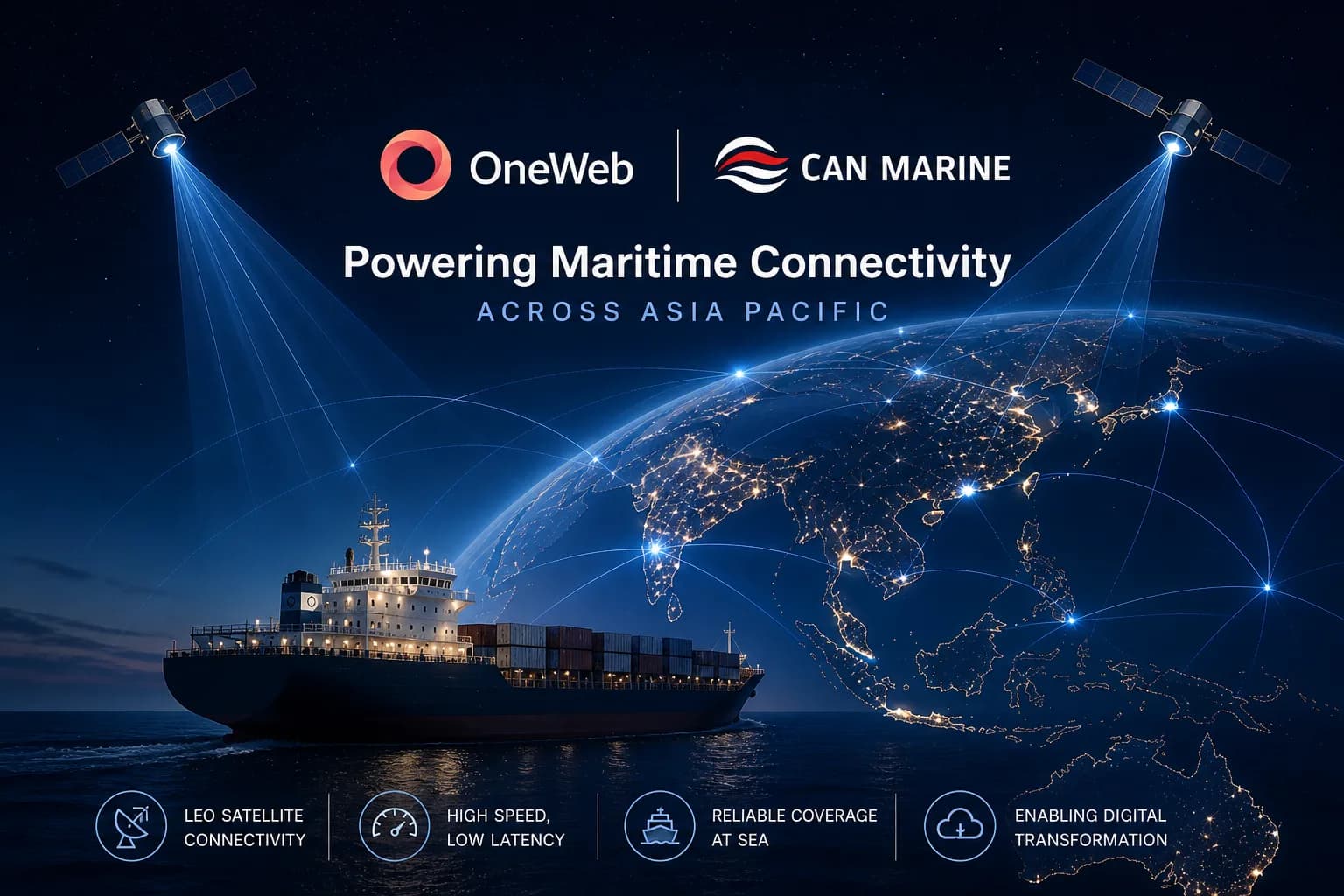
Sovereign deployability, applied to connectivity: multi-party governance, no single chokepoint, politically distributed origin.
What else fits the pattern
Once you see the criterion, you start seeing it elsewhere.
The MediaTek-SUTD collaboration — S$34 million for a 6G and satellite-connected wireless research lab, MediaTek's first such collaboration in Singapore — is worth noting. MediaTek is Taiwanese. Taiwan occupies a peculiar geopolitical position: not formally aligned with either the US or China, a critical node in the global semiconductor supply chain, with strong incentives to build technology relationships with countries that want optionality. The collaboration sits in 6G and satellite connectivity — exactly the infrastructure layer where sovereignty questions will become acute in the next decade.
Across AI, satellite connectivity, 6G research, and defence electronics: non-American, non-Chinese partners for the sovereign-sensitive layer. US and Chinese companies are simultaneously present and active in Singapore at the commercial layer — AWS, Google Cloud, NVIDIA, various Chinese tech firms. Singapore is not decoupling from either. It is segmenting: one set of partners for where sovereignty is non-negotiable, another for where commercial efficiency dominates.
The segmentation is visible if you look for it.
The structural reason this is happening now
I want to be honest about something. This pattern could exist for purely commercial reasons. Mistral needed Asian GPU infrastructure and Singtel needed an AI story. OneWeb needed maritime distribution in APAC. Thales has been building Singapore relationships for decades through its aerospace business.
But the timing of Balakrishnan's speech, the explicit articulation of middle power partnerships as a foreign policy workstream, the specific mention of France among the upgraded partnerships — these make it harder to argue the technology and geopolitical layers are fully independent.
The structural driver is 2025-2026 US foreign policy. Under Trump's second term, the US has become visibly more transactional: tariffs deployed as foreign policy instruments, security guarantees made conditional, bilateral relationships reframed around explicit reciprocity. For a small state like Singapore, which has built its entire strategic position on being a reliable neutral node, this creates a specific problem. If your most powerful patron becomes less reliably committed to rules-based order, you need demonstrated alternatives — not to replace the patron, but to demonstrate that replacement is possible. The demonstration itself is the leverage.
This is classic Singapore strategy: make the dependency bilateral by making yourself indispensable, and make the indispensability visible by showing you have options.
The ministerial speeches articulate the direction. The institutional procurement decisions follow a consistent logic.
A note on American sovereign cloud
One objection worth addressing directly: US technology giants are not standing still on this. Microsoft, AWS, and Google are all aggressively building what they call "sovereign cloud" offerings — physical infrastructure in Singapore that promises data residency and local key management.
This is real and it matters. But there is a meaningful distinction between "data managed by an American company inside Singapore's borders" and "technology that Singapore itself fully controls."
AWS Sovereign Cloud means your data sits in a building in Singapore operated by AWS personnel, under contracts governed by Amazon's global legal structure, with encryption keys held according to Amazon's key management architecture. In normal operation, this is functionally sovereign. Under legal or geopolitical pressure — a US government subpoena, a sanctions escalation, an executive order — the sovereignty is what Amazon chooses to defend, not what Singapore can enforce unilaterally.
Mistral open weights mean the model lives on Singtel's servers, operated by Singtel's people, with no ongoing relationship with Mistral required to keep running. Mistral could cease to exist tomorrow and Singapore's deployment would be unaffected. There is no call home, no licence renewal, no dependency on Mistral's continued goodwill or legal posture.
These are genuinely different levels of control. For commercial applications, the AWS sovereign cloud is probably sufficient and likely superior on other dimensions. For applications where Singapore needs to be certain that no external party can affect availability — defence systems, financial market infrastructure, crisis communications — the open-weight model answers a question that sovereign cloud cannot fully answer.
This is probably why Singtel chose both: NVIDIA for commercial AI, Mistral for sovereign-critical AI. The two are not in competition; they serve different points on the sovereignty spectrum.
Where I think I might be wrong
Three reasonable counterarguments.
First: Singtel chose Mistral because Mistral's sales team offered a better deal and the open-source stack genuinely solves a technical problem independent of geopolitics. The sovereign framing is Singtel's marketing. This is plausible. I cannot rule it out.
Second: Can Marine chose OneWeb because Starlink's enterprise maritime contracts have terms that didn't fit Can Marine's customer requirements — pricing, latency profiles, ground station topology. Again, purely commercial. Possible.
Third: The pattern I am seeing is selection bias. I found three European examples in one quarter and built a theory around them. Singapore is simultaneously running dozens of US technology partnerships that I am not counting in this analysis.
Fourth: The European partners are not risk-free either. A French government decision, an EU regulatory shift, or a sanctions regime that sweeps in unexpected directions could create its own dependency problem. The bet on European partners is that multi-jurisdictional governance distributes risk better than concentrated control — not that it eliminates risk entirely. That bet could be wrong.
I think the third objection is the most serious. Singapore's overall technology posture is not "European." It is deeply integrated with US and Chinese technology at the commercial layer. The European and Taiwanese choices in sovereign-sensitive sectors represent one specific layer of Singapore's strategy, not the whole thing.
The question is whether that layer is deliberate and growing, or incidental and stable. I believe it is deliberate and growing. I hold that view at medium confidence, not high.
What this means for anyone doing technology business here
If you are a technology company trying to understand Singapore's procurement logic in 2026, I think the sovereign deployability criterion is real and will become more explicit, not less, over the next three years.
The practical implication has three parts, matching the three components:
Architecture: if your product requires data to leave Singapore's physical infrastructure, you have a structural problem in sovereign-sensitive sectors. This is addressable through on-premise deployment, open weights, or genuinely air-gapped architecture — but it requires a different product decision, not just a marketing repositioning.
Political risk profile: if deploying your technology creates legal or regulatory exposure for your Singapore customer — through sanctions proximity, supply chain dependencies, or legal frameworks that create external access pathways — this is increasingly disqualifying in the sovereign layer. This affects both Chinese and American vendors, though through different mechanisms.
Governance structure: for connectivity infrastructure and platforms, single-entity control is increasingly a liability. Multi-jurisdictional governance, open standards, and distributed ownership reduce the risk that a single external decision interrupts service.
The companies who will lose are those who assume Singapore will keep buying cloud-dependent services for sensitive applications because it always has. The policy direction, the ministerial speeches, and the procurement decisions suggest that assumption is becoming wrong.
This logic does not stop at Singapore's borders. Malaysia, Indonesia, and Vietnam are watching the same dynamics unfold and asking the same questions under different constraints.
Malaysia has its own data sovereignty framework and a government that has explicitly avoided choosing sides between the US and China. Indonesia, with the largest digital market in Southeast Asia, faces the same dilemma at a much larger scale: any technology dependency that a foreign government can switch off is, by definition, a national risk. Vietnam, which signed a Comprehensive Strategic Partnership with the EU in January 2026, is already moving in a similar direction.
None of them will frame it as "sovereign deployability." But the procurement criterion is converging. Singapore, as usual, is simply further ahead.
The prediction I am willing to make publicly
Within eighteen months, I expect Singapore to make at least one more significant technology partnership decision in a sovereignty-sensitive sector — quantum computing, deep cybersecurity infrastructure, space situational awareness — that follows the same pattern: not the most technically powerful American option, not a Chinese option, but a partner whose architecture allows Singapore to run it without ongoing external dependency.
The candidates are identifiable: IQM (Finnish quantum computing), ID Quantique (Swiss quantum key distribution), Israeli companies in cybersecurity (Israel occupies a structurally similar geopolitical position — small, technically sophisticated, outside the major blocs). The Israeli option carries its own complication: Israel's international standing has become increasingly contested, which means partnering with Israeli firms could introduce a different category of geopolitical optics risk — the very problem sovereign deployability is designed to avoid. Worth watching, but not a clean bet. I would also watch for a Japan or South Korea technology partner in semiconductor or materials research, given the explicit upgrading of those bilateral relationships in 2025.
If that prediction is right, the pattern becomes a documented strategy. If I am wrong, I will say so here.
Why I am writing this on a space platform
Because Can Marine and OneWeb is where I noticed it. I was writing about LEO constellation competition — specifically about why a Singapore company chose a European satellite operator over a technically superior American alternative. The answer I landed on was multi-party governance and political neutrality. Then Singtel+Mistral was announced the same week I published.
The connection between LEO connectivity infrastructure and sovereign AI infrastructure is not superficial. Both are critical infrastructure layers. Both face the same sovereignty question: who controls the signal or the data, who can turn it off, whose government can intervene in a crisis. Singapore's answer to that question, applied consistently across two completely unrelated technology domains in the same quarter, is what I am pointing at.
I do not know whether this is intentional policy or emergent behaviour from multiple independent decisions that share a common logic. The effect is the same either way. The criterion is real. The pattern is visible.
Anyone building technology partnerships in Singapore over the next five years should be asking: does my product satisfy all three components of sovereign deployability? If the answer is no, the question is whether it still works when your vendor’s government decides otherwise. — and how quickly.
This is an observation piece, not a research report. The facts cited are sourced below. The interpretation is mine, and I welcome disagreement. If you have a different reading of these events — especially if you are inside any of the institutions mentioned — I am genuinely interested in hearing it. You can find me at @spacesgp.
This article is based on the public sources listed below. Analysis and forward-looking judgments are the author's independent views and are not investment, legal, or procurement advice.
Sources10 entries with source notes and links
- Eutelsat and Singapore's Can Marine Partner to Deliver Maritime Connectivity Services – Eutelsat Press Release, February 23, 2026(mynewsdesk.com)
Multi-year agreement, APAC maritime coverage via OneWeb LEO constellation; merchant shipping and offshore energy operators
Sovereign AI focus on financial services, defence, government, healthcare; Mistral open-source stack; data remains in Singapore; Applied AI Centre of Excellence
Thales: Singapore as one of three global FlytEDGE R&D centres, ~40 specialists to be trained, cyber-secured-by-design focus; MediaTek-SUTD: S$34M joint lab for 6G and satellite-connected networks
- Vivian Balakrishnan: Singapore to Deepen Middle Power Ties Amid "Tectonic" Global Rupture – The Online Citizen, February 27, 2026(theonlinecitizen.com)
Parliament statement; "geostrategic tectonic plate rupture"; five foreign policy workstreams; partnerships upgraded with Australia, France, India, NZ, Vietnam; new partnership with South Korea; EU-Singapore Digital Trade Agreement
South Korea: "optimal and ideal partner"; AI cooperation agreements 2022 and 2025; National AI Council chaired by PM Lawrence Wong
- Singtel's RE:AI Teams Up with Mistral AI on Sovereign Offering in Singapore – Data Centre Dynamics, April 27, 2026(datacenterdynamics.com)
Technical architecture; RE:AI sovereign cloud ensures sensitive data remains onshore; Mistral open-source stack enables on-premise deployment; GPU infrastructure in Nxera data centres
- OneWeb Ownership Structure – Eutelsat Corporate(eutelsat.com)
Bharti Global ~38%, France ~10%, UK ~10%, SoftBank ~12%; multi-national governance structure
- The EU is Forging a 'Hedging Alliance' with Indo-Pacific Middle Powers – The Diplomat, April 2026(thediplomat.com)
Macron's "coalition of independents" speech Tokyo/Seoul; EU Strategic Development Partnerships with India, Australia, Vietnam; structural context for European outreach to Indo-Pacific middle powers
- How Middle Powers Can Weather US and Chinese AI Dominance – Chatham House, February 16, 2026(chathamhouse.org)
Four pathways for middle powers; Singapore explicitly named as hedger; cost analysis of multi-vendor sovereign AI environments
- Seeking Agency in Uncertainty: Asian Middle Powers and the Fragmenting Global Order – Asia Society Policy Institute, April 2026(asiasociety.org)
Middle power hedging logic in 2026; Japan-India-Korea-Australia intraregional cooperation; India-South Korea Digital Bridge
Continue reading
13 Apr 2026 · 14 min read
NSAS Signals a New Execution Era for Singapore's Space Strategy
NSAS marks Singapore's shift from space policy to a national execution system spanning industry, regulation, international partnerships, and market deployment.
31 Mar 2025 · 9 min read
Why Singapore Is Becoming APAC's Most Useful Commercial Space Hub
Singapore is not trying to outspend larger nations in launch. It is winning by combining capital, policy clarity, and regional execution.

28 Apr 2026 · 45 min read
The Orbital Compute Contest: US-China Space Data Centers and Three Windows for Asia-Pacific
US and Chinese orbital-compute plans could reshape AI infrastructure, but APAC's near-term openings lie in validation, standardized subsystems, and rule-setting.