
The Orbital Compute Contest: US-China Space Data Centers and Three Windows for Asia-Pacific
US and Chinese orbital-compute plans could reshape AI infrastructure, but APAC's near-term openings lie in validation, standardized subsystems, and rule-setting.
Method & disclosure
Confidence: Medium to high (core facts are synthesized from public filings, company announcements, industry reporting, and research; some timelines, scale claims, and forward-looking judgments remain subject to change)
Review mode: Human + AI cross-check
Writing support: AI assisted
Singapore Space Agency
On this page · 13
- 01Quick Take
- 02Executive Summary
- 03Contents
- 04Confidence And Review Notes
- 051. Trigger Point: Earth Can No Longer Comfortably Absorb AI's Power Hunger
- 062. Meta's Detour: A Symptom, Not a Cure
- 073. SpaceX's Orbital Data Center: The Ultimate Form of Vertical Integration
- 084. China's State-Capital Response: Reading the Orbital Chenguang Signal
- 095. Technical Reality Check: Physics Has No Nationality
- 106. The Bear Case: Why Orbital Compute May Fail
- 117. Commercial Impact: Who Buys, Who Loses, Who Must Adapt
- 128. Standout: The Structural Opportunity For The Asia-Pacific Supply Chain
- 13Conclusion: There Is No Neutral Ground In Orbit
Key findings
The argument in brief
- Orbital compute is not just a new data-center format; it is a fight over where AI infrastructure physically sits and who governs the resulting power, heat, data, and orbital constraints.
- Meta's space-solar deal is best read as an option on energy access, while SpaceX's orbital data-center plan is a directional bet on building a separate compute layer in orbit.
- China's Orbital Chenguang response matters less as immediate funded capacity than as proof that orbital compute has entered the country's state-capital planning system.
- Asia-Pacific's most realistic path is not to outbuild SpaceX or China on constellation scale, but to win in validation infrastructure, optical links, thermal systems, advanced packaging, and regional rule-setting.
Orbital compute is not an infrastructure shift. It is a redefinition of where computation belongs, physically, economically, and politically. From Singapore, the question is not who wins the race, but whether Asia-Pacific captures the rules, the margins, or merely the bill of materials.
Quick Take
- On April 27, 2026, Meta announced a partnership with Overview Energy to deliver 1 GW of near-infrared beamed power from space to Earth, attempting to route around terrestrial grid bottlenecks. But a widely shared engineering reply on X immediately exposed the deeper issue: instead of sending energy down and then absorbing heat, land, and regulation on the ground, why not send computation up, assuming you have rockets.
- On January 30, 2026, SpaceX filed with the FCC to deploy an Orbital Data Center System of up to 1 million satellites. A March supplement answered more than 1,400 public comments and argued the network would be phased in while atmospheric effects were monitored.
- On April 20, 2026, Beijing Orbital Chenguang Technology announced a Pre-A1 equity round of RMB 170 million and strategic credit intent from 12 banks totaling RMB 57.7 billion. It is the largest policy-capital signal yet seen in China's commercial space sector. But one month earlier, second-largest shareholder Shunhao formally waived its pre-emptive subscription right and explicitly warned that the credit facilities were non-binding.
- On March 21, 2026, Musk unveiled Terafab, a Tesla-SpaceX-xAI chip joint venture later joined by Intel in April, claiming a target of 1 TW of annual compute output with 80% allocated to space. Bernstein's analysis suggested such a target would require $4-5 trillion of investment and more than 100 leading-edge fabs, a number larger than the combined market value of the world's three largest listed companies.
- The central technical bottleneck in orbital data centers is not launch cost. It is thermal rejection. Under the Stefan-Boltzmann law, keeping 1 MW of compute at around 20°C requires roughly 1,200 square meters of radiator area. Vacuum is not cold in the useful engineering sense. Vacuum is an insulator.
- Asia-Pacific is the world's fastest-growing projected region for orbital data centers, with market forecasts implying CAGR ranges from 22.8% to 74.2%, but it still represents only about 20% of the global space economy today. That creates both significant upside and a real risk of being structurally marginalized by vertically integrated giants.
- The core argument of this article is that orbital compute is not simply about moving data centers into space. It is about redrawing the geographic and political boundaries of computation. Asia-Pacific should not approach this race through a linear "become a launch superpower" mindset. The structural opportunity is three-layered: in the short term, be the validation-infrastructure shovel seller; in the medium term, be the standardized supplier of thermal, optical, and packaging subsystems; in the long term, be the rule-setter for regional compute orchestration and data-sovereignty governance.
Executive Summary
In the final week of April 2026, three things crystallized within a single month: Meta said it would buy power from space, SpaceX said it wanted to build computing infrastructure in space, and China signaled that it would mobilize state-backed capital to build a space data-center stack of its own. All three developments point to the same diagnosis: terrestrial AI infrastructure is approaching a physical ceiling defined by power, cooling, and land constraints.
Meta's answer is indirect. If ground infrastructure is constrained, add energy from orbit. SpaceX's answer is direct. If solar energy in orbit is continuous and thermal rejection can in principle be externalized to space, then move the compute layer upward. China's answer is mobilizational. Use policy banks, planning institutions, and strategic credit signaling to offset the speed of private vertical integration in the United States.
Yet all three approaches face the same wall of physics. SpaceX itself acknowledges in its own IPO materials that orbital data centers may fail to achieve commercial viability. A million-satellite constellation has already triggered more than 1,400 FCC objections. Vacuum is an insulator rather than a free cooling system. Kilowatt-scale demonstrations may be feasible, but moving from megawatts to gigawatts implies radiator growth on a near-explosive scale. Radiation-hardened chips cost roughly 5x as much as terrestrial chips, while Bernstein's estimate of $4-5 trillion for Terafab exposes the gap between Musk's narrative and semiconductor reality.
For Asia-Pacific, this is not a race to observe from the sidelines. The region accounts for roughly one-third of global launch activity, has the fastest growth in radiation-hardened electronics demand, and spans a supply-chain mosaic that stretches from TSMC's advanced process capability and Singapore's optical communications companies to Japanese radiation-hardened compute work and Indian low-cost manufacturing.
But that industrial mosaic remains fragmented, while both SpaceX and Chinese state-backed actors are moving toward tighter vertical integration.
Our judgment is that Asia-Pacific's greatest risk in the orbital-compute era is not technological backwardness. It is being trapped in the value chain as a "supplier" rather than becoming a "standards setter." In the short term, ground stations, optical terminals, and validation services for international constellations are the clearest revenue pools. In the medium term, thermal-management modules, inter-satellite optical links, and rad-hard chip packaging are the most defensible high-margin niches. In the long term, the real premium sits with whoever defines regional protocols for orbital compute orchestration, data sovereignty, and cross-border spectrum sharing.
Contents
- Trigger Point: Earth Can No Longer Comfortably Absorb AI's Power Hunger
- Meta's Detour: A Symptom, Not a Cure
- SpaceX's Orbital Data Center: The Ultimate Form of Vertical Integration
- China's State-Capital Response: Reading the Orbital Chenguang Signal
- Technical Reality Check: Physics Has No Nationality
- The Bear Case: Why Orbital Compute May Fail
- Commercial Impact: Who Buys, Who Loses, Who Must Adapt
- Standout: The Structural Opportunity for the Asia-Pacific Supply Chain
- 8.1 Where the Profit Pools Actually Sit
- 8.2 Short-Term Window (2025-2027): The Arithmetic of Selling Shovels
- 8.3 Medium-Term Window (2028-2030): The Moat of Standardized Suppliers
- 8.4 Long-Term Window (2031-2035): The Premium of Rule-Setters
- 8.5 Regional Tactical Map
- 8.6 Market Scenarios and Sizing Assumptions
- 8.7 Risk: Why Most Participants Still Lose Money
Confidence And Review Notes
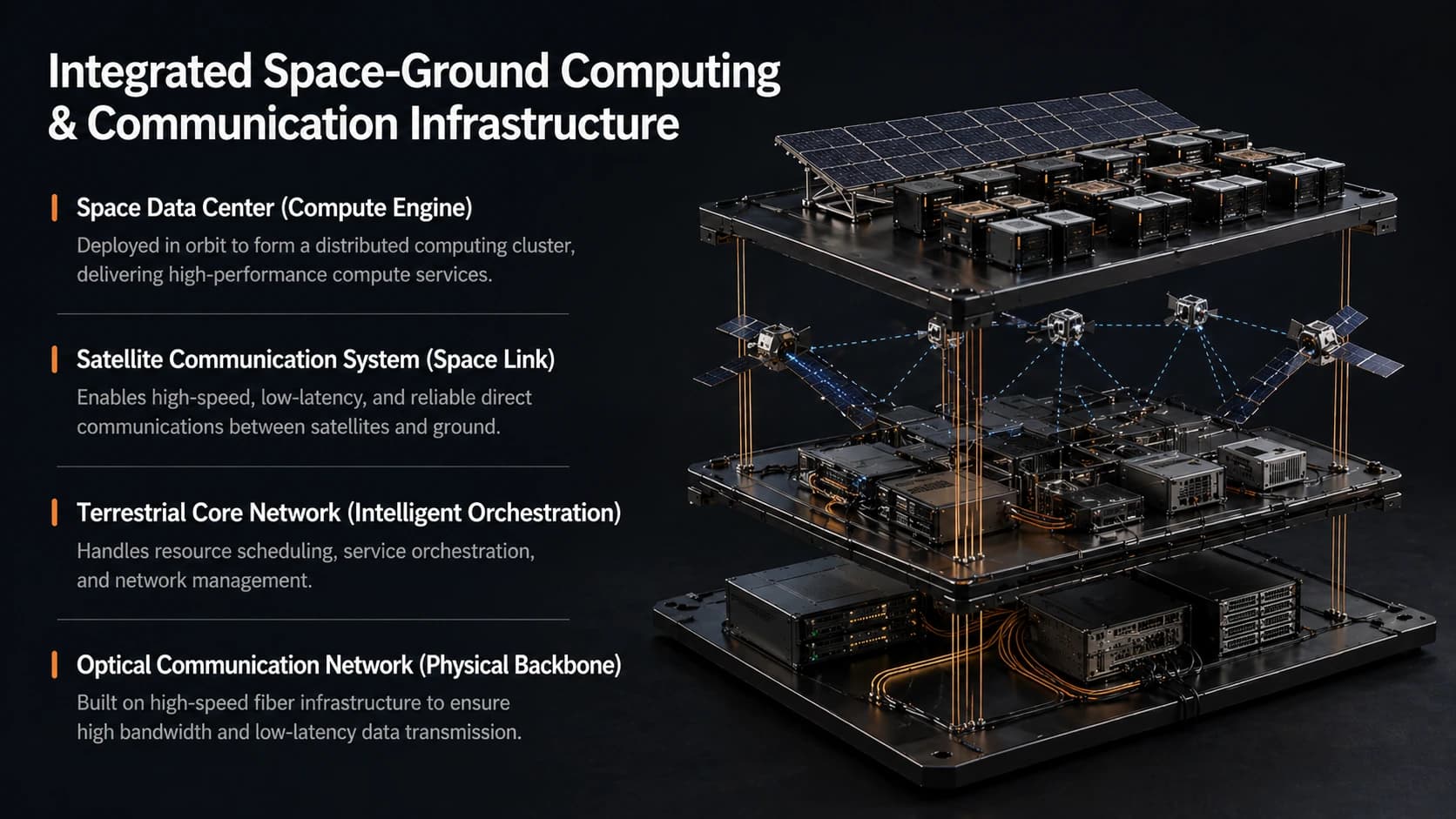
1. Trigger Point: Earth Can No Longer Comfortably Absorb AI's Power Hunger
AI training and inference are consuming electricity at a speed with little historical precedent. In 2025, global data centers used electricity equivalent to roughly 1.5% of total power generation. By 2028, that share is expected to exceed 4%. In Northern Virginia, the world's largest data-center cluster, new AI data-center projects already demand power at the level of a mid-sized city, while interconnection queues stretch out 3-5 years.
Meta's April 27, 2026 announcement is an extreme expression of that constraint. Instead of waiting for grid expansion, it wants to source energy from orbit. Under the agreement with Overview Energy, low-intensity near-infrared beams would send power from geostationary orbit to existing ground solar stations, converting intermittent daytime generation into something closer to baseload-like continuity. Overview promised 1 GW of early capacity, with a demonstration target of 2028 and commercialization around 2030.
But the engineering community on X immediately highlighted the absurdity embedded in that pathway:
"Why spend enormous money sending energy down from space only to keep facing heat rejection, land scarcity, and NIMBY constraints on the ground? Just move the compute to space, where solar is continuous and cooling is nearly free. Oh right, you can't, because you don't have rockets."
That reply spread because it captured the underlying issue: the energy bottleneck is the symptom, while Earth's surface-level physical constraints are the disease. In orbit, solar irradiance is around 1.3-1.4 kW/m², without atmospheric filtering or terrestrial day-night cycles. That is why Musk has long framed the problem not as how to feed Earth-based compute, but where compute should physically reside.
On January 30, 2026, SpaceX translated that intuition into regulatory language by asking the FCC to authorize an orbital data-center system with up to 1 million satellites.
Earth will not be abandoned overnight, of course. Meta's space-solar pathway, SpaceX's orbital data-center pathway, and China's "compute in the sky" pathway are all responses to the same triad of constraints: power, cooling, and land. To assess those responses, we first need to answer a basic question: just how tight have those terrestrial constraints already become?
By late 2025, there were roughly 160 GW of large-load interconnection requests queued in the United States alone, equivalent to about 22% of peak national electricity demand. Hyperscalers are already shifting toward the "energy park" model, integrating solar, storage, and compute on the same site in order to bypass interconnection queues. Alphabet's $4.75 billion acquisition of Intersect Power is emblematic of that trend. Meta's orbital power partnership is simply the same logic pushed one layer higher: if land and grid access are full on the ground, then look upward for more room.
But there are two versions of "going upward." Meta's version is to send energy down. SpaceX's version is to send compute up. The former must solve beam-conversion efficiency, atmospheric absorption, and safety regulation. The latter must solve launch cadence, orbital thermal rejection, radiation hardening, and debris management. Both are difficult. But only SpaceX owns the three critical enabling assets Meta lacks: reusable heavy-lift rockets, an in-orbit communications network, and an internal chip narrative through Terafab.
Core judgment of this section: Meta is not solving AI's physical constraints. It is purchasing time against worsening constraints. The directional bet comes from SpaceX, which is not buying an energy option but trying to build a separate orbital compute layer.
From an Asia-Pacific perspective, this trigger point matters because it implies a structural reshuffling in where global compute capacity will sit over the next 5-10 years. APAC is simultaneously the world's largest power-demand growth region, one of its densest manufacturing clusters, and the region with the largest concentration of islands and remote geographies. It will feel the ripple effects first.
2. Meta's Detour: A Symptom, Not a Cure
Meta's agreement with Overview Energy is a public-relations victory for "future energy," but from an engineering and economic standpoint it is an explicitly compromised transitional solution.
2.1 The Brutal Math of Physical Efficiency
Overview's system collects solar energy in GEO, converts it into a low-intensity near-infrared beam, and sends it down to Earth. Its core appeal is obvious: no new land acquisition, no new fuel, and shorter time to useful energy than waiting for grid expansion. But the efficiency losses are severe. Space-to-ground transmission requires at least three major conversions: solar energy to electricity, electricity to infrared beam, and beam back to usable electricity on the ground. End-to-end round-trip efficiency may fall into the 10-20% range. That means 1 GW gathered in orbit may leave only 100-200 MW of useful ground power.
By contrast, if computation is done directly in orbit, energy is converted only once into useful work, while waste heat is rejected in the orbital environment itself. According to numbers cited in the SpaceX FCC materials, effective energy cost from orbital solar could be around $0.002/kWh, versus roughly $0.045/kWh for U.S. wholesale terrestrial power.
2.2 The Thermodynamic Paradox, And Its Limits
Meta's space-solar approach faces a deeper conceptual problem: it still adds energy into Earth's thermal budget. Even if the beam is low-intensity and safe by design, that energy ultimately turns into heat once it is consumed inside terrestrial data-center chips. In a world already facing climate stress, using orbital energy to support ever-larger ground AI clusters is still a strategy that adds thermal burden to the Earth system.
That is the physical logic behind the sharp X reply quoted above: if waste heat must ultimately be rejected to space, why not do the computation in space and reject it there directly?
A fair rebuttal has to be acknowledged. If space solar displaces fossil-fuel generation, the net heat and emissions effect is not straightforwardly worse. Fossil fuel combustion also produces waste heat and greenhouse gases. But the rebuttal has boundaries. Meta's 1 GW deal is tiny relative to global data-center demand, which is measured in the hundreds of gigawatts, and the transmission losses mean that for a given solar collection area, direct orbital compute yields far more useful work than relay-to-ground architectures. At the margin, Meta's path remains thermodynamically inferior to doing the compute directly in orbit.
2.3 Strategic Reading: Meta Is Buying An Option
Meta's orbital power partnership is not a substitute for orbital compute. It is a form of downside protection. Meta is effectively betting on two things at once. First, if orbital compute fails to scale in 2028-2030, space-sourced power might still extend the useful life of terrestrial AI data centers. Second, if orbital compute does scale, that 1 GW of orbital power can still become part of a hybrid ground-orbit architecture.
This is a classic option strategy: pay a premium today in order to preserve access across multiple future scenarios. But an option is not a directional commitment.
The true directional commitment comes from SpaceX: it is not buying an energy option. It is attempting to build an autonomous orbital compute layer.
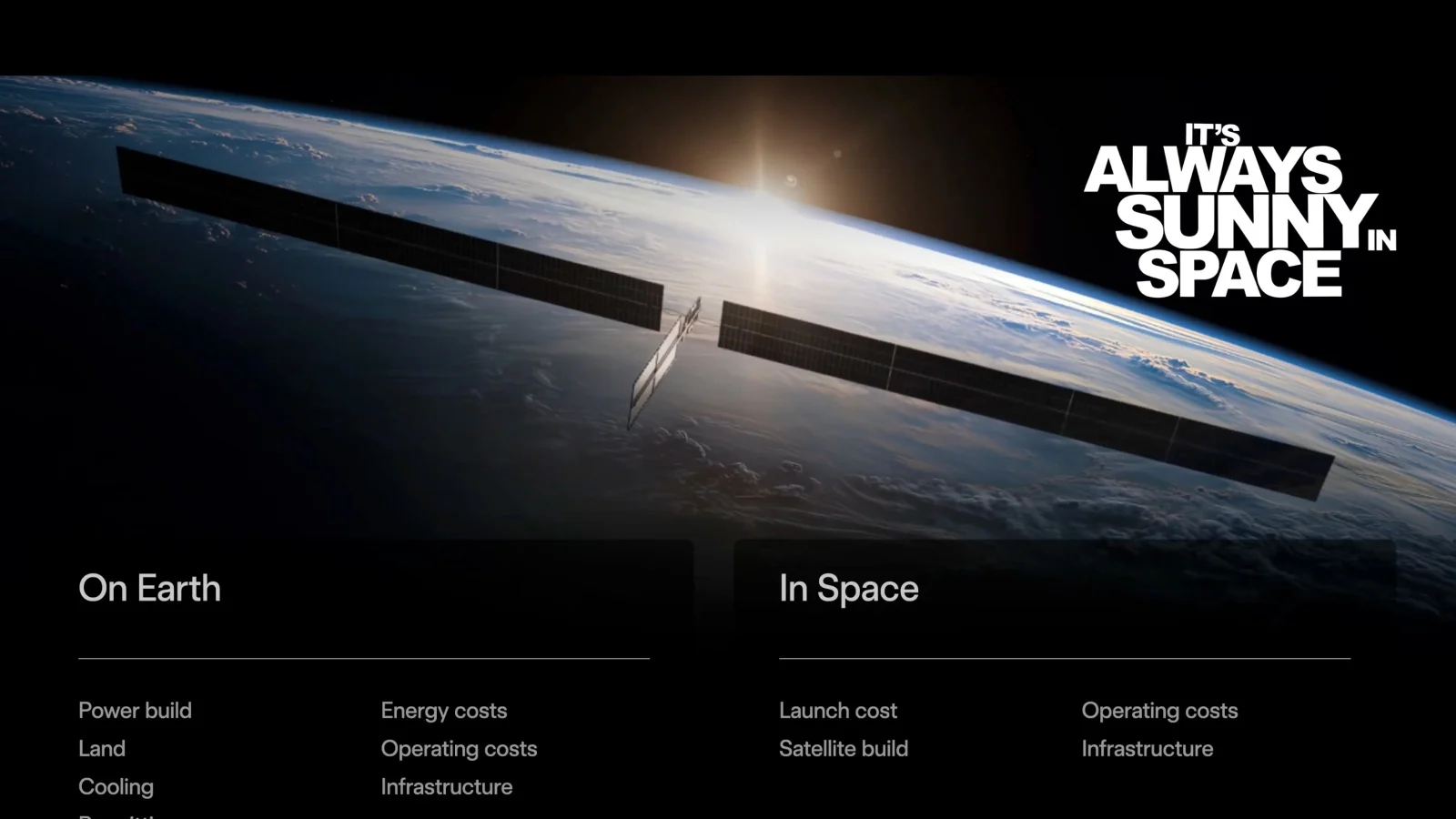
3. SpaceX's Orbital Data Center: The Ultimate Form of Vertical Integration
SpaceX's orbital data-center plan is not an isolated act of technological excess. It is the most extreme extension yet of a 20-year logic of vertical integration.
3.1 The FCC Filing: Architecture And Controversy Around 1 Million Satellites
SpaceX's January 30, 2026 FCC filing centers on the following headline parameters:
The choice of sun-synchronous orbit is strategically significant. SSO satellites can remain in near-constant illumination, which is indispensable for sustained AI training workloads.
But the filing triggered an unusually strong backlash. The FCC received more than 1,400 comments, largely focused on light pollution, atmospheric effects from re-entry, orbital debris, and allegations of spectrum monopolization, with rivals such as Amazon, Viasat, and WISPA actively involved.
In its March 2026 supplement, SpaceX said deployment would be phased, with initial operations far below the maximum authorized count, and argued that 1 million satellites would still occupy only 0.005% of the total spatial volume between 500 and 2,000 km.
Orbital-debris specialist Hugh Lewis immediately countered that 0.005% of 1.1 trillion cubic kilometers is still roughly 60 million cubic kilometers, and that once maneuvering, replacement, and operational overlap are considered, much of LEO would in practice become touched by SpaceX's orbital data-center footprint.
Core judgment: the phased-deployment promise is probably real, but once a million-satellite authorization exists, it creates a de facto orbital monopoly even before full deployment. Priority occupation of spectrum and orbital resources is itself a strategic asset.
3.2 Starlink V3 And Starship: The Economics of Lift Capacity
Orbital data centers do not begin from zero. SpaceX plans to integrate compute modules directly into the Starlink V3 platform:
In its 2026 target configuration, Starship V3 is meant to place 100-150 tons into LEO on a fully reusable basis. Falcon 9's current effective launch cost is roughly $2,700/kg, while Starship's target range is $10-100/kg.
If Starship reaches two launches per week, a 2028 management aspiration, then just 20 Starship missions could match the total mass that Falcon 9 delivered across all 165 launches in 2025. That matters because once Starlink V3 deployment needs are met, residual lift capacity can seed entirely new markets. Orbital compute is the most obvious candidate.
But one under-discussed constraint remains: Starship reusability is still in the validation phase. The V3 prototype entered engine testing in April 2026, with Flight 12 targeted for May. If heat shield performance or booster recovery fails, the entire orbital-data-center schedule moves to the right. Satellite lifetime is only around five years, which means "maintenance" at scale effectively means replacing satellites through continued launch.
3.3 Terafab: The Gap Between Announced Target And Engineering Reality
On March 21, 2026, Musk announced Terafab, a Tesla-SpaceX-xAI chip venture based in Austin, later joined by Intel on April 7.
Musk's stated targets included:
- Initial capacity: 100,000 wafers per month;
- Full target: 1 million wafers per month, described as about 70% of TSMC's current global capacity;
- Node: 2nm;
- Chip mix: AI5 for ground inference plus D3 radiation-hardened chips for space;
- Allocation ratio: 80% to space, 20% to ground.
These figures are a pillar of the SpaceX orbital-compute narrative. They also demand serious skepticism.
First, capacity. Bernstein Research, cited through Tom's Hardware, argued that a 1 TW annual compute target would imply something like:
- roughly 22.4 million Rubin Ultra GPU-equivalent wafers per year;
- roughly 27.16 million Vera CPU-equivalent wafers per year;
- roughly 15.82 million HBM4E memory wafers per year;
- a requirement for 100-358 leading-edge fabs;
- total investment on the order of $4-5 trillion.
Bernstein's precise numbers depend on assumptions around die size, yield, packaging, and architecture, but the order-of-magnitude conclusion is sturdy. The claim that 1 million wafers per month equals roughly 70% of TSMC's current global output implies capital needs in the hundreds of billions or trillions, while Musk's disclosed $20-25 billion budget is enough for perhaps half of one leading-edge fab to one fab, not an industrial network of that scale.
This is not an argument that Musk lacks ambition. It is an argument for separating "announced target" from "engineering reality." Tesla's 2020 Battery Day promises around 4680 cells undershot original capacity targets dramatically over the following five years. Semiconductors are materially harder than batteries. A far more realistic Terafab path is an advanced-packaging and pilot-wafer facility first, followed by gradual expansion over 5-10 years. The 1 million wafers per month target is not operationally realistic before the 2030s.
Second, the 80% space allocation. Musk explicitly used that number, and multiple reports repeated it. But from an engineering-economics standpoint, it is hard to defend. SemiWiki, citing McKinsey's 2025 data-center demand model, showed total global data-center demand at roughly 82 GW, with AI training at 23 GW, AI inference at 21 GW, and non-AI workloads at 38 GW.
The critical problem is that inference is latency-sensitive. Real-time response requires compute to remain close to users and population centers. That is a physical constraint, not just a cost question. McKinsey projects that by 2030, AI inference could represent more than 40% of total data-center demand, while training falls below 30%. In other words, the fastest-growing and largest compute category is precisely the one least suited to migration into orbit.
A more defensible estimate is that orbital compute might capture 20-35% of global data-center demand over the next two decades, concentrated in training, batch workloads, and selected latency-tolerant inference. That is still a very large market. It is just not the 80% world Musk describes.
Section conclusion: SpaceX's vertical integration is real, powerful, and the most complete orbital-compute loop yet proposed. But Terafab's capacity numbers and the 80% allocation ratio look more like strategic narrative than engineering blueprint. Investors evaluating a future SpaceX IPO need to separate those two layers and apply a conservative multiplier to both timeline and scale.
4. China's State-Capital Response: Reading the Orbital Chenguang Signal
Eighty-one days after SpaceX submitted its FCC filing, China answered the orbital-compute challenge through a completely different form of capital organization.
4.1 Three Layers of Financing Logic
On April 20, 2026, Beijing Orbital Chenguang Technology announced via official channels:
- a Pre-A1 equity round totaling RMB 170 million, backed by investors such as Haisong Capital, CSC Investment, Cathay Capital, and InnoAngel;
- debt-side financing support consisting of strategic credit agreements or letters of intent from 12 banks, totaling RMB 57.7 billion.
Layer one: the equity side. For a company founded only in December 2024, RMB 170 million is not trivial. But in the space sector it is also not extraordinary. The real signal sits on the debt side.
Layer two: the debt side. RMB 57.7 billion is not interesting mainly because of its nominal amount. It is interesting because it is a political signal. The participating lenders span state-owned majors, joint-stock banks, and urban commercial banks. In China's financial system, that kind of coordinated signaling typically appears only around nationally strategic emerging industries, government-priority investment projects, or entities with unusually strong state-linked backing.
Orbital Chenguang's ownership helps explain why. Beijing Future Space Technology Research Institute is the controlling shareholder at 30.18%, while listed company Shunhao holds 27.81%, later diluted to 23.78% after the round.
The Beijing institute itself was established in 2024 under guidance from the Beijing Municipal Science and Technology Commission and the Zhongguancun Administrative Committee, with an explicit mission around space data-center development. Zhang Shanchong, Orbital Chenguang's chairman and chief scientist, also leads the institute and serves as a director of Shunhao.
This makes Orbital Chenguang less like a normal commercial-space startup and more like a hybrid structure combining a state-backed research national team with a listed-company capital channel. The institute supplies technical legitimacy and state credibility. Shunhao supplies an A-share financing conduit. Banks lend signal strength against both.
Layer three: Shunhao's subtle caution. One month before this financing round, on March 9, 2026, Shunhao's board formally waived its pre-emptive right to subscribe to Orbital Chenguang's capital increase.
Its public explanation deserves close reading:
"The debt financing is a routine operating activity of the investee Orbital Chenguang. This financing is only a preliminary credit intention. Final credit and eventual financing implementation remain subject to a long cycle and significant uncertainty... The company's current businesses have not yet produced operational synergies with Orbital Chenguang. Orbital Chenguang's business has limited impact on our current performance, and future returns remain highly uncertain. Orbital Chenguang is still a startup, has not yet achieved profitability, and may affect the company's profit and loss in the future."
The subtext is clear: the listed company does not want to stand behind RMB 57.7 billion of bank signaling for an unprofitable orbital-compute startup. A credit letter is not a funded loan. If Orbital Chenguang fails to meet milestones, Shunhao could face reputational or impairment exposure. Waiving its subscription right was therefore a rational hedge between capturing thematic heat and avoiding full downside participation.
What investors and observers should take from this is that the signal value of RMB 57.7 billion is much greater than its near-term financial value. It tells us that orbital compute has entered China's policy imagination. It does not mean that an $8 billion-equivalent project is already funded in cash.
4.2 Technology Path And Three-Stage Roadmap
Orbital Chenguang's core technology narrative is to deploy compute satellites in the Earth twilight orbit regime, creating a space data-center architecture powered by continuous space solar exposure and deep-space thermal rejection, enabling both "space-native compute" and "ground data processed in orbit."
At a November 2025 policy meeting in Beijing, Zhang Shanchong described a three-stage roadmap:
This roadmap aligns closely with CASC's broader planning language around a gigawatt-scale space digital-intelligence infrastructure.
4.3 SpaceX Versus China: Private Vertical Integration Versus State Mobilization
China's strengths are capital endurance and manufacturing scale. If a technology path is validated, China can scale with policy-bank credit and industrial-policy muscle in ways that resemble what happened in solar, EVs, and batteries. China's weakness is advanced-process chip vulnerability. No Chinese producer currently manufactures a 2nm-class radiation-hardened chip equivalent to Musk's D3 claim. If Terafab reaches even partial D3 production in 2027-2028 while China's alternatives remain at 28nm or more mature nodes, the compute-density gap could become severe.
Section conclusion: SpaceX's model is fast, expensive, and uncertain. China's model is slower, more durable, and potentially more scalable if technically validated. Neither pathway is proven. Asia-Pacific should not simply bet on one side. It should focus on the supply-chain demand both pathways create, because that is where the tradeable opportunity sits.
5. Technical Reality Check: Physics Has No Nationality
Whether the future belongs to SpaceX's million-satellite vision or China's 2035 space-data-center roadmap, both confront the same set of physical constraints.
5.1 Thermal Rejection: The Achilles' Heel Of Orbital Data Centers
The intuition that "space is cold" is misleading. Space is thermally isolating, not a magical heat sink. In vacuum, there is no air convection and no ordinary conductive path. Waste heat can only leave through infrared radiation, governed by the Stefan-Boltzmann law:
P = εσA(T⁴ - T₀⁴)
with σ = 5.67×10⁻⁸ W/m²K⁴. To keep chips operating near 20°C (293K) while radiating toward deep space, rejecting 1 MW of heat requires roughly 1,200 square meters of radiator area, equivalent to about four tennis courts.
SpaceX's "AI Sat Mini" concept is described around 100 kW today, with later versions targeting 1 MW. If 1 million satellites ever reached 1 MW each, total thermal rejection demand would reach 100 TW, well beyond any known practical materials or systems limit.
Real-world engineering therefore moves toward compromise: higher operating temperatures, deployable radiators that increase mass and failure points, or space-grade heat pumps that consume still more power. Starcloud's "Hypercluster" concept, for example, already points to deployable radiators in order to handle a 100x power jump versus earlier systems.
Key judgment: thermal rejection is not an impossible barrier, but it is a hard scaling ceiling. The first commercial systems are far more likely to be dozens of high-power satellites or hundreds of lower-power satellites than anything resembling a million-satellite compute fabric.
5.2 Radiation Hardening: Chips At Five Times The Cost
High-energy particles in space cause single-event upsets, latch-up, and total ionizing dose effects in semiconductor devices. The market for radiation-hardened chips was about $1.82 billion in 2025 and is projected to reach $3.48 billion by 2036, implying a CAGR of around 5.91%.
The crucial number is this: radiation-hardened chips cost roughly five times as much as commercial terrestrial chips. That premium reflects specialized materials, design techniques, long testing cycles, and certification burdens that can stretch 18 months or more.
Terafab is attractive in theory because it would internalize that bottleneck for SpaceX. But as discussed above, the capacity story remains wildly ahead of operational reality. China's response includes gallium nitride pathways and domestic substitution efforts, but sub-7nm radiation-hardened capability remains a major gap.
5.3 Debris And Astronomy Interference
According to astronomer Jonathan McDowell, SpaceX has already retired around 1,500 Starlink satellites, all of which burned up on re-entry. If orbital data-center fleets ever reach 100,000 or 1 million units, the frequency of satellite retirement and re-entry would rise by orders of magnitude. Scientists worry that fluoropolymers, aluminum oxides, and other re-entry byproducts could impose cumulative effects on the ozone layer and upper atmosphere.
The astronomy community is even more vocal. University of Regina astronomer Samantha Lawler has argued that current Starlink satellites are already bright enough to disrupt telescope observations, and larger solar arrays on compute satellites would worsen the problem.
From an Asia-Pacific perspective, debris is especially sensitive. China, Japan, India, and Australia all run active Earth observation and astronomy programs. Overcrowding in LEO affects every state's safety margin. Singapore's MiNERVA HUB space-situational-awareness platform is receiving regional attention in precisely this context, because it offers tracking and collision-risk analysis.
6. The Bear Case: Why Orbital Compute May Fail
Any analysis that tells only one side of the story is incomplete. The orbital-compute narrative has at least three weak joints. If any one of them deteriorates, the whole market could slip by 5-10 years.
6.1 Starship As The Foundational Bottleneck
Starship is the cornerstone of orbital-data-center economics. If reusable operations fail to validate, if V3 experiences repeated flight failures, or if 100+ launches per year by 2028 never materialize, then deployment costs remain stuck near Falcon 9's $2,700/kg level. At that cost, orbital data centers make sense mainly for military and scientific use, not broad commercial workloads.
The historical analogy is sobering. The Space Shuttle promised airline-like cadence and never came close, averaging only 4-5 launches per year in practice. Starship is in many ways more ambitious than Shuttle was.
6.2 Terrestrial Technology May Ambush The Thesis
Orbital compute's most dangerous competitor may not be another orbital-compute company. It may be the ground. If any of the following achieve a breakthrough, the economic edge of orbital compute narrows sharply:
- Small modular reactors (SMRs), from companies such as Oklo and NuScale, offering localized 50-500 MW baseload power for data centers without traditional interconnection delays;
- Room-temperature superconductivity, which would radically alter terrestrial power transmission and cooling economics if it became practical in 2028-2032;
- Next-generation renewables plus storage, where perovskite solar plus solid-state batteries could push terrestrial LCOE toward $0.01/kWh, close to orbital-solar theoretical economics.
Key judgment: orbital compute is not simply racing against other orbital systems. It is racing against terrestrial cost curves. If terrestrial AI power falls below roughly $0.01/kWh by 2030 through SMRs or new solar-storage combinations, orbital compute's economic advantage compresses dramatically.
6.3 Regulatory And Environmental Blowback
If light pollution and debris from mega-constellations are handled poorly, a broad public backlash could emerge globally. A politically resonant anti-orbital-data-center movement is entirely plausible around 2028-2030, much as anti-5G or anti-nuclear movements gained public traction in other domains. If the FCC cuts SpaceX's requested authorization or if the ITU imposes stricter LEO spectrum allocation discipline, capital confidence across the sector could cool quickly.
At the same time, data sovereignty becomes sharper. If sensitive training data is processed on a satellite transiting over a country's airspace, who has jurisdiction? Existing treaty structures provide no mature answer.
Section conclusion: orbital compute depends on a fragile chain of conditions: Starship success, orbital deployment, chip supply, and scale effects. If any link snaps, the whole story slips. That is not pessimism. It is a recognition of how vulnerable the technology-capital-regulation triangle really is.
7. Commercial Impact: Who Buys, Who Loses, Who Must Adapt
Orbital compute should not be understood as a total replacement for terrestrial data centers. It is better understood as a superior solution for certain workload categories.
7.1 First Buyers: Power-Starved Hyperscale Training Clusters
The first commercial workloads are almost certainly large-scale AI training. The reason is simple: training has extreme power density, tolerates batch processing, and is less latency sensitive than real-time inference. Training GPT-5/6-class systems can consume gigawatt-scale power.
Meta, Google, Microsoft, and Amazon are the natural customers. But they will not want to buy satellites directly. They will want to buy Orbital Compute as a Service. SpaceX's likely commercial stack is a bundled vertical cloud: Starlink provides subscription connectivity, orbital data centers provide subscription compute, and xAI / Grok provides model services.
7.2 Second Buyers: Sovereignty-Sensitive And Edge Scenarios
For regions with weak or non-existent grids, orbital compute may become the only practical option:
- Southeast Asian archipelagos: many of Indonesia's 17,000 islands lack stable grid infrastructure, while Starlink coverage already exists. Orbital edge compute could support fisheries monitoring and climate modeling.
- Remote Australian mining sites: operators such as Rio Tinto and BHP already use satellite communications, and orbital compute could support real-time AI-assisted prospecting and remote operations.
- Japanese disaster response: after earthquakes or tsunamis, ground infrastructure can fail. Orbital edge compute could support immediate image analysis and communications relay.
- Military and intelligence workloads: likely the largest shadow market. Orbital compute offers resilience against terrestrial attack and a degree of jurisdictional ambiguity that defense users will find highly attractive.
7.3 Who Dies, Who Is Forced To Adapt?
Accelerated decline: the GEO satellite video-broadcast market, which is already shrinking despite a large installed revenue base, and remote terrestrial data-center geographies built on cheap power and cold weather alone, such as parts of Mongolia, Siberia, or northern Chile.
Forced adaptation: traditional telecom operators become even more commoditized. If SpaceX can bundle connectivity, compute, and AI models, communications service providers risk being reduced to the physical last-mile layer.
Potential winners: hybrid-architecture operators. Microsoft Azure Orbital is already working with commercial space-station operators to evaluate Azure workloads in LEO environments. That hybrid model, ground cloud plus orbital edge, may prove more resilient than either pure-orbit or pure-ground architectures.
Section conclusion: orbital compute does not kill ground data centers. It redefines the division of labor. Training moves upward. Inference largely stays down. Batch processing moves upward. Real-time interaction stays close to users. That partition is not a stylistic prediction. It follows from physics and economics together.
8. Standout: The Structural Opportunity For The Asia-Pacific Supply Chain
This is the core differentiating section of the article. Rather than offering generic encouragement about a bright future for space, we break the orbital-compute value chain into its profit pools, barriers to entry, policy-arbitrage windows, and timeline mismatches.
8.1 Where The Profit Pools Actually Sit
The orbital-compute stack can be divided into eight layers:
The key insight is that L1 and L8 contain the thickest profit pools but also the highest entry barriers. Outside TSMC and a handful of top-tier chip actors, APAC has relatively few direct routes into L1. By contrast, L5 and L7 are layers where APAC can win at meaningful scale. L3 and L6 represent the strongest medium-term growth opportunities.
Why does L5 score five stars? Because optical terminals are effectively a function of constellation density: more satellites mean more links. Transcelestial is already in orbital validation after a November 2025 Transporter mission and has partnership activity involving ST Engineering, Gilmour Space, and Axiom Space. Why does L7 score five stars? Because APAC contains the world's densest concentration of low-latitude, high-value LEO markets, including Indonesia, the Philippines, Vietnam, and India. Ground-station demand naturally concentrates there.
8.2 Short-Term Window (2025-2027): The Arithmetic Of Selling Shovels
In any orbital-compute gold rush, the most reliable way to make money is not to mine the gold. It is to sell the shovels. APAC has three of them.
Shovel one: validation and test infrastructure
Orbital data-center hardware requires thermal-vacuum testing, vibration testing, and radiation-effects testing on the ground before flight. Australia's Saber Astronautics is already working with the Australian Space Agency on radiation-effects testing in Adelaide. China, Japan, Korea, and India all possess national-level test infrastructure, but commercial, internationally accessible test services remain undersupplied.
- Market size: the global spacecraft environmental testing market is roughly $1.2-1.5 billion in 2025, with APAC representing around 25%.
- Window: from 2025 to 2028, pilot satellite programs from SpaceX, Orbital Chenguang, Axiom, Starcloud, and others should sharply increase validation demand.
- APAC edge: facilities tied to KARI, JAXA-linked ecosystems, ISRO/NSIL, NTU, and NUS can be commercialized further for international customers.
Shovel two: optical ground-station networks
Orbital data centers depend on optical inter-satellite links, but data must still come down. Transcelestial built proprietary optical ground stations in Singapore and Spain between Q4 2025 and Q1 2026, using closed-loop tracking to lock onto LEO satellites traveling at 7 km/s.
- Market size: Starlink V3's 1 Tbps-per-satellite downlink capability means traditional RF ground stations become bottlenecks quickly. Optical ground-station demand could grow at 50%+ CAGR over the next five years.
- APAC edge:
- Singapore: near-equatorial geometry, financial and data-center hub status, and Transcelestial's headquarters;
- Australia: wide airspace, strong subsea-cable connectivity to both Asia and the United States, and active local facilitation via Paspalis;
- Japan: early commercial laser-link deployments and world-class deep-space communications capability.
Shovel three: spare parts and precision manufacturing
Even if SpaceX achieves only 10% of its stated million-satellite ambition, that still implies 100,000 satellites.
- Connectors, cables, sensors, solar cells, battery packs, structural parts: these are not glamorous but they are reliability-critical, and APAC manufacturing remains highly competitive in them.
- A Starlink V3-class platform may weigh 1-2 tons, with structures and power systems representing roughly 30-40% of mass. At 100,000 satellites, that implies 30,000-80,000 tons of high-precision manufacturing demand.
- China's photovoltaic dominance, Japanese precision mechanics, and Korean battery technology all translate naturally into orbital hardware supply opportunities.
Short-term conclusion: all three shovels share one feature. They do not require radical scientific breakthrough. They require the "space-qualification" of already-existing industrial competence: reliability, traceability, and environmental survivability. That is exactly the kind of game APAC manufacturing knows how to play.
8.3 Medium-Term Window (2028-2030): The Moat Of Standardized Suppliers
If early pilots succeed, then 2028-2030 becomes the transition window from demonstration to limited commercial deployment. At that point, the supply chain shifts from custom integration to standardization, and that is where APAC can build scale advantage.
Opportunity one: standardized optical-link modules
Transcelestial's current link performance is on the order of 10 Gbps downlink and 100 Mbps uplink for space-to-ground, with star-to-star capability at 10 Gbps over 2,000 km, in low-mass, low-power packages. If unit cost falls from today's roughly $200,000-500,000 range to $50,000-100,000, optical interconnects become a true standard component.
- APAC tactic: a Singapore-led Transcelestial + ST Engineering cluster can compete to become a tier-two supplier to SpaceX, Axiom, and Kuiper-class networks. Transcelestial has already built partnership pathways with Gilmour Space, Axiom Space, and Open Cosmos.
Opportunity two: modular thermal-management components
As discussed earlier, thermal rejection is the hard constraint. Radiators, heat pipes, loop heat pipes, and phase-change materials will gradually move from bespoke engineering to semi-standardized plug-in modules.
- Market estimate: if 1,000-5,000 orbital data-center satellites are deployed globally in 2028-2030, and each carries a thermal-management system worth $500,000-2 million depending on power class, the total market is roughly $0.5-10 billion.
- APAC edge:
- Japan in precision materials and thermal engineering;
- Taiwan in server and PC cooling supply chains that can be upgraded toward space qualification;
- Singapore in advanced thermal research;
- China in accumulated know-how from state space-station thermal systems.
Opportunity three: packaging and test services for radiation-hardened chips
Even if chip design itself remains dominated by BAE, Honeywell, Microchip, and perhaps Terafab, packaging and testing remain accessible entry points.
- Market size: the rad-hard electronics market sits near $1.96 billion in 2026 and around $3.48 billion by 2036. Packaging and testing account for roughly 15-20% of total chip cost.
- APAC edge:
- Taiwan through ASE and PTI in advanced packaging;
- Korea through HBM memory leadership, potentially critical if rad-hard memory variants emerge;
- China through rapidly improving advanced packaging capacity for domestic constellation demand.
Medium-term conclusion: the standardization window rewards first movers. Whoever defines optical interfaces, thermal modules, and packaging/testing conventions for orbital data centers gains access to the long tail of "standards rent" in the 2030s. That requires both enterprise investment and state-backed standards support.
8.4 Long-Term Window (2031-2035): The Premium Of Rule-Setters
By the 2030s, orbital compute is no longer a spectacle but an infrastructure layer. At that point, the greatest economic surplus lies not in hardware but in standards, protocols, and governance frameworks.
Rule one: APAC orbital-compute orchestration protocols
If the region contains simultaneous orbital networks from SpaceX, Chinese systems, Amazon Kuiper, European constellations, and domestic Japanese, Korean, or Indian systems, then cross-constellation compute orchestration becomes a practical necessity. Whoever defines APIs, billing conventions, and quality-of-service rules can take a fee from every cross-border compute transaction.
The analogy is not selling servers. It is becoming a space-age version of Equinix or AWS Direct Connect. Singapore, with its financial and legal centrality, is unusually well placed to convene such a framework. If an entity like NSAS can help drive an APAC orbital-compute interoperability framework before 2028, Singapore's role jumps from "small player" to "rules node."
Rule two: data sovereignty and cross-border governance
Orbital compute creates a novel legal problem. If data is processed aboard a satellite passing over a state's airspace, does that state have jurisdiction? If a Singaporean enterprise trains an AI model on SpaceX orbital infrastructure and the data never lands inside Singapore, does Singapore law govern the process?
The opportunity for APAC policymakers is to move first: require orbital-compute providers serving domestic markets to maintain auditable ground logs; define tax treatment for orbital data processing; establish regional allow-lists for cross-border orbital data flows. The EU's GDPR is burdensome, but it also gave Europe asymmetrical influence over global data governance. APAC could seek a similar logic adapted to orbital infrastructure.
Rule three: debris and sustainability standards
The debris challenge of mega-constellations is not merely technical. It is a public-governance problem. If APAC creates a regional sustainability certification for orbital data centers by 2030, analogous to LEED certification or carbon-labeling schemes, operators that want access to APAC markets may have to comply.
Singapore again has a natural role. ST Engineering's MiNERVA HUB is already one of the region's more visible space-situational-awareness platforms. Expanded into a collision-avoidance and traffic-management governance node for orbital data centers, it could become infrastructure that no serious operator can ignore.
Long-term conclusion: the premium for rule-setters is not linear. It is exponential. Once hardware margins compress into the 10-15% range, players with standards authority can capture 30-50% gross margin through licensing, certification, compliance, and data-service fees. That is the true consultant-level endgame.
8.5 Regional Tactical Map
Singapore: Rule-Setter And Connection Hub
- Current assets: Transcelestial in optical communications; ST Engineering with two decades of satellite manufacturing experience and MiNERVA HUB; NTU's in-orbit edge AI work; and the creation of NSAS on April 1, 2026.
- Suggested tactics:
- Short term: establish an APAC orbital-data-center testbed and regulatory sandbox through OSTIn and NSAS;
- Medium term: support an ST Engineering + Transcelestial cluster to become a tier-two supplier in optical links;
- Long term: drive APAC technical standards for orbital compute services through standards and digital-regulation bodies.
Japan: Precision Manufacturing And Rad-Hard Leadership
- Current assets: JAXA-linked rad-hard GPU efforts with NEC and Mitsubishi Electric; strong domestic players in radiation-hardened semiconductors; early commercial optical-link deployment; and space-solar validation programs.
- Suggested tactics:
- Short term: provide custom rad-hard design and test services to emerging orbital-compute programs;
- Medium term: lead in thermal-management components for orbital data centers;
- Long term: position QZSS and adjacent infrastructure as a high-precision navigation-communication-compute layer for APAC orbital edge systems.
Korea: Memory And LEO Infrastructure
- Current assets: KARI's LEO AI infrastructure plan through 2028; Samsung and SK hynix dominance in HBM; and Hanwha's technology-sharing ties in rad-hard domains.
- Suggested tactics:
- Short term: push the concept of "space-grade HBM" as a critical bottleneck component for orbital AI chips;
- Medium term: use the KARI program to build APAC's first state-backed orbital edge-compute test constellation;
- Policy caution: participate as a technical supplier rather than as a visibly bloc-aligned geopolitical actor where possible.
Taiwan: Advanced Process And Packaging In Delicate Balance
- Current assets: TSMC at the leading edge of chip manufacturing and globally dominant packaging/test firms such as ASE and PTI.
- Core constraint: U.S. export controls make direct supply into Chinese orbital-compute projects structurally difficult.
- Suggested tactics:
- Short term: enter through packaging rather than front-end wafer manufacturing, including CoWoS- and SoIC-type services for rad-hard and AI packages;
- Medium term: build a "space-grade chiplet" ecosystem for modular compute units;
- Risk hedge: diversify the customer base across the U.S., Japan, Europe, and Southeast Asia.
India: Low-Cost Manufacturing And Sovereign Cloud Pathways
- Current assets: low-cost launch through PSLV/SSLV; NSIL-TCS work on ground-orbit hybrid cloud concepts; and a large domestic-content share in recent space electronics.
- Suggested tactics:
- Short term: provide low-cost satellite assembly for non-SpaceX, non-CASC constellations;
- Medium term: package orbital compute as a sovereign-cloud product for data-sovereignty-sensitive customers in Africa, South Asia, and Southeast Asia;
- Long term: if in-orbit servicing becomes necessary, develop space logistics as an industrial vertical.
Australia: Airspace, Resources, And Test Corridors
- Current assets: vast low-density territory suitable for ground stations and testing, Saber Astronautics' testing capability, and Northern Territory links to Transcelestial.
- Suggested tactics:
- Short term: build an APAC orbital-data-center validation corridor spanning Darwin to Adelaide;
- Medium term: leverage lithium and rare-earth strength into space-grade battery and magnet supply chains;
- Long term: become a space-technology and defense test node for AUKUS-linked orbital compute use cases.
China: Export Openings Inside A Dual-Circulation Supply Chain
- Current assets: the world's largest photovoltaic and battery manufacturing base, a full satellite industrial chain, and satellite manufacturing costs approaching $1,000/kg levels.
- Core constraint: export controls and technological decoupling make direct entry into Western markets difficult.
- Suggested tactics:
- Short term: sell bundled "ground station + edge compute + orbital compute" packages into Belt and Road-aligned digital infrastructure markets;
- Medium term: if Orbital Chenguang's path validates, position space data centers as digital-sovereignty infrastructure for states seeking alternatives to AWS, Azure, and Starlink;
- Long term: under RCEP-like frameworks, explore a China-ASEAN orbital-compute common-market logic.
8.6 Market Scenarios And Sizing Assumptions
Third-party CAGR estimates as high as 74.2% for orbital data centers are likely too optimistic because they begin from tiny bases and very high uncertainty. We therefore use scenario-adjusted assumptions:
Our judgment is that the base case is the most plausible. That implies an APAC orbital data-center market of roughly $15-30 billion by 2030, or about 3-5% of the global space economy: large enough to matter, but still not a fully monopolized market.
Revenue APAC Could Actually Capture In The Base Case
Assume a $25 billion APAC orbital data-center market in 2030. Based on value-chain structure and APAC competitiveness by layer:
Core conclusion: by 2030, APAC could realistically capture about $7.5 billion in revenue along the orbital-data-center value chain. This is not a trillion-dollar fantasy. It is a structural, high-value, defensible niche opportunity.
Those numbers are based on competitiveness judgments rather than a hard econometric model. Optical links and ground segment receive larger share assumptions because APAC already has real deployments there, including Transcelestial's orbital validation, optical ground stations, and ST Engineering's manufacturing base. Chip design and heavy launch receive lower share assumptions because their entry barriers remain much higher.
8.7 Risk: Why Most Participants Still Lose Money
A final reality check is necessary. Most participants in the orbital-compute race, including investors, suppliers, and governments, still face at least five major risks.
Risk one: technical validation failure
If pilot satellites in 2026-2028 repeatedly fail on thermal, radiation, or reliability grounds, capital confidence could collapse quickly. In that case, the $7.5 billion APAC opportunity shrinks sharply.
Risk two: geopolitical bifurcation
If U.S.-China technology decoupling in space deepens, APAC will be pushed to choose sides. TSMC cannot fully serve both Terafab and Chinese constellations under a hard bifurcation scenario. Singaporean optical hardware may not be freely saleable into both U.S. and Chinese architectures. That reduces total addressable market.
Risk three: over-subsidy and overcapacity
China's RMB 57.7 billion credit signal may trigger copycat subsidy programs in India, Korea, Japan, and elsewhere. History from solar, EVs, and semiconductors suggests that subsidy races often end in overcapacity, price wars, and painful consolidation.
Risk four: environmental and social backlash
If light pollution and debris are mishandled, a global anti-orbital-data-center narrative could emerge around 2028-2030.
Risk five: terrestrial ambush
Orbital compute's most dangerous rival may still be breakthroughs on the ground. If SMRs, room-temperature superconductivity, or next-generation solar plus storage improve faster than expected, the orbital value proposition weakens materially.
Final judgment of this section: these risks are not isolated. They reinforce one another. If Starship slips while terrestrial SMRs improve at the same time, orbital-compute commercialization could be pushed out 5-10 years. In that world, the only clear winners may be the shovel sellers who profit from attempts, not from eventual success.
Conclusion: There Is No Neutral Ground In Orbit
The orbital-compute contest is best understood as the spaceward extension of U.S.-China competition in AI infrastructure. SpaceX's million-satellite filing and Terafab's announced targets together define a private-capital technology loop on the American side. China's RMB 57.7 billion banking signal and Orbital Chenguang's staged roadmap define a planning-and-mobilization loop on the Chinese side. Both face the same wall of physics. They are simply trying to climb it by different means.
For Asia-Pacific, this is not a market to watch passively. The 2025-2027 validation window, the 2028-2030 standardization window, and the 2031-2035 rule-setting window each have clear deadlines and entry barriers.
Singapore's optical links, Japan's rad-hard chips, Korea's memory, Taiwan's packaging, India's low-cost manufacturing, and Australia's testing infrastructure are all meaningful fragments. But if those fragments are not coordinated within a regional framework, they will be absorbed separately into the vertical gravity fields of either SpaceX or CASC.
Asia-Pacific's best strategy in the orbital-compute era is not to build the most satellites. It is to write better rules and sell higher-value components. Satellite manufacturing is a capital-heavy, slow-cycle, high-risk contest. Rule-setting and standardized subsystem supply are knowledge-intensive, deeper-moat, higher-margin contests. When orbital data centers become infrastructure rather than spectacle in the 2030s, the players that profit most may not be those launching the most satellites, but those defining how the satellites communicate, dissipate heat, get priced, and get regulated.
From Sengkang, Singapore, the stars are turning into compute farms, energy stations, and contested jurisdictional zones. The strategic question for Asia-Pacific is simple: will it be the tenant on the farm, or the local magistrate?
Analysis is based on public information available through late April 2026. The Sources section below consolidates the principal public materials used in this article for verification and further reading.
Sources15 entries with source notes and links
- Overview Energy and Meta Announce First-of-Its-Kind Agreement to Bring Space Solar Energy to Data Centers(ca.advfn.com)
Meta and Overview Energy's 1 GW space-solar announcement
Demonstration timeline, transmission architecture, and commercialization target
Official FCC notice on the SpaceX orbital data-center application
- The Orbital Data Center Race: Every Major Player, Timeline, and Economic Reality in 2026(introl.com)
Market structure, economic framing, and timeline synthesis
- Beijing Orbital Chenguang completes Pre-A1 financing and secures RMB 57.7 billion in strategic credit - Sina Finance(finance.sina.com.cn)
Reporting on Orbital Chenguang's financing round and strategic credit intent
- Shunhao announcement on waiving pre-emptive subscription rights(money.finance.sina.com.cn)
Public filing on Shunhao's decision not to exercise pre-emptive rights
- Shunhao clarification on non-binding credit intent(chnfund.com)
Public clarification that the credit facilities remain preliminary and non-binding
- Elon Musk lays out Terafab AI chip project plan(cio.economictimes.indiatimes.com)
Terafab project structure, Austin buildout, and stated production ambitions
Bernstein-based capex and fab-count counterargument
- Research on space-qualified parts - JAXA(ard.jaxa.jp)
JAXA's work on space-grade components and radiation-hard methodologies
Australia's National Space Test Facility and qualification capabilities
- National Space Qualification Network - ANU InSpace(inspace.anu.edu.au)
Australian test-network participants including Saber Astronautics
- Paspalis brings Transcelestial's laser communications to Australia's Northern Territory(transcelestial.com)
Optical ground-station and laser-communications expansion in the Northern Territory
- Azure Orbital Ground Station - Microsoft Azure(azure.microsoft.com)
Official product framing for cloud-ground-space integration
- Jonathan's Space Pages - Starlink Group 17-5(planet4589.org)
Jonathan McDowell's Starlink status and reentry tracking page
Continue reading
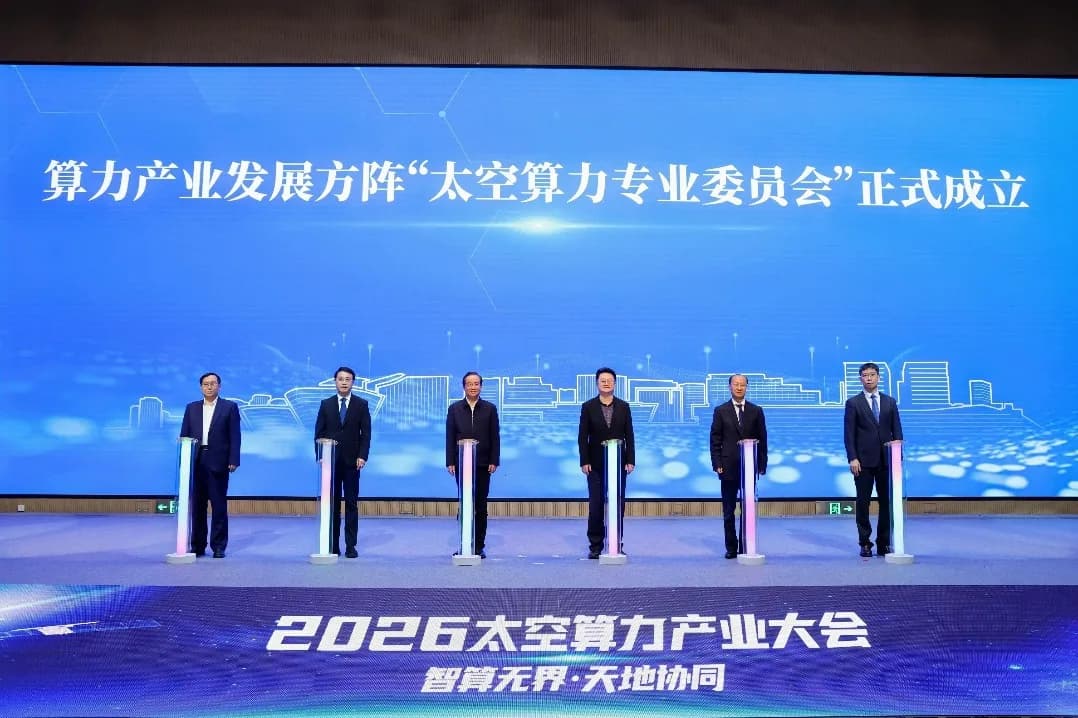
23 Jun 2026 · 30 min read
China's Orbital-Compute Mobilisation: Capital, Constraints, and the Layers That Can Actually Win
China is organising state capital, launch, satellites, silicon, and optical links around orbital compute before the sector has proved a commercial closed loop.
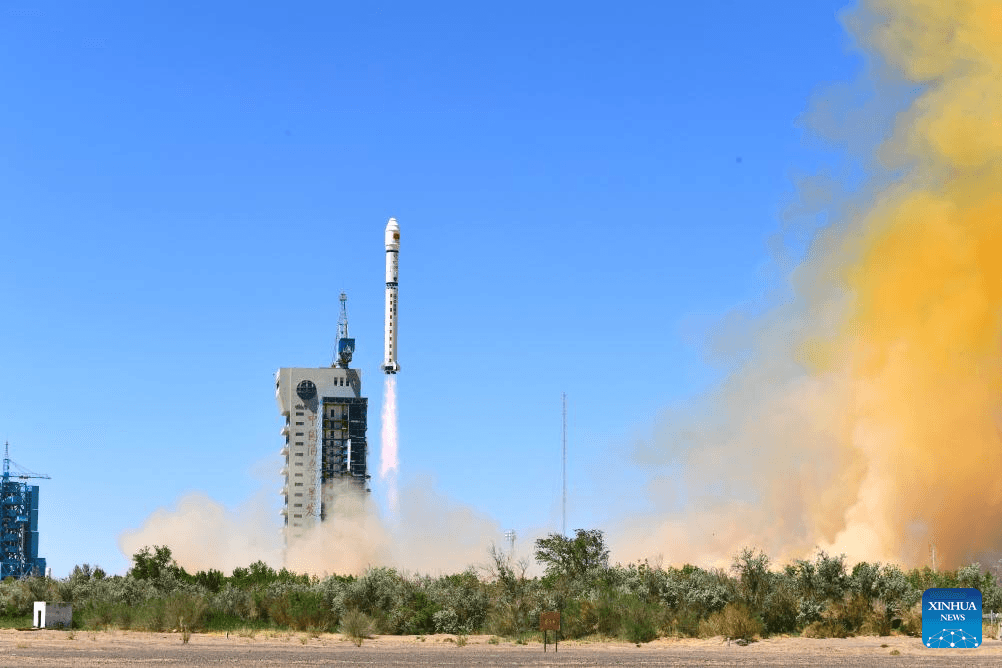
20 May 2026 · 38 min read
China's Orbital Compute Reality Check: Who Is Actually in Orbit?
China's orbital-compute programs now include real in-orbit validation, but public evidence still separates credible engineering paths from constellation-scale claims.
22 Jun 2026 · 42 min read
AI1 and SpaceX's $1.77 Trillion IPO: What the Orbital-Compute Option Is Actually Worth
AI1 is a credible engineering option, not a proven business: the gap between Musk's unveiling and SpaceX's own S-1 risk language is the investment case.