
Rocket Lab in 2026, Part II: The Scarcity Machine, Industrial Tempo, and Why Neutron Is Really a Management Test
Rocket Lab is a scarcity-forged industrial operating system, not a mini-SpaceX; Neutron tests whether founder-driven execution can scale into a medium-lift institution.
Method & disclosure
Confidence: Medium to high (based on public sources and cross-checking; some timelines, figures, and judgments may change as new disclosures emerge)
Review mode: Human + AI cross-check
Writing support: AI assisted
Singapore Space Agency
On this page · 13
- 01Executive Summary
- 02I. The Real Sequel Is About How Rocket Lab Operates
- 03II. Scarcity Was Not a Backstory. It Was the Design Brief.
- 04III. "Relentless" Is Not a Vibe. It Is Rocket Lab's Operating System.
- 05IV. Electron's Most Important Achievement Is Not That It Exists. It Is That It Industrialized.
- 06V. Launch Is the Wedge. Space Systems Is the Scale. The Operating System Connects Them.
- 07VI. Defense Is Not Buying Rocket Lab's Storytelling. It Is Buying Its Metabolism.
- 08VII. Neutron Is Not Just a Rocket. It Is a Test of Whether Rocket Lab Can Institutionalize Itself.
- 09VIII. The Civil Side Still Matters Because It Proves Rocket Lab Is Not Only a Defense Story
- 10IX. The Culture Is a Strength. It Is Also a Throttle.
- 11X. What APAC Should Learn, and What It Should Stop Pretending
- 12XI. What The Market Still Gets Wrong
- 13Conclusion
Key findings
The argument in brief
- Rocket Lab's real moat in 2026 is a scarcity-forged industrial operating system, not a single rocket or contract.
- Electron matters less as a standalone launch business than as a trust engine, cadence machine, and manufacturing school for the wider company.
- Defense customers are validating Rocket Lab because of its speed, supply-chain control, and execution rhythm, not because it tells a better startup story.
- Neutron is the decisive management test because it determines whether Rocket Lab can institutionalize founder-driven urgency into scalable medium-lift execution.
The first Rocket Lab article in this series argued that the company should no longer be read as a niche small-launch provider. That remains true. But Peter Beck's March 2026 appearance on Relentless adds a more useful layer to the story. It tells us what kind of machine Rocket Lab believes it has built, what kind of discipline it thinks separates it from the space industry's graveyard, and why Neutron is not just another rocket program but a test of whether the whole operating model can scale without breaking.
The most important line in the podcast is not about SpaceX, even though Beck says Electron's launch cadence scaled faster than Falcon 9 from first flight to 50 flights. It is not even the line that Rocket Lab's Electron factory is already capable of roughly one rocket per week. The most important line is philosophical: Rocket Lab grew up knowing it would never outspend richer competitors. In other words, the company did not accidentally become efficient. It was built under capital scarcity, supplier scarcity, talent scarcity, and geographic skepticism. Those pressures became an operating system.
That matters because the market often discusses Rocket Lab in the wrong categories. Optimists flatten the story into a generic "second SpaceX" narrative. Skeptics flatten it into a small-launch business that should eventually be commoditized into irrelevance. Both interpretations miss the central fact. Rocket Lab's real asset is not any one vehicle. It is an industrial tempo: a learned ability to move from design to manufacture to launch to spacecraft delivery with unusual speed, unusually high internal ownership of key subsystems, and a level of schedule aggression that traditional aerospace organizations still struggle to match.
That does not mean the story should be romanticized. In fact, the opposite is true. The podcast is revealing partly because Beck is blunt about the cost of this model. Rocket Lab is not run like a lifestyle employer. Beck describes a place where nobody lasts if they merely want to work predictable hours and cruise. That kind of culture can produce extraordinary execution in hard-tech industries. It can also produce managerial fragility if heroics are not converted into systems. This article therefore is not a celebration of hustle. It is an attempt to understand when hustle becomes a durable industrial advantage, and when it starts to become a liability.
Executive Summary
- Rocket Lab's deepest moat in 2026 is not simply
Electron,Neutron, or one defense contract. It is a scarcity-born operating system that prizes manufacturability, speed, internal problem-solving, and ruthless capital efficiency. - Peter Beck's podcast comments confirm something the financials already hinted at: Rocket Lab behaves like a company that expects suppliers to fail, schedules to slip, and capital to remain precious, so it designs products and organizations to absorb those shocks.
- The results are concrete. Rocket Lab generated
$602 millionof revenue in2025, ended the year with roughly$1.85 billionin backlog, and flew21Electron and HASTE missions with100%mission success for the year according to its 2025 Annual Report. Electronis strategically more important than many analysts admit, but not because it is a giant profit pool on its own. It is a trust engine, a customer-acquisition wedge, and a live factory for production rhythm.Vertical integrationat Rocket Lab is not ideology. Beck explicitly says it is "not a religion." The company buys externally where it can and internalizes where the supply chain proves too slow, too fragile, or too artisanal for defense and constellation scale.Defenseis not a side business anymore. SDA Tranche 2, SDA Tranche 3, NSSL Phase 3 Lane 1 on-ramp work, HASTE hypersonics, and tactically responsive space missions show that national security buyers are validating Rocket Lab's industrial model.Neutronis the hinge variable, but not only for launch economics. It is the management test that determines whether Rocket Lab can scale its culture from small-rocket intensity into a repeatable medium-lift institution.- The biggest risk is not just technical failure or competition from SpaceX. It is internal complexity. Rocket Lab now has to prove it can turn founder-driven urgency into durable multi-line industrial governance.
I. The Real Sequel Is About How Rocket Lab Operates
The previous article focused on what Rocket Lab had become: a vertically integrated space systems company with real exposure to national security space and a potentially transformative medium-lift program. This sequel asks a different question: how did Rocket Lab become that company, and what does its method imply for the next stage?
The podcast matters because Beck rarely sounds like a polished public-market CEO. He still sounds like a production engineer who thinks first in bottlenecks, welds, fittings, fatigue margins, and assembly flow. When he explains why Rocket Lab named the Rutherford engine after Ernest Rutherford, the point is not branding. The point is a sentence: "we have no money, so we have to think." That line is not a joke. It is a map of how the company learned to operate.
Many space firms say they value efficiency. Very few are genuinely organized around it. In practice, much of the sector still behaves like a hybrid of government-contractor habits and venture-funded optimism: large engineering ambition, fragile suppliers, bespoke hardware, soft deadlines, and the quiet assumption that the next financing event will solve organizational weakness. Beck's critique is harsher. His view is that money does not solve hard space problems. If it did, the industry's cemetery would be much smaller.
That judgment is not theoretical. In the same conversation Beck contrasts Rocket Lab's development path with Virgin Orbit, noting that Richard Branson had vastly more capital to pursue a concept that still ended as both a commercial and technical failure. Beck's point is not that capital is irrelevant. It is that capital without manufacturing discipline and decision quality often just buys more expensive failure.
That is the angle that matters in 2026. Rocket Lab's story is no longer especially interesting as startup folklore. The useful question is whether scarcity, once translated into culture and systems, can continue to generate an advantage when the company is larger, richer, more public, more politically exposed, and more entangled in defense obligations.
II. Scarcity Was Not a Backstory. It Was the Design Brief.
Beck's origin story has become familiar enough that some observers now treat it as founder mythology. That is a mistake. The story about crawling through junk yards to salvage Swagelok fittings is not just colorful history. It tells you how Rocket Lab learned to think.
According to Beck, the early company could afford the ferrules but not the fittings, so the first vehicles and ground infrastructure used cleaned-up second-hand parts. That detail matters for two reasons.
First, it explains the company's long-running obsession with cost as a design problem rather than merely a procurement problem. Most aerospace companies talk about cost late, after the architecture already exists. Rocket Lab appears to have learned to think about cost at the moment of conception. That does not automatically make the engineering better, but it does tend to force much sharper tradeoffs and much greater respect for manufacturability.
Second, it helps explain why Rocket Lab treats beautiful execution and thrift as compatible rather than contradictory. Beck is unusually emphatic on this point. In the podcast he says the standard in his upbringing was that if something came out of the garage, it had to be beautiful. He extends that logic directly into Rocket Lab. Beautiful hardware, in his philosophy, is not aesthetic vanity. It is a visible signal that care was taken deeply enough for the thing to probably work.
That combination of thrift and pride is rarer than people think. Cheap and good are often treated as opposites in aerospace, especially in low-volume programs. Rocket Lab's culture appears to reject that binary. It assumes that ugly work, sloppy work, and expensive work often travel together. That is not always true, but it is true often enough to become an organizational instinct.
This is where many APAC founders misread the Rocket Lab story. They see scarcity and imagine the lesson is simply to do more with less. That is too shallow. Scarcity by itself does not create excellence. It often creates bad engineering, exhausted teams, and fragile products. What made scarcity useful in Rocket Lab's case was that it was paired with design taste, production literacy, and a refusal to confuse low budget with low standards. That combination is the hard part.
III. "Relentless" Is Not a Vibe. It Is Rocket Lab's Operating System.
Every ambitious company eventually develops internal folklore about its own intensity. Most of that folklore is performative. Rocket Lab's podcast examples are more interesting because they are operational.
Beck tells one story about a super-thin-wall titanium pressure vessel for a satellite. A supplier failed badly enough that most companies, in his view, would have stopped and accepted delay. Rocket Lab instead developed its own technique to 3D print the tank, created the welding processes internally, qualified the parts, accepted them, and delivered on time. The side effect, Beck notes, was that there were now three suppliers in the United States able to build that category of tank, because Rocket Lab itself had become one.
That anecdote says almost everything important about the company.
It says Rocket Lab assumes the external supply chain is unreliable.
It says the company thinks schedule promises are real obligations rather than marketing aspirations.
It says management is willing to drag expertise across organizational boundaries to solve a manufacturing bottleneck.
And it says that when Rocket Lab vertically integrates, it is not usually because somebody in strategy wrote an elegant memo about value-chain adjacency. It is because a supplier missed the date, the budget, or the quality bar and the company decided the risk had to be internalized.
This is where Beck's line that vertical integration is "not a religion" becomes especially important. It is one of the most revealing comments in the whole conversation. Much of the startup world fetishizes vertical integration as though it proves seriousness. Beck's formulation is much more practical and, frankly, more credible. Rocket Lab would rather buy good off-the-shelf components immediately if the market can deliver them. It integrates because the market often cannot.
That is a far more mature position than the caricatures from both fans and critics. Fans sometimes imagine Rocket Lab is building the everything company of space out of pure ambition. Critics sometimes imagine it is empire-building because it cannot win a cleaner launch race. Both readings are incomplete. The deeper truth is uglier and more industrial: aerospace suppliers are often late, bespoke, low-volume, and fragile. Defense customers dislike that reality. Constellation customers dislike it. If Rocket Lab has found a repeatable way to drag those constraints inside the company and force them through one operating tempo, that is a genuine competitive advantage.
But it is not free.
Beck's own language makes that obvious. He says the team is relentless, that nobody survives there if they only want a conventional workday, and that people run toward the fire rather than away from it. One can admire the execution without pretending this is soft or universally healthy. Culture like that can produce extraordinary outcomes in hard-tech businesses. It can also hide managerial debt by converting structural problems into heroic effort. That distinction matters now more than it did five years ago.
IV. Electron's Most Important Achievement Is Not That It Exists. It Is That It Industrialized.
The space sector has a persistent habit of misunderstanding Electron.
For optimists, Electron is sometimes treated as proof that Rocket Lab can do anything. For skeptics, it is treated as an eventually limited small-launch business that can never be large enough to justify the company's valuation. Both views miss the point. Electron's real strategic value is not that it dominates the entire future of launch. Its value is that it proved Rocket Lab could move from R&D theater to industrial rhythm.
Beck says in the podcast that Electron was designed from day one to be producible, not merely to reach orbit once. That distinction matters enormously. Plenty of startups can brute-force a prototype or an early flight campaign. Much fewer can cross the much nastier gap between technical possibility and repeatable production. Beck explicitly calls that gap "production hell." His point is that Rocket Lab suffered it too, but less catastrophically than it might have because manufacturability was part of the initial design brief.
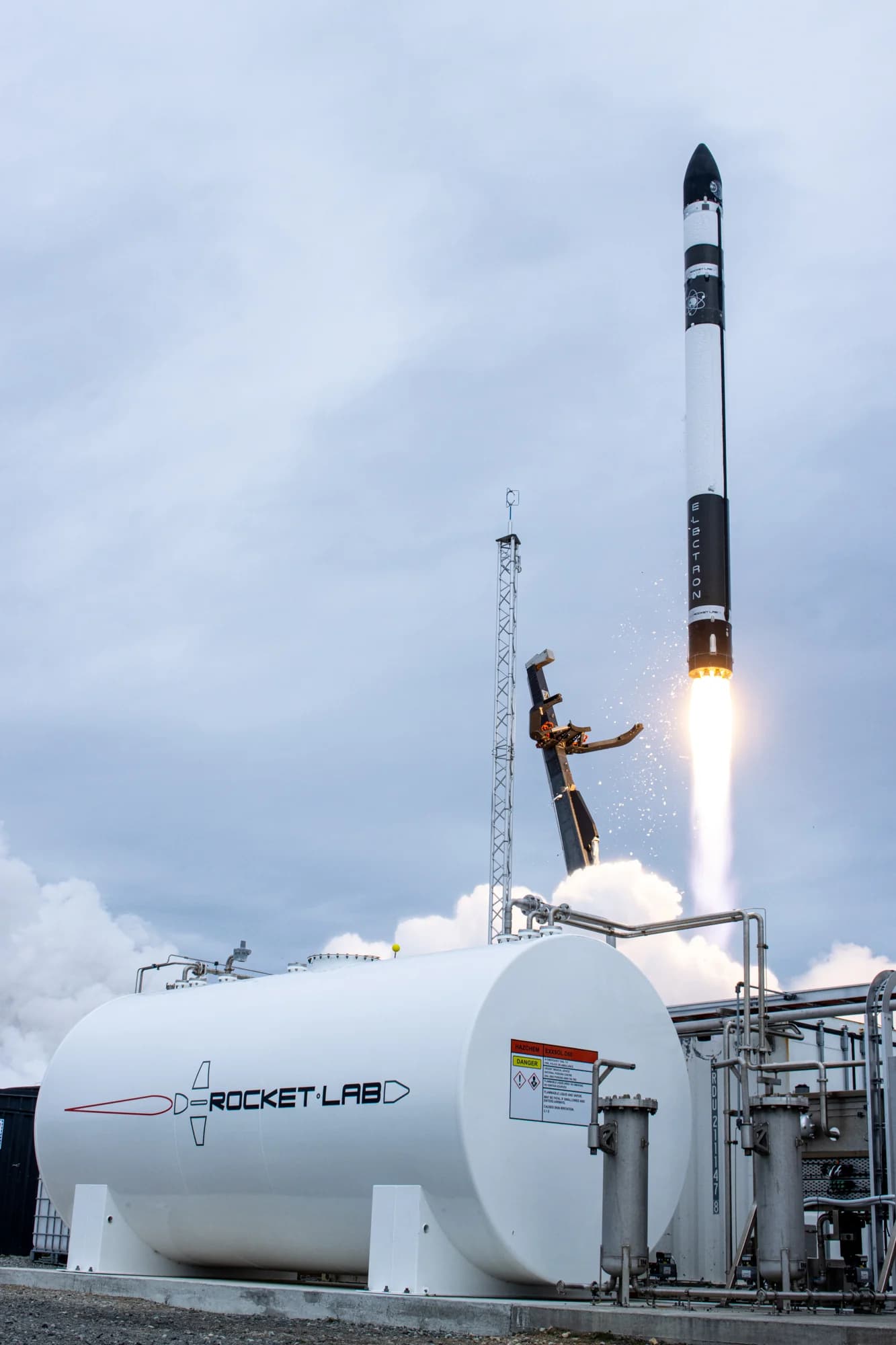
The public record supports that framing. According to Rocket Lab's 2025 Annual Report, the company flew 21 Electron and HASTE missions in 2025 with 100% mission success for the year, generated record annual revenue of $602 million, and ended the year with around $1.85 billion in backlog. In June 2025 Rocket Lab completed two launches from Launch Complex 1 in less than 48 hours. In March 2026 it pointed to two successful launches in less than a week from two different countries. These are not vanity statistics. They are signs of operating rhythm.
The more revealing comment from Beck is that Electron's factory is capable of around one rocket per week. That means the primary constraint is no longer only whether Rocket Lab can physically produce vehicles. Quite often, he says, the bottleneck is customer readiness. That is a quietly important admission because it reveals how far the company has progressed. Once a launch provider moves from asking "can we build and fly this thing?" to asking "is the market ready at the cadence our factory can sustain?" it has crossed into a different category.
This is also why comparing Electron only to Falcon 9 misses the strategic point. Beck says Electron scaled faster than Falcon 9 in cadence from first flight to 50 flights. That is an interesting fact, but it is not mainly useful as a scorecard against SpaceX. It is useful because it says Rocket Lab has internalized one of the hardest lessons in aerospace: repeatability is a business capability, not a press release.
And yet Electron should not be mythologized either. Beck himself says launch is roughly one-third of the company, while about two-thirds is Space Systems. That is consistent with what Rocket Lab's segment reporting has already shown: launch is no longer the whole business. But precisely because launch is no longer the whole business, Electron may be more strategically valuable than its direct revenue contribution suggests. It creates flight heritage, customer intimacy, responsive access, frequent mission practice, and a constant proving ground for hardware, software, people, and process.
In plain English: Electron is not just a rocket. It is Rocket Lab's trust machine.
V. Launch Is the Wedge. Space Systems Is the Scale. The Operating System Connects Them.
Once you accept that launch is not the entirety of Rocket Lab, the company's structure starts to make more sense.
The standard lazy description of Rocket Lab is still that it is a launch company that expanded into adjacent products. That is backwards. Rocket Lab increasingly looks like a space systems prime that uses launch as the sharpest possible wedge into customer relationships, mission assurance, and schedule credibility.
This is why Beck's comment that two-thirds of the company is on the space systems side is so important. It aligns with the company's own financial disclosures, but it also clarifies management attention. Beck says Electron is now such a light-touch product for him personally that the team largely drives it without heavy intervention, while Neutron remains high-touch because it is deep in development. That is exactly how a more mature industrial company should behave: protect the production engine, keep leadership pressure on the future bottleneck.
The systems side of Rocket Lab is broader than many people still appreciate. The company already had spacecraft buses, solar power, software, separation systems, avionics, guidance, and on-orbit management capability. It has since continued to widen the stack. In August 2025 Rocket Lab closed its acquisition of Geost, bringing EO/IR payloads more directly into the company. In April 2026 it completed the acquisition of Mynaric, a move disclosed via SEC filing, giving Rocket Lab greater control over laser communications terminals that matter deeply for proliferated constellations and defense architectures. On the same day in April 2026 Rocket Lab also introduced its Gauss electric propulsion system, emphasizing high-volume production because propulsion availability itself had become a supply-chain bottleneck.
There is a pattern here, and it is more coherent than many critics admit. Rocket Lab is trying to own enough of the mission stack that it can promise something precious to customers: not merely components, not merely launch, but schedule control across a much wider portion of the architecture.
That promise is strategically powerful in three specific markets.
In national security, it helps with sovereignty, trusted supply, manufacturability, and resilient constellation deployment.
In civil and exploration missions, it helps with integration simplicity and accountability.
And in commercial constellations, it helps with production speed and interface compression.
This is not glamorous. But real industry power rarely is.
VI. Defense Is Not Buying Rocket Lab's Storytelling. It Is Buying Its Metabolism.
The strongest evidence that Rocket Lab's operating model is being validated is not venture enthusiasm or stock performance. It is the behavior of the U.S. national security market.
The company is now deeply inside that market.
Rocket Lab won a $515 million SDA Tranche 2 Transport Layer-Beta prime contract for 18 satellites. It then followed that with an $816 million Rocket Lab-described Tranche 3 prime contract to build 18 missile-defense satellites, while the Space Development Agency release described a total potential value of $805 million. Neutron was on-ramped into U.S. Space Force NSSL Phase 3 Lane 1 with a $5 million task order for capability assessment, and the same step was reflected by Space Systems Command. HASTE continues to deepen the relationship on the hypersonics side, including a March 2026 block contract worth $190 million for 20 HASTE launches and earlier MACH-TB-related selections in January 2025 and April 2025.
This is what many market observers still understate: the Pentagon is not adopting Rocket Lab because it is cute, disruptive, or merely cheaper than legacy firms. It is adopting Rocket Lab because the company increasingly looks like a supplier and prime that can move at useful speed.
Defense buyers care about exquisite performance, yes. But they also care about manufacturing repeatability, supplier assurance, secure interfaces, and delivery discipline. In an era defined by proliferated architectures, missile tracking, responsive launch, and the broader strategic logic behind concepts such as Golden Dome, a company that can manufacture the bus, integrate the payload, control software, supply key components, and eventually launch the system itself becomes very interesting.
This is why I think the best description of Rocket Lab today is not mini-SpaceX and not "newspace launcher." It is something closer to a fast industrial prime.
That does not mean it has escaped prime-contractor risk. On the contrary, fixed-price defense execution can be vicious. Big wins pull visibility forward, but they also move cost and schedule risk onto the contractor. Rocket Lab is now far enough inside this business that execution missteps would matter a lot. Investors who cheer every new award as pure upside are missing how unforgiving prime responsibility can become.
VII. Neutron Is Not Just a Rocket. It Is a Test of Whether Rocket Lab Can Institutionalize Itself.
There is a sentence in the podcast that every serious Rocket Lab observer should underline: Beck says Rocket Lab could be profitable instantly if it stopped developing Neutron.
That one line clears away a lot of nonsense.
It tells you that Neutron is not a vanity science project.
It tells you management is consciously sacrificing near-term financial cleanliness for a much larger market opportunity.
And it tells you that if Neutron fails, the damage is not limited to launch. It affects the company's broader strategy for constellation deployment, infrastructure in orbit, defense relevance, and its long-term claim to be an end-to-end space company rather than a very capable partial stack.
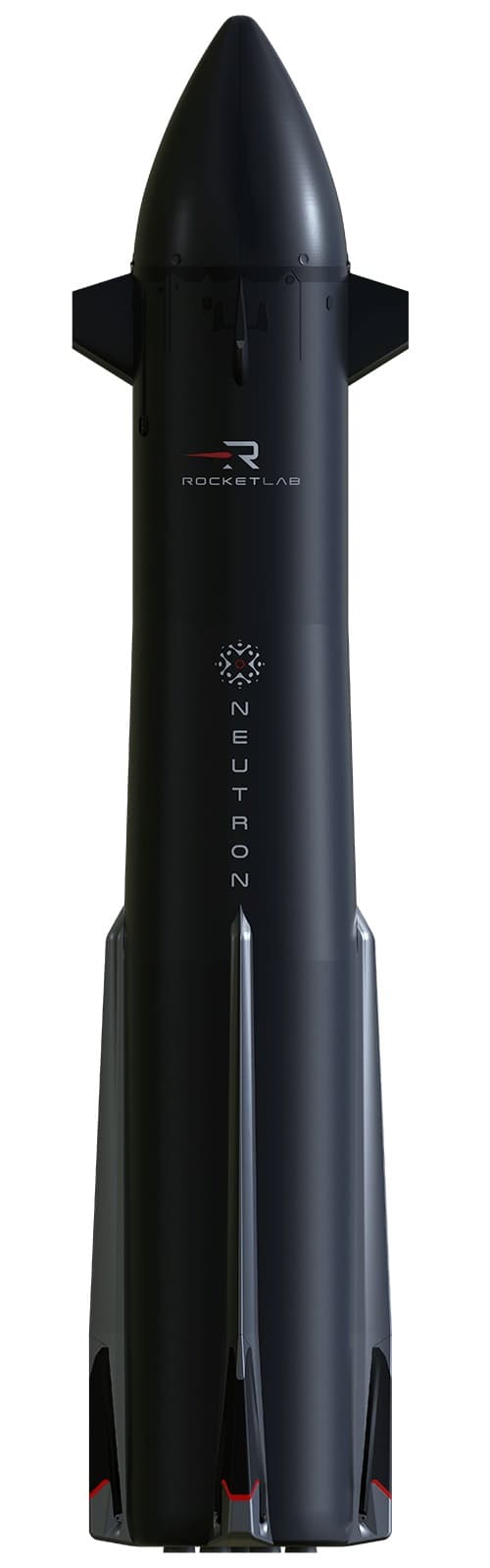
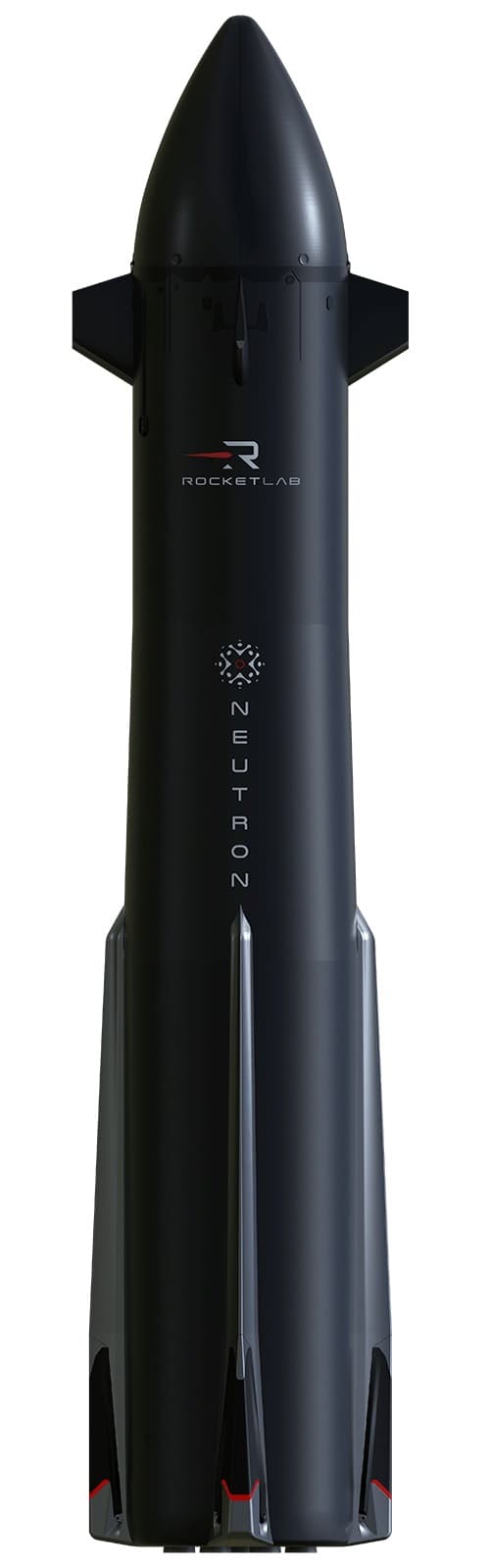
Beck's explanation of Neutron in the podcast is revealing because he talks about it less as a moonshot and more as a production system. He says Neutron is better than Electron from a production standpoint because it is less mass-sensitive, because fluid systems are built off the rocket and assembled as modules, and because the complete electrical system can be installed as an integrated package rather than pulled manually through the vehicle. This is a production engineer's answer, not a rocket romantic's answer.
The public milestones matter too. Rocket Lab opened Launch Complex 3 in August 2025, describing it as the dedicated test, launch, and landing facility for Neutron at Wallops. It previously revealed the Return On Investment ocean landing platform for downrange recoveries, and later highlighted the arrival of the Hungry Hippo captive fairing as another milestone in the Neutron system architecture. In its third-quarter 2025 financial results, Rocket Lab updated the schedule to place the rocket at Launch Complex 3 in Q1 2026, with first launch thereafter pending qualification and acceptance testing.
That last phrase is the whole point. Qualification and acceptance are where operating systems get tested.
Small-rocket companies can sometimes survive on founder intensity, long nights, and tactical improvisation longer than outsiders expect. Medium-lift systems, defense-class assurance, and higher mission criticality are much less forgiving. Neutron therefore is not simply a technology program. It is the exam that tests whether Rocket Lab can turn its celebrated hustle into institutional repeatability.
I do not think the biggest Neutron question is "can Rocket Lab design a good rocket?" The company has already demonstrated enough engineering credibility that this is no longer the primary issue. The harder question is whether it can absorb the scale, capital burn, qualification rigor, recovery logic, launch infrastructure complexity, and customer expectation stack that a reusable medium-lift vehicle requires, all while still executing Electron, HASTE, spacecraft manufacturing, defense primes, and acquisition integration.
That is a management problem before it becomes a market problem.
VIII. The Civil Side Still Matters Because It Proves Rocket Lab Is Not Only a Defense Story
A lot of current Rocket Lab analysis is becoming too defense-heavy. That is understandable, but incomplete.
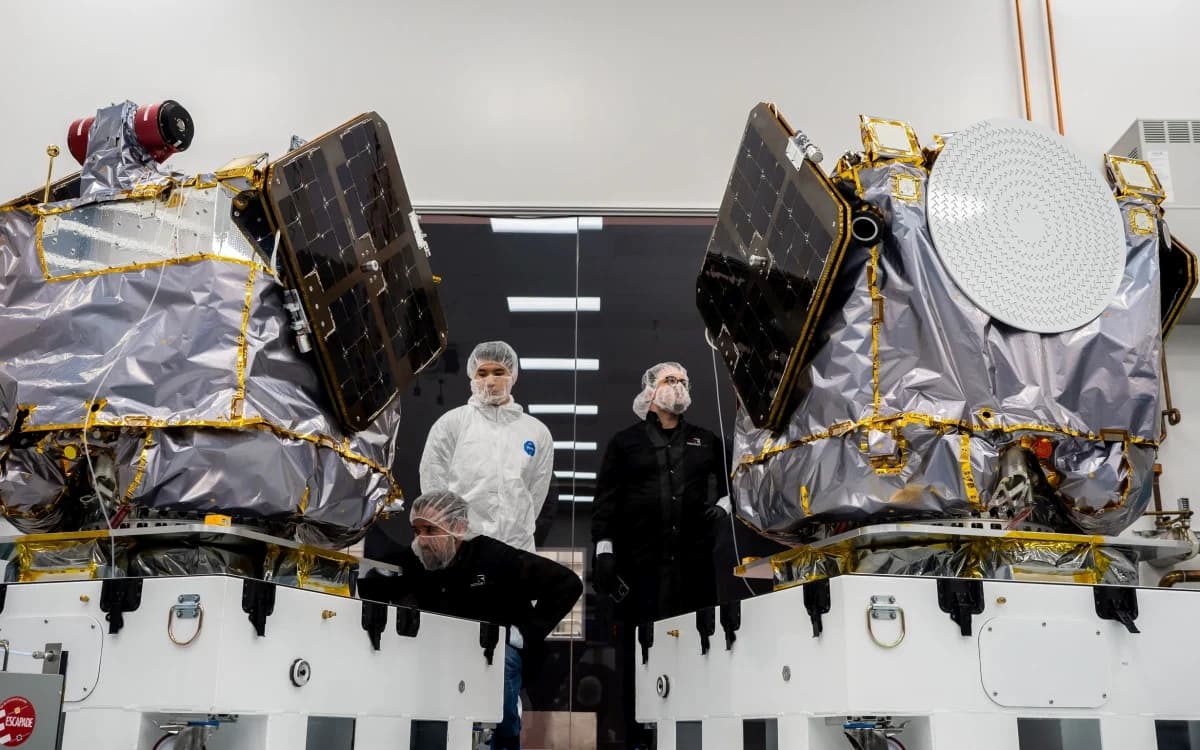
Civil and exploration work still matters because it proves the company can execute spacecraft beyond military procurement logic. CAPSTONE remains one of the best examples. In the podcast Beck calls it a totally impossible project, notes that NASA paid only about $10 million, and says Rocket Lab ended up roughly three times over budget but delivered anyway because a commitment had been made. That is not a healthy contract economics model by itself, but it is a revealing signal about how the company treats trust.
The official record backs up the broader point. Rocket Lab launched CAPSTONE for NASA's lunar mission. It later completed the twin ESCAPADE spacecraft for Mars, and NASA confirmed that ESCAPADE launched on November 13, 2025. Those are not symbolic side quests. They demonstrate that Rocket Lab's spacecraft organization can do more than standardized proliferated buses.
That matters strategically because defense buyers notice civil credibility, and civil buyers notice defense-grade process. The company benefits from the cross-pollination of both.
It also complicates the simplistic debate about whether Rocket Lab should be valued more like a launcher or more like a defense contractor. The correct answer is probably neither in pure form. It is an industrial space company building optionality across launch, spacecraft, components, payloads, software, and eventually perhaps its own on-orbit infrastructure.
Beck hints at this direction in the podcast when he says the future will blur the line between what is and is not a space company. That is one of his smartest comments. SpaceX is already hard to classify cleanly because Starlink changed the business. Rocket Lab is not there. But Beck is clearly thinking in the same direction: first own launch credibility, then own more of the mission stack, then decide what infrastructure to deploy.
That is precisely why Neutron matters so much. It is the bridge from selling the picks and shovels to possibly deploying more of Rocket Lab's own strategic infrastructure.
IX. The Culture Is a Strength. It Is Also a Throttle.
There is a temptation when reading this podcast to turn Rocket Lab into hustle pornography. That would be lazy.
Beck openly says the company is not for everyone, that the hiring bar is extraordinarily high, and that one of the biggest constraints is feeding enough great talent into the machine. He also says that when things are not going well, the company does not run from the problem. People run toward it. This is admirable. It is also a potential scaling bottleneck.
The more a company depends on exceptional people, exceptional urgency, and internal cultural selection, the harder it becomes to expand without dilution. This is especially true when the business is spread across launch vehicles, spacecraft, components, payloads, software, hypersonics, and defense primes.
A weaker company would simply lower the bar and hire faster. Beck makes clear Rocket Lab has resisted that instinct. I respect that. But it creates a real strategic tension. If growth outruns the ability to recruit and acculturate high-standard operators, then the very culture that created the edge can become the reason scaling slows.
There is another tension too. Founder-centered intensity is powerful early. Later, it can become dangerous if it is not translated into institutional decision-making. Beck, to his credit, seems more self-aware about this than many hard-tech founders. In the podcast he says he wanted Rocket Lab to go public partly because he wanted it to outlive him, and because public-company discipline forces rigor that private abundance often does not. He even says explicitly that he does not want Rocket Lab to be one of those companies where the founder leaves and the soul disappears.
That is healthy rhetoric. But rhetoric alone is not enough. The real test is whether Rocket Lab can codify the behaviors Beck describes into systems that persist under scale, turnover, acquisition, and geographic spread.
If it can, the company becomes much more formidable.
If it cannot, then the mythology of hustle will become a trap.
X. What APAC Should Learn, and What It Should Stop Pretending
Rocket Lab matters to APAC observers for reasons that go beyond its headquarters or Nasdaq listing.
This is still, at some level, a transpacific company. Its roots are in New Zealand. Its scaling capital and defense access are in the United States. Its customer set includes important Asian operators such as iQPS and Synspective. Its launch footprint spans New Zealand and the U.S. Its relevance therefore sits exactly at the intersection APAC space ecosystems often fail to manage well: global ambition, regional credibility, and hard industrial execution.
There are several lessons here.
The first is that geography is not destiny, but capital and demand gravity still matter. Beck is explicit in the podcast that America offered a level of belief, venture financing, and entrepreneurial permissiveness that he could not have found elsewhere in the same way. This should not be read as American self-congratulation. It should be read as a strategic reminder. Great hardware companies can begin in smaller ecosystems, but if they want to become globally consequential they still need to plug into the deepest capital pools, the toughest customers, and the most credible procurement systems.
The second lesson is that APAC space ecosystems often talk too much and manufacture too softly. There is still a tendency across the region to over-reward symbolic announcements, memoranda, delegations, and generic statements about the new space economy. Rocket Lab is a useful antidote because its culture is fundamentally anti-cosmetic. The company cares about whether the thing ships, whether it works, whether the customer made contact, whether the schedule held. That is a healthier industrial instinct than most regional ecosystems currently display.
The third lesson is that launch should be read as a wedge, not an end state. Too many emerging ecosystems still talk as if an indigenous launch vehicle is the whole prize. It is not. Launch matters because it creates trust, mission access, engineering seriousness, and adjacency into higher-value system layers. Rocket Lab seems to understand that. Many others do not.
The fourth lesson is that sovereign relevance is earned operationally. It is fashionable in APAC to speak quickly about defense relevance and strategic autonomy. But the real path into national-security markets is slow, brutal, and technical. It runs through performance, supply-chain control, qualification discipline, and repeat delivery. Rocket Lab did not become defense-relevant because it said the right words. It became defense-relevant because it built a body of evidence.
XI. What The Market Still Gets Wrong
I think the market still makes five recurring analytical errors with Rocket Lab.
1. It still treats Rocket Lab as a launch company first.
Launch is the visible entry point. It is no longer the whole economic story. The company is better understood as an integrated space-industrial platform whose launch business creates trust and whose systems businesses create scale.
2. It confuses vertical integration with ideology.
Rocket Lab is not vertically integrating because Peter Beck read a startup textbook about control. It is integrating because the market for many critical aerospace parts still does not deliver the schedule, cost, and volume needed. That is a harder, more practical reason.
3. It underestimates how much Electron matters.
Electron is not strategically obsolete just because Neutron is the bigger future prize. Electron is Rocket Lab's live operating core: the place where cadence, customer relationships, responsive mission execution, and manufacturing muscle are continually exercised.
4. It frames Neutron mainly as a technical milestone.
Neutron is also a capital allocation decision, a management exam, a defense credibility bridge, and a prerequisite for Rocket Lab's larger infrastructure ambitions. Thinking about it only as a rocket misses the point.
5. It worries about the wrong competitor.
Yes, SpaceX is the obvious giant. But the more interesting threat is not just a giant competitor with better economics. It is internal overload: too many programs, too much fixed-price risk, too many acquired pieces to integrate, too many high standards to maintain simultaneously.
That is the real knife-edge.
Conclusion
The most useful way to read Rocket Lab in 2026 is not to ask whether it is the next SpaceX. That question is lazy, and at this point it is analytically useless.
A much better question is this: has Rocket Lab built a scarcity-forged operating system strong enough to scale from small-launch excellence into a durable, defense-relevant, medium-lift, multi-program industrial company?
I think the answer today is: mostly yes, but not yet conclusively.
The evidence in favor is real. Record revenue. Real backlog. A functioning launch rhythm. Repeat customers. A defense position that is now clearly substantive. Smart acquisitions that fit a mission-stack logic. A founder who still sounds like he thinks first in production bottlenecks rather than public-market slogans. And perhaps most importantly, a culture that seems to believe schedule commitments are moral commitments.
But the risks are real too. Hustle does not automatically scale. Founder intensity does not automatically become institution. Vertical integration can solve supplier problems, but it can also multiply managerial complexity. Defense wins can re-rate a company upward, but they can also punish it brutally when execution slips. And Neutron, for all its promise, still has to emerge from development into reliable operation before the larger thesis is truly complete.
That is why this moment is so interesting.
Rocket Lab no longer has the luxury of being judged as a heroic insurgent. It is too large, too visible, too contracted, and too strategically relevant for that. The company is now being judged by a tougher standard: whether it can turn its famous relentlessness into repeatable industrial governance.
If it can, then Rocket Lab's real moat will not be a rocket. It will be a way of building.
If it cannot, then all the right instincts that got it here will become the very things that cap its next phase.
That is the real sequel to the Rocket Lab story.
This article is based on the public sources listed below. Analysis and forward-looking judgments are the author's independent views and are not investment, legal, or procurement advice.
Sources36 entries with source notes and links
- Relentless podcast episode featuring Peter Beck(podcasts.apple.com)
- Rocket Lab 2025 Annual Report / Form 10-K(investors.rocketlabcorp.com)
- Rocket Lab third quarter 2025 financial results(investors.rocketlabcorp.com)
- Rocket Lab full year and fourth quarter 2024 financial results(rocketlabcorp.gcs-web.com)
- Rocket Lab awarded $515M prime contract for 18 SDA Transport Layer satellites(rocketlabcorp.gcs-web.com)
- Rocket Lab's Neutron on-ramped to U.S. Space Force NSSL Phase 3 Lane 1(rocketlabusa.com)
- Rocket Lab secures $190M contract for 20 HASTE launches(investors.rocketlabcorp.com)
- Rocket Lab selected by Kratos to deliver hypersonic test launches for DoD with HASTE(rocketlabcorp.gcs-web.com)
- Rocket Lab awarded new HASTE launch contract for the DoD by Kratos(rocketlabcorp.gcs-web.com)
- Rocket Lab successfully launches HASTE hypersonic test vehicle from Wallops(rocketlabcorp.gcs-web.com)
- Rocket Lab closes acquisition of Geost(rocketlabcorp.gcs-web.com)
- Rocket Lab enters payload market with agreement to acquire Geost(rocketlabcorp.gcs-web.com)
- Rocket Lab completes acquisition of Mynaric - SEC Form 8-K(stocktitan.net)
- Rocket Lab announces intention to acquire Mynaric(rocketlabcorp.gcs-web.com)
- Rocket Lab unveils new electric propulsion satellite thruster(rocketlabcorp.gcs-web.com)
- Rocket Lab completes 10th launch for BlackSky(rocketlabcorp.gcs-web.com)
- Rocket Lab completes record launch turnaround from Launch Complex 1(rocketlabcorp.gcs-web.com)
- Mission success: Rocket Lab completes 83rd launch(rocketlabcorp.gcs-web.com)
- Rocket Lab signs second multi-launch deal with iQPS(rocketlabcorp.gcs-web.com)
- Rocket Lab launches final five satellites for Kinéis constellation(rocketlabcorp.gcs-web.com)
- Rocket Lab selected to launch Synspective's StriX constellation satellites(rocketlabcorp.gcs-web.com)
- Rocket Lab opens Launch Complex 3 for Neutron(rocketlabcorp.gcs-web.com)
- Rocket Lab reveals ocean platform for Neutron rocket landings at sea(rocketlabcorp.gcs-web.com)
- Rocket Lab launches CAPSTONE for NASA's mission to the Moon(rocketlabcorp.gcs-web.com)
- Rocket Lab successfully completes twin spacecraft for NASA's ESCAPADE mission(rocketlabcorp.gcs-web.com)
- Rocket Lab acquires Advanced Solutions, Inc.(rocketlabcorp.gcs-web.com)
- Rocket Lab acquires Planetary Systems Corporation(rocketlabcorp.gcs-web.com)
- Rocket Lab acquires SolAero Holdings(rocketlabcorp.gcs-web.com)
- Rocket Lab selected to launch VICTUS HAZE mission for Space Safari(rocketlabcorp.gcs-web.com)
- Rocket Lab successfully launches second and final PREFIRE mission for NASA(rocketlabcorp.gcs-web.com)
- Rocket Lab successfully launches first mission from U.S. soil for the National Reconnaissance Office(rocketlabcorp.gcs-web.com)
- Electron launch vehicle overview(rocketlabusa.com)
Continue reading
20 Apr 2026 · 22 min read
Rocket Lab in 2026: Vertical Integration, Defense Scale, and the Neutron Inflection Point
Rocket Lab is now a vertically integrated space-systems prime; its upside depends on defense execution, satellite scale, and whether Neutron converts promise into cadence.
12 Jul 2026 · 51 min read
Japan's Launch-Startup Tier: Real Rockets, Borrowed Engines, and a Market the State Forgot to Build
Japan has funded an unusually capable launch-startup tier while allowing its commercial manifest to flow abroad; capability grants cannot substitute for a repeat customer.
19 Apr 2026 · 38 min read
Full-Flow Staged Combustion: Why FFSC Is the Everest of Rocket Engines, and Who Is Actually Climbing It
A practical map of rocket-engine cycles, Raptor V1–V3, and the 2026 full-flow staged-combustion race — where reflight economics matter more than test-stand claims.