
Orbit Is Architecture: Why Orbital Compute Is First an Orbit-Design Problem
Orbit choice sets the limits of orbital compute: illumination, heat rejection, radiation, downlink, lifetime, and regulation change across LEO, MEO, GEO, and SSO.
Method & disclosure
Confidence: High for orbital mechanics, radiative heat-transfer calculations and official mission parameters. Medium for company road maps, undisclosed orbital parameters and scale-up timelines; confirmed facts, media reporting and author inference are separated throughout.
Review mode: Human + AI cross-check
Writing support: AI assisted
Singapore Space Agency
On this page · 13
- 0190-Second Summary: Orbit Is Not Background; It Is the Compute Architecture
- 02I. Why Orbit Must Be a First-Principles Decision
- 03II. Orbit Classes Through the Lens of Compute
- 04III. Six Orbital Elements and Four Underestimated Constraints
- 05IV. Constellation Design: From One Satellite to Walker-Delta and Multiple Shells
- 06V. Turning Orbital Knowledge into Mission Choice
- 07VI. How Companies Encode Strategy in Orbit
- 08VII. How Orbit Determines Orbital-Compute Economics
- 09VIII. What Would Change This Assessment
- 10IX. Conclusion: Orbit Is Architecture, but No Orbit Does Everything
- 11Appendix A: Key Formulae
- 12Appendix B: Evidence Confidence
- 13Appendix C: Terms and Abbreviations
Key findings
The argument in brief
- Orbit selection is the first architecture decision because it sets latency, illumination, radiation, thermal geometry, downlink access, lifetime, and disposal at once.
- Dawn-dusk SSO can improve power continuity and thermal stability, but it does not eliminate eclipses, batteries, or attitude-dependent heat rejection.
- Orbital compute scales against effective radiator area and acceptable operating temperature; gigawatt concepts imply square kilometres of heat-rejection surface.
- There is no universal orbit: workload latency, power density, data path, debris residence, and regulatory footprint must drive the choice.
Technical Brief | From LEO and SSO to dawn-dusk orbit: how illumination, heat rejection, bandwidth, radiation and launch cost determine the real feasibility of space-compute constellations
Where this brief sits in the series: spacesgp's orbital-compute work has already examined capital and governance architecture through DayOne, platform and software architecture through Space Android, and market and industry architecture through the Western and Chinese reality checks. This brief adds the lowest layer: physical and orbital architecture. Before chips, cooling or AI models can work, a more basic decision has to hold: which orbit the spacecraft occupies.
Method: this is a technical brief with very little tolerance for false precision. Engineering figures state their calculation basis; company orbital parameters are separated into confirmed evidence from official records or TLEs, media reporting and author inference. Unverified regulatory claims carry a Fact Status label. The underlying formulae appear in Appendix A.
What this brief does not claim: it does not argue that every space-compute mission should use dawn-dusk orbit, that orbital data centres are already commercially viable, or that any application, financing announcement or road map equals validated engineering capacity. It makes one narrower claim: orbit changes power, thermal control, radiation, communications, lifetime and regulatory exposure simultaneously, so it is the first layer of space-compute architecture.
90-Second Summary: Orbit Is Not Background; It Is the Compute Architecture
The orbital-compute conversation usually starts with chips, cooling and AI models. It should start one level earlier: with orbit.
Five core findings:
-
There is no universal best orbit. Dawn-dusk sun-synchronous orbit (SSO) offers clear advantages in power continuity and thermal-boundary stability, but it is not optimal for every low-latency interaction, equatorial market or real-time user service. Orbit selection is a mission-driven trade, not a search for one superior altitude.
-
Dawn-dusk does not mean zero battery. Relative to ordinary LEO geometries that repeatedly enter eclipse, it can approach continuous illumination. Whether eclipses occur, when they occur and how long they last still depend on altitude, inclination, LTAN error and the actual beta angle. Batteries must cover worst-case eclipse energy, attitude-manoeuvre peaks and safe mode. "High sunlight fraction" cannot be simplified into "no battery."
-
Heat rejection is jointly constrained by effective area and acceptable temperature. At emissivity ε=0.9 and 20°C, one square metre of radiator rejects about 376 W to deep space. Values above 800 W/m² generally require a radiator near 80°C or hotter, depending on emissivity. A 10 kW GPU cluster needs roughly 27 m² of ideal effective radiator area; gigawatt systems require square kilometres. Temperature cannot rise without limit, making deployable effective area a fundamental scaling constraint.
-
Altitude determines more than latency; it also sets radiation and lifetime. Moving compute satellites to 1,200-2,000 km for improved illumination also places them in a harsher radiation environment, gives failed objects far longer residence times and raises the burden of active disposal. This cost is routinely understated.
-
Inclination also sets the regulatory footprint. High-inclination and near-polar orbits expose ground tracks and communications footprints to more jurisdictions, expanding spectrum coordination, market-access, gateway and data-compliance work. Overflight in outer space, provision of service into a country and construction of a local gateway are different legal acts. More precisely, inclination determines how many regulatory systems a compute constellation must confront.
I. Why Orbit Must Be a First-Principles Decision
When people discuss computing in space, they tend to focus on processor throughput, thermal systems and AI models. The starting point that determines whether those technologies can operate effectively is orbit design.
Altitude, equator-crossing geometry, period, illumination and ground-station visibility directly govern six constraints:
Choose the wrong orbit and GPUs worth tens of millions of dollars may lose power during critical work, become debris after a thermal-system failure, or produce results that cannot be returned on time. Orbit is architecture: it is the first decision to make before deploying compute in space, not the last.
II. Orbit Classes Through the Lens of Compute
Orbit classes are not a ladder from "lower" to "better." LEO trades short links for drag and limited footprint; MEO trades latency for visibility; GEO trades a fixed view for long propagation delay; SSO uses nodal precession to preserve local solar time. For compute missions, altitude, inclination and local solar time must be evaluated as one architecture.
2.1 Low Earth Orbit (LEO): Low Latency, Constrained Illumination and Lifetime
Definition: near-circular Earth orbit at roughly 200-2,000 km, the most densely used region of space.
LEO offers low latency, relatively modest injection energy and high imaging resolution. Yet each satellite sees a limited footprint and pass duration, so continuous wide-area service requires a constellation. Outside dawn-dusk geometries, high-power payloads must also bridge eclipse through batteries, workload scheduling or constellation-level task migration.
Atmospheric drag and lifetime, quantified without false precision:
NASA's small-spacecraft assessment says that spacecraft near 400 km will typically decay within five years, while above 500 km disposal within either five or 25 years cannot be assumed. "Five to seven years at 550 km" is not a universal rule and must not be confused with Starlink's planned operational life. Altitude creates a three-way trade: lower means lower latency and easier natural disposal, but stronger drag and more station-keeping; higher means longer residence, but stronger radiation and heavier disposal responsibility.
2.2 Medium Earth Orbit (MEO): A Navigation Sweet Spot, Not Today's Compute Default
MEO spans roughly 2,000-20,000 km with periods of two to 12 hours. Its value lies in navigation, high-visibility relay and regional broadband: GPS operates near 20,200 km, and fewer satellites can cover a broad area. Higher latency, harsher radiation and greater injection energy make it a poor default for the high-power, low-latency general-purpose AI systems now being proposed. MEO may still suit navigation or timing edge processing, long-term storage and high-visibility relay. It is simply not the leading orbital-data-centre candidate.
2.3 Geostationary Earth Orbit (GEO): Vast Coverage, Hard Latency and Radiation Costs
GEO is precisely 35,786 km above the equator at 0° inclination, making a satellite appear fixed in the sky.
One GEO spacecraft can see about 42% of Earth's surface; three to four cover most of the planet except the poles, and ground antennas do not track. For compute, however, GEO brings extreme latency, high launch cost, no polar visibility and long exposure to a severe radiation environment. It is well suited to broadcast and relay, not general-purpose space computing.
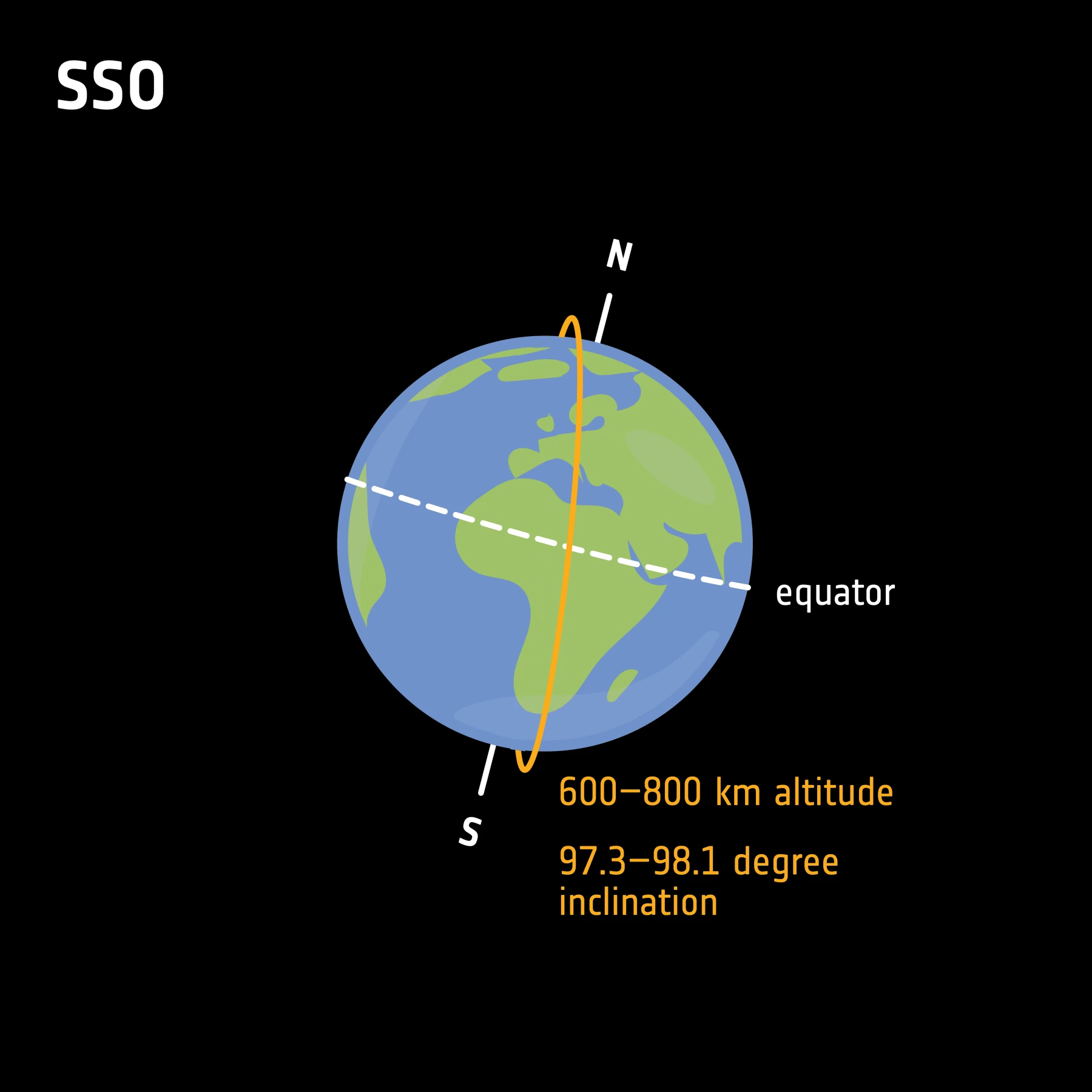
2.4 Sun-Synchronous Orbit (SSO): The Geometry of Repeatable Lighting
SSO is a near-polar orbit whose plane precesses to preserve local solar time. Common 600-800 km Earth-observation missions use inclinations near 97-99°; higher SSOs may exceed 100°. Designed nodal precession approaches Earth's mean motion around the Sun, about 0.9856° per day, so repeated passes over a location occur at nearly the same local solar time. The lighting geometry repeats, though the illumination is not identical on every pass.
SSO exploits Earth's J2 gravity term, produced by the equatorial bulge. For a near-circular orbit, the right ascension of the ascending node evolves as:
$$\dot{\Omega} = -\frac{3}{2} J_2 , n \left(\frac{R_E}{a}\right)^2 \cos i$$
When i > 90°, the orbit is retrograde and cos(i) < 0, so Ω̇ > 0: the node precesses eastward. The Sun's apparent motion is also eastward at about 0.9856° per day. Matching that motion is why SSO uses a retrograde inclination.
Common-error correction: SSO is often described as having "westward" or "negative" precession. That mixes coordinate conventions. A retrograde orbit produces the positive, eastward nodal precession needed to follow the Sun's apparent eastward motion.
The circular-orbit inclination-altitude relationship below uses a first-order J2 approximation. Precision mission design must iterate with higher-order gravity and solar/lunar perturbations.
In a circular, first-order J2 model, SSO has a mathematical altitude limit near 5,974 km, where the required inclination approaches 180°. This is not a physical exclusion zone or a practical mission boundary: higher-order perturbations, radiation, launch energy and operational risk bind earlier. At 1,200-2,000 km, SSO is geometrically possible at roughly 100.4-104.9°.
2.5 Dawn-Dusk SSO: A High-Illumination Candidate, Not "Permanent Sunlight"
A dawn-dusk orbit is an SSO whose local time of ascending node (LTAN) lies near sunrise, about 06:00, or sunset, about 18:00. Its plane nearly follows the terminator.
This geometry is especially attractive to space computing because it supports power continuity and thermal stability. Its benefits are also frequently overstated.
The beta angle is not a simple 90°±23.5° oscillation. It is set by solar declination, inclination and LTAN. For a representative 98° dawn-dusk SSO, |β| can fall toward roughly 58° near one solstice. If it drops below the critical angle for that altitude, the orbit enters eclipse. The relevant months and duration are mission-specific rather than a universal "equinox eclipse season."
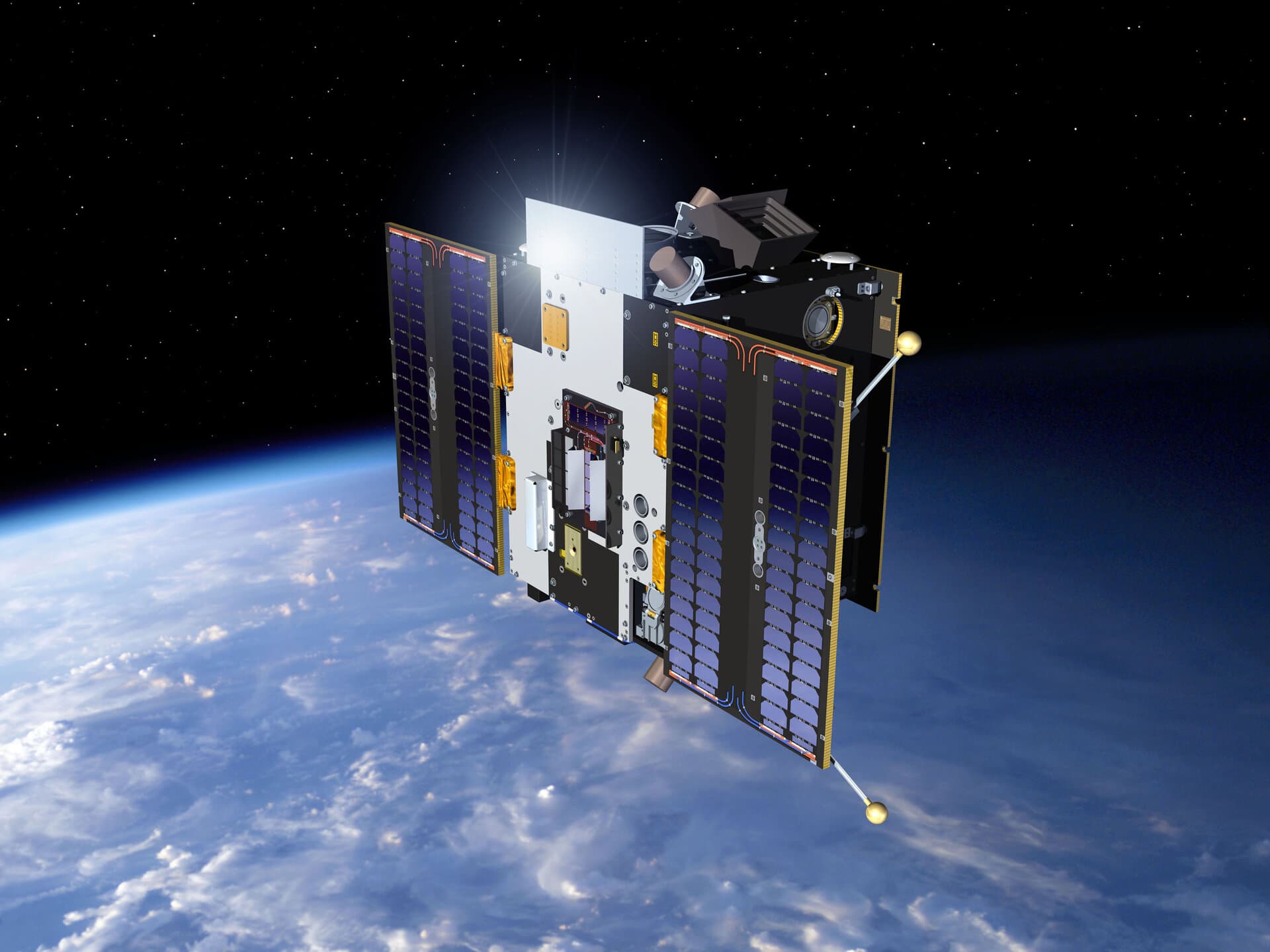
BRITE-Constellation recorded eclipses in a near-dawn-dusk mission. ESA's Proba-2 operates near 725 km and LTAN 06:00, remains eclipse-free for more than nine months of the year, yet still sees winter eclipses approaching 20 minutes per orbit. These cases do not prove that every dawn-dusk mission has a 20-minute eclipse. They prove that a nominal 06:00/18:00 label cannot replace propagation of the actual beta angle and shadow geometry.
Engineering myth to retire: "Dawn-dusk needs no battery" is false. Capacity must cover the worst eclipse, attitude-control peaks, payload transients, loss-of-lock recovery and safe-mode duration. No fixed 15-20% allowance applies to every mission.
Thermal geometry is more stable, but attitude still determines heat rejection. Dawn-dusk keeps the Sun, Earth and deep-space directions in a more stable relationship, making it easier to maintain a radiator view to cold space. Orbit supplies geometric stability, not an automatically cold surface. Performance still depends on attitude, view factors, Earth infrared flux of roughly 250 W/m², albedo and radiator area.
Reduced thermal cycling is a hidden component-life benefit. In ordinary LEO, a spacecraft may heat in sunlight and cool in eclipse 14-16 times per day. Repeated expansion and contraction accumulates fatigue in packages, solder joints and interconnects. A near-eclipse-free dawn-dusk orbit can move the dominant cycle from every revolution to seasonal changes, attitude manoeuvres and workload switching. The reduction is mission-specific and should not be collapsed into a universal "90%." For compute, the benefit is not only energy but a more stable thermal boundary.
2.6 Other Special Orbits
III. Six Orbital Elements and Four Underestimated Constraints
3.1 The Six Classical Orbital Elements
An orbit is precisely described by six Keplerian elements:
Professional detail: popular explanations often use true anomaly
νas the sixth element. Operational constellation work and two-line element sets store mean anomaly M. True anomaly is an instantaneous geometric angle that evolves non-linearly; mean anomaly advances linearly in time and is the quantity recorded on line two of a TLE.
The maximum latitude reached by a satellite's sub-satellite point, or ground track, is approximately its inclination. Communications coverage may extend farther because of altitude and the minimum-elevation requirement, but link quality degrades. A 53° Starlink shell therefore keeps its ground track within ±53°, while beams may reach somewhat higher latitudes with different elevation, capacity and licensing conditions.
3.2 Four Underestimated Constraints: Radiation, Debris Lifetime, Downlink and Regulation
Constraint one: radiation changes sharply with altitude and inclination.
- South Atlantic Anomaly: the inner Van Allen belt descends over the South Atlantic. High-inclination LEO spacecraft may cross enhanced proton flux several times per day.
- Van Allen belts: the proton-dominated inner belt, roughly 1,000-6,000 km, overlaps the proposed 1,200-2,000 km "continuous training" region.
- Solar particle events: energetic particles threaten missions at every altitude.
- Cumulative effects: total ionising dose degrades performance over time; single-event upsets cause transient logic errors.
Moving a compute satellite from 550 km to 1,500 km to improve high-illumination orbit options also moves it into a harsher radiation regime. A processor qualified for one LEO dose case cannot be assumed reliable for a multi-year mission at 1,200-2,000 km. Orbit, shielding, duration and device-level failure modes must be modelled again.
Constraint two: debris lifetime and disposal responsibility.
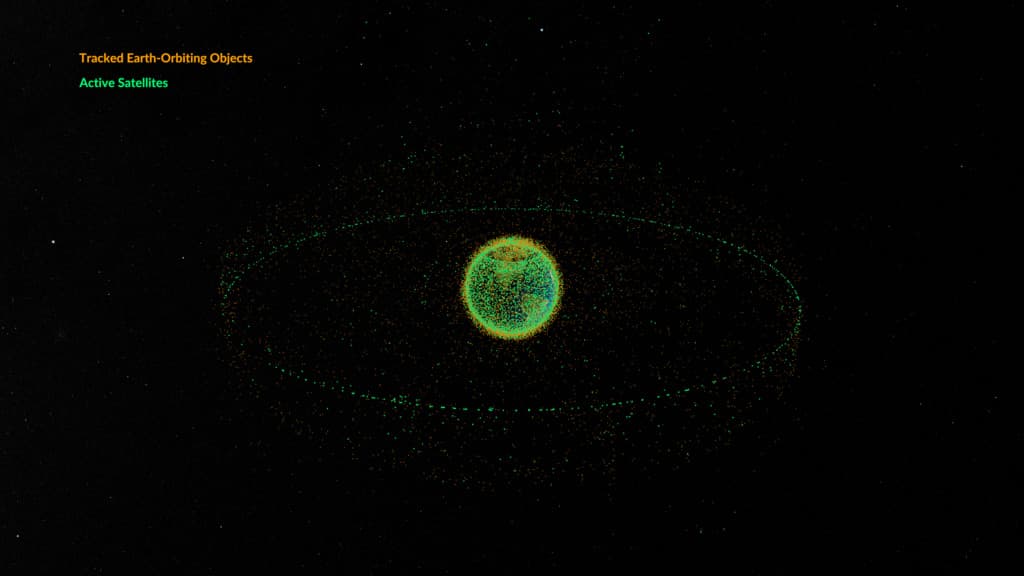
Objects at 700-800 km and 1,200-2,000 km remain far longer than those at 400-500 km. For a large compute constellation, that means collision exposure grows with population and residence time; disposal obligations become more demanding; and insurance and regulatory costs rise. IADC guidance has long used a 25-year benchmark, while the US FCC applies a five-year post-mission disposal rule to relevant LEO spacecraft under its jurisdiction.
Lower altitude requires more propulsion for maintenance, but it also offers faster natural decay and a smaller long-term debris burden. "Longer life is always better" misses this reverse trade.
Constraint three: downlink availability may bind before power.
Space compute must return results. Inter-satellite bandwidth is not service bandwidth. Optical downlinks face cloud, turbulence, site visibility and acquisition-and-tracking limits. A link's peak bit rate is not deliverable throughput: useful capacity depends on the number and weather correlation of ground stations, handovers, RF backup and the target service availability.
This distinction shapes suitable workloads:
- Suitable: in-orbit preprocessing of remote-sensing data, autonomous decisions and aggregation of space-originated data.
- Poor fit: large-scale training that depends on continuous ground interaction, and real-time inference whose users require millisecond response.
For scale, a task producing a 1 GB checkpoint or gradient summary every five minutes needs about eight seconds of raw transmission at 1 Gbps, or 0.8 seconds at 10 Gbps. The harder problem is whether a link is available at that moment, has completed acquisition and tracking, and how many jobs share a few useful minutes per orbit. Training that closes every iteration through the ground becomes availability- and scheduling-bound; autonomous runs that return sparse checkpoints can amortise the link. Peak bandwidth is not schedulable throughput.
Constraint four: orbital footprint is not permission to serve.
A high-inclination spacecraft passes over more countries, but outer-space overflight, radio transmission, service to local users and construction of an in-country gateway are different legal questions. Inclination expands the set of spectrum and market-access regimes; it does not grant automatic service rights. Maritime, aviation and cross-border compute services therefore need geographic beam, terminal and frequency controls, plus compliant switching between jurisdictions.
IV. Constellation Design: From One Satellite to Walker-Delta and Multiple Shells
4.1 Walker-Delta Geometry
Modern large constellations such as Starlink, OneWeb and Amazon Leo, formerly Project Kuiper, use Walker-Delta patterns, the systematic geometry developed by J. G. Walker.
Notation: i : T / P / F
i= inclinationT= total satellitesP= orbital planesF= phasing factor,0 ≤ F ≤ P−1
The phase offset between corresponding satellites in adjacent planes is ΔΦ = 360° × F / T.
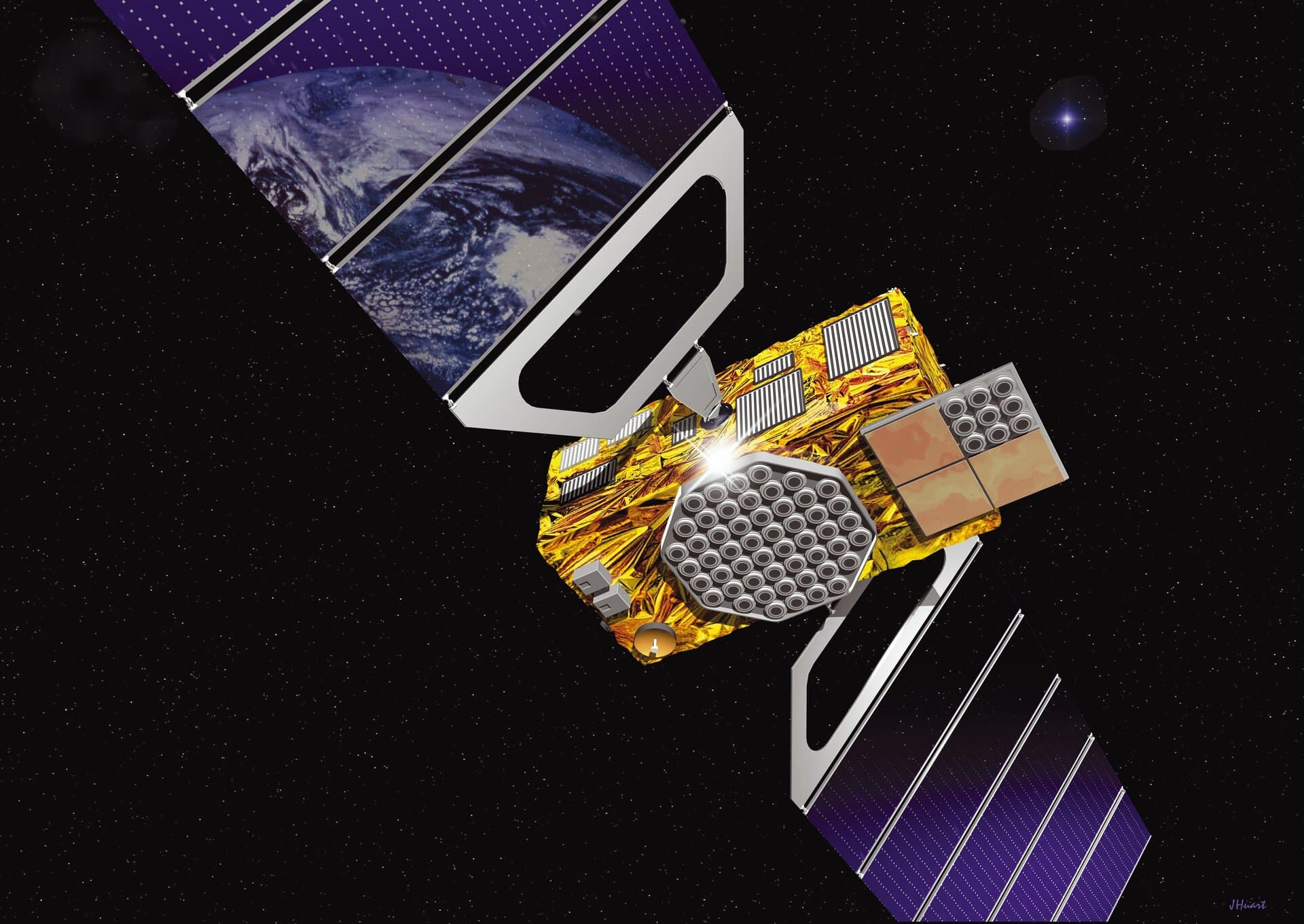
For Starlink Gen1 Shell 1, the shorthand is 53° : 1584 / 72 / F: 72 planes, 22 satellites per plane, and a RAAN spacing of 5°. Published TLE fits do not all yield the same exact F, so this brief retains the defensible conclusion that satellites are phased between planes rather than anchoring an uncertain value.
4.2 Multi-Shell Architecture
Starlink overlays several Walker-Delta sub-constellations at different altitudes and inclinations:
TLE analysis in 2025-2026 shows active testing and deployment near 480-490 km. Public-catalogue entries around 350-355 km must be separated from durable operating shells: drag is severe there, and such records may represent injection, testing, special missions or pre-raise states. Lower altitude improves latency, link budget and natural decay, while increasing propulsion use and replacement pressure.
4.3 Perturbations and Maintenance: The Hidden Operating Cost
Real orbits are never ideal Keplerian paths:
Collision avoidance is a core operating function, not a peripheral task. Large LEO constellations screen close approaches continuously and manoeuvre above risk thresholds. Every manoeuvre consumes propulsion and may interrupt attitude, links or compute schedules.
Station-keeping, conjunction avoidance, formation control and final disposal all draw from the same propulsion-life budget. A node may have a healthy processor yet still end its mission because propulsion fails or reserves become insufficient. Large heat-rejection surfaces further increase solar-pressure and drag cross-section, converting the radiator-area problem into fuel and lifetime costs.
V. Turning Orbital Knowledge into Mission Choice
The table below deliberately avoids an apparently precise $/TFLOPS-day. Until launch price, payload utilisation, thermal-system mass, lifetime, insurance and ground-network performance stabilise, a single number creates false precision. The first step is to identify the dominant cost and risk.
The decision logic has three layers:
- Start with latency. Millisecond interaction requires low LEO and acceptance of poorer illumination. Batch work can exploit dawn-dusk energy geometry.
- Then examine power density. As per-satellite power rises, continuous power and heat rejection dominate. Low-power payloads can often use batteries in ordinary SSO.
- Finally trace the data path. If the data starts in space, in-orbit processing saves downlink and orbit follows the source. If large volumes must return to Earth, ground windows and weather may outweigh the energy advantage.
VI. How Companies Encode Strategy in Orbit
Each profile separates orbital facts or reasonable inference, design philosophy, mission fit and principal uncertainty.
6.1 SpaceX Starlink: Maximise Coverage
Orbit: multi-shell LEO at roughly 475-570 km and inclinations of 53°, 70° and 97.6°.
Design philosophy: maximise coverage and minimise latency. Most people live within ±60° latitude, so 53° shells serve the core market; real-time applications favour 500-570 km; polar service requires 97.6° shells; and Falcon 9/Starship launch capacity shapes satellite size and batch count. Multiple shells match capacity to latitude instead of forcing one geometry across the globe.
6.2 SpaceX Orbital Data Centres: A Very Large Multi-Shell Filing
Fact Status: on February 4, 2026, the FCC accepted SpaceX's Orbital Data Center application for filing under SAT-LOA-20260108-00016. The public notice describes an upper bound of one million spacecraft, altitudes of 500-2,000 km, 30° and sun-synchronous inclinations, shells no more than 50 km thick and optical inter-satellite links. This is a pending application, not an authorisation or deployment commitment. A previously reported "three-layer functional architecture" is not an FCC classification.
Including low inclination, SSO and several altitude bands preserves options for both low-latency capacity and high-illumination compute. Section 2.4 shows that SSO at 1,200-2,000 km is geometrically possible in a first-order J2 model. Geometry alone does not prove feasibility in radiation, cooling, collision risk, spectrum or unit economics.
SpaceX's May 20, 2026 S-1 says deployment of orbital AI compute satellites could begin as early as 2028, while also disclosing that the infrastructure is unproven, difficult to access or maintain and exposed to radiation, thermal cycling, debris, permitting and large-scale operating risk. Standard securities risk language is not a corporate rejection of the programme; neither does it turn the one-million-satellite ceiling into an executable near-term baseline.
At that scale, every per-satellite issue grows by six orders of magnitude. If each spacecraft rejected only 100 kW at an ideal 350 K, it would need about 130 m² of radiating area, or roughly 130 km² across one million spacecraft before arrays, view factors, redundancy or spacing. Regulatory acceptance is not engineering execution, and an application ceiling is not a deployment plan.
6.3 Starcloud: Minimum Viable Orbit, Maximum Technical Validation
Orbit, inferred from public information: approximately 550-600 km SSO at 97-98°, reached by rideshare in single or small batches.
Starcloud-1 is intended to test whether an H100 can operate in space, not to provide an optimised commercial service. Transporter rideshare reduces launch cost, and SSO gives a single demonstrator sufficient illumination. Starcloud-2's exact orbit, LTAN, power and radiator area remain unverified. Public emphasis on a large deployable radiator shows that the company recognises the area constraint; it does not establish that the deployment or thermal performance has been achieved in orbit.
6.4 Loft Orbital: Orbital Pragmatism in the Rideshare Era
Orbit: FCC records place the YAM fleet in 425-570 km SSO at 97.1-97.7°. YAM-9, carrying a Hub Compute demonstration, entered SSO on Transporter-15 in November 2025.
Loft does not own a launch vehicle; it buys available rideshare capacity. Its business is partly launch-capacity arbitrage: procure Transporter slots in bulk, standardise the Hub interface, and sell software customers a predictable deployment experience while absorbing orbital variability.
SSOs at different altitudes and inclinations do not naturally retain fixed relative geometry because their nodal precession rates differ. Loft can control some dispersion through mission design and propulsion, but its first product is a set of independently hosted nodes rather than a tightly formed compute constellation.
6.5 Kepler Communications: Optical Relay First
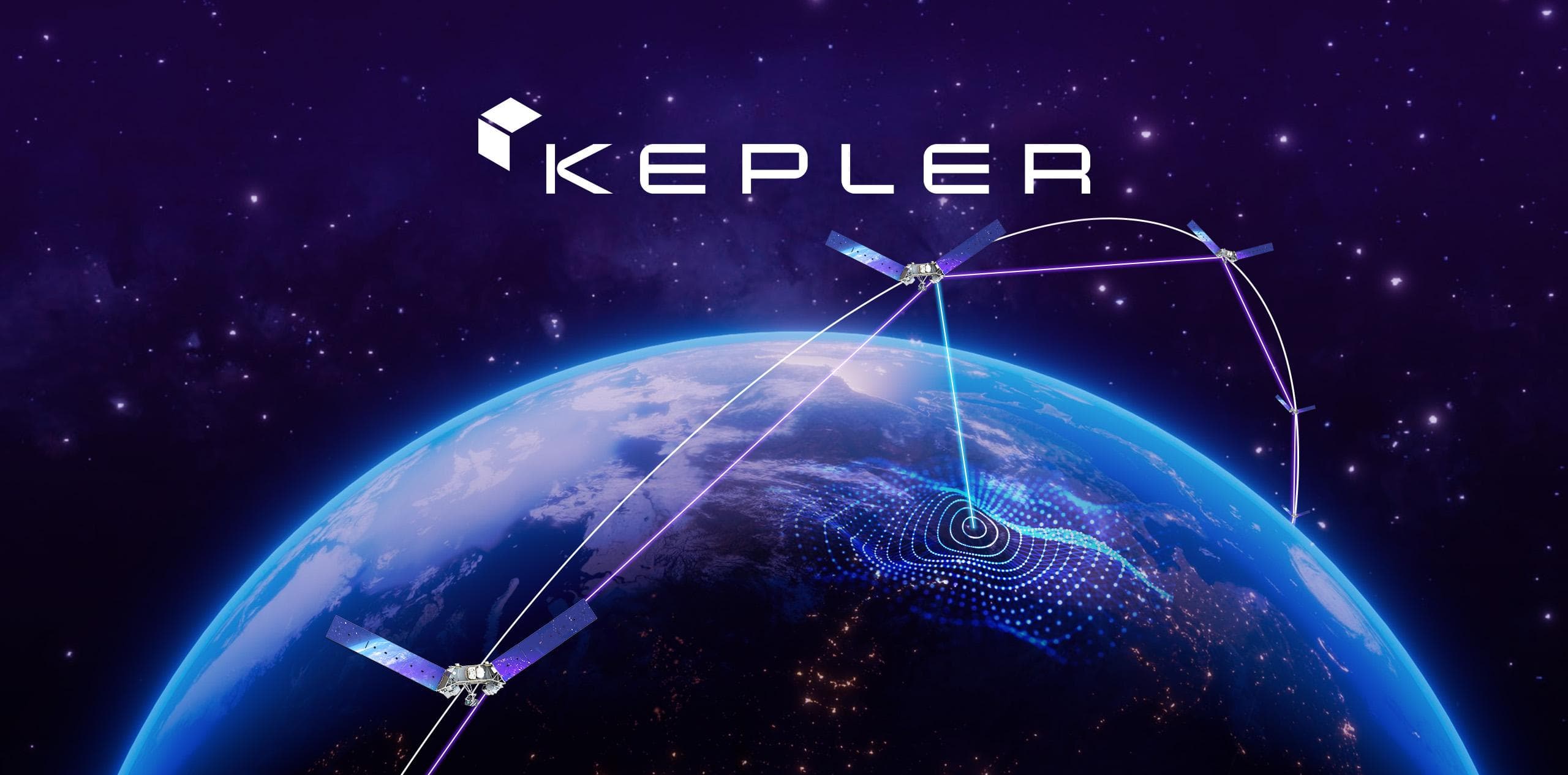
Fact Status: Kepler's first optical-relay satellites launched on SpaceX's "Twilight" rideshare in January 2026. Twilight is the mission name; it does not prove a dawn-dusk orbit. Confirmation requires TLEs or disclosed LTAN.
Kepler says Tranche 1 comprises ten spacecraft near 570 km SSO, with the first plane at about 22:00 LTAN rather than 06:00/18:00. Its March 2026 compute announcement reports 42 NVIDIA Jetson Orin NX modules across the tranche, linked into distributed edge infrastructure.
The network is the primary asset; compute attaches to the optical relay layer. One ten-satellite plane cannot guarantee continuous visibility to every LEO client. Full coverage depends on later planes, customer-orbit matching, link scheduling and ground infrastructure. Treating either the Twilight launch name or 22:00 LTAN as a dawn-dusk architecture would overstate the evidence.
Future planes must control altitude, inclination and precession to retain their intended relative geometry. Being "in SSO" does not by itself stabilise a formation.
6.6 Orbital Dawn (轨道辰光): A Gigawatt Dawn-Dusk Ambition
Orbit: a company-planned 700-800 km dawn-dusk SSO at roughly 98.2-98.6°, with near-continuous sunlight and eclipse margin.
The altitude reduces drag and station-keeping relative to about 500 km while enabling dawn-dusk lighting. It also creates longer debris residence, stronger disposal requirements and a different radiation environment. Public material does not establish that "700-800 km is emptier" or that lower SSO is hard to maintain as the company's primary rationale, so neither is treated here as fact.
The company describes a two-phase fluid loop using HFO-1234ze. Evaporation at the heat source and condensation at the radiator can transport high heat flux, but this is not the only path above 100 kW: loop heat pipes, pumped two-phase systems and modular heat-pipe arrays retain different trade-offs.
Key failure modes include micro-leakage, pump or valve failure, unstable phase distribution, freeze/start transients and MMOD damage. Redundant lines, isolation valves, leak detection, segmented loops and shielding improve resilience at the cost of mass, complexity and parasitic power. A deployable radiator does not imply the absence of fluid transport. The real choice is not "liquid cooling versus radiation," but how to move heat reliably from the chip to a radiator of sufficient area.
The disclosed road map targets 200 kW in 2025-2027, in-orbit assembly and expansion in 2028-2030, and gigawatt scale in 2031-2035. The first validation spacecraft entered orbital testing in January 2026. Until telemetry, thermal balance, sustained load and service availability are public, it is a technology demonstrator rather than proven commercial capacity.
6.7 Guoxing Aerospace: Mixed Remote Sensing and Compute
Fact Status: detailed orbital parameters for the proposed roughly 2,800-satellite Star-Compute programme are not public. The following inference uses TLEs for the launched Three-Body Computing Constellation and carries medium confidence.
The likely architecture is a mixed remote-sensing and compute mission in 500-600 km SSO near 97-98°. SSO serves imaging through repeatable local time, but a non-dawn-dusk geometry usually includes substantial eclipse and therefore needs batteries sized to payload power. It is an imaging-first design in which compute continuity is secondary.
VII. How Orbit Determines Orbital-Compute Economics
7.1 Energy Economics
For a representative 700 W accelerator, ten chips draw roughly 7 kW before the rest of the spacecraft. Bridging a 35-minute eclipse requires about 4.1 kWh for the chips alone. Conversion losses, bus and communications loads, depth of discharge, life margin and safe mode add mass. Dawn-dusk can reduce that burden, but the reduction must come from the mission power curve and worst eclipse rather than a fixed percentage. Sunlight fraction is also not compute utilisation: thermal limits, links, radiation events, maintenance and scheduling still intervene.
7.2 Heat-Rejection Economics: Correcting the Numbers
Space is vacuum. Conduction, heat pipes and fluid loops can move heat inside a spacecraft, but final rejection to the environment is radiative:
$$P = \varepsilon \sigma A (T_{sat}^4 - T_{space}^4)$$
Here σ = 5.67×10⁻⁸ W/(m²·K⁴), T_space ≈ 3 K, and ε=0.9 represents a high-emissivity surface.
Correction: an earlier draft stated that a 20°C radiator could reject about 838 W/m². That is wrong. At 20°C and ε=0.9 the value is about 376 W/m². More than 800 W/m² requires roughly 75-85°C, depending on emissivity.
An ideal blackbody at 20°C emits 418 W/m²; ε=0.9 gives 376 W/m². Area here means effective radiating surface. If both sides can maintain a cold-space view they may each count, but projected area, mass and view factors cannot be counted twice. These are unobstructed, zero-external-flux upper bounds toward 3 K. A real thermal balance must include Earth and deep-space view factors, absorptivity, direct Sun, Earth infrared, albedo, coating degradation, transport temperature drop and redundancy.
Starcloud has discussed a multi-gigawatt vision and kilometre-scale structures. At 350 K, 5 GW of waste heat alone requires about 6.5 km² of ideal radiating area, equivalent to a square roughly 2.55 km on a side. Arrays, unusable backsides, spacing, structure and engineering margin make the deployed system larger. Company concept-art dimensions and this brief's pure effective radiating area are different quantities.
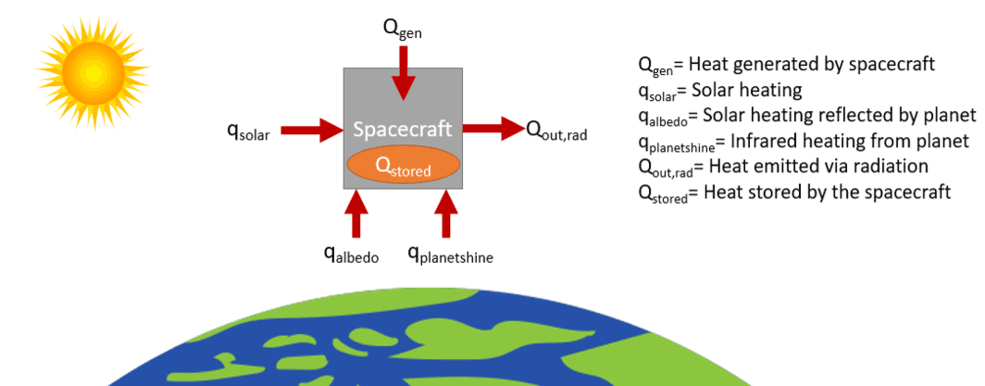
Radiator area, not process node, is the fundamental scaling constraint for orbital compute. Above roughly 100 kW, the critical question is no longer only which chip flies, but whether the spacecraft can deploy, orient and maintain enough radiating area over its life.
7.3 Launch and Full-Lifecycle Cost
Different altitudes cannot be converted into a universal "+5%" or "+30%" launch premium. Payload loss depends on launch-site latitude, target inclination, upper stage, rideshare destination, plane change, recovery mode and mission profile.
Dawn-dusk may exchange higher injection cost for smaller batteries, a steadier thermal environment and longer useful operation. Lower LEO may exchange replenishment for latency and faster natural disposal. The correct metric is not launch price alone but lifecycle cost per usable compute hour, with payload utilisation and downlink availability in the denominator.
VIII. What Would Change This Assessment
IX. Conclusion: Orbit Is Architecture, but No Orbit Does Everything
Orbit design is the most underestimated decision in space computing, and one of the earliest that must be answered. A poor orbit defeats even an excellent chip or model.
Three counterintuitive conclusions follow.
First, putting compute in space is a launch problem and a thermodynamic-area problem. At 100 kW, success depends on reliably deploying radiators measured in hundreds of square metres; at gigawatt scale, in square kilometres. Schedule forecasts systematically understate this constraint.
Second, regulatory exposure is partly designed through inclination. High-inclination, near-polar and SSO systems touch more jurisdictions through their footprints, increasing spectrum, market-access, gateway and data-compliance complexity. Outer-space overflight does not itself equal local service. A compute constellation seeking neutrality must put inclination, beam geofencing and capital/data governance on one architecture diagram.
Third, orbital compute has no zero marginal cost. Terrestrial cloud amortises cost through scale, virtualisation, repairability and continuously supplied data centres. Space compute settles every token against downlink windows, battery cycles, thermal allowance, propulsion life and fixed pass times.
Dawn-dusk SSO is emerging as an important candidate where continuous power and thermal stability outrank low latency, equatorial capacity and flexible contact times. SpaceX preserves SSO options, Kepler uses a non-dawn-dusk SSO, and Orbital Dawn describes dawn-dusk SSO. The industry is exploiting sun-synchronous geometry without converging on one orbit.
For any organisation planning to deploy compute in space, orbit design should be the first question, not the last. Over the next decade, orbital design may become as central to a space-compute company as chip architecture is to terrestrial AI.
Appendix A: Key Formulae
A.1 Sun-synchronous condition
For a circular orbit with J2 only:
$$\dot{\Omega} = -\frac{3}{2} J_2 , n \left(\frac{R_E}{a}\right)^2 \cos i, \quad n = \sqrt{\frac{\mu}{a^3}}$$
Set Ω̇ to the Sun's mean apparent motion, 0.9856° per day or 1.991×10⁻⁷ rad/s, and solve for inclination. Constants are J₂=1.08263×10⁻³, R_E=6,378.137 km and μ=3.986×10¹⁴ m³/s². The circular, first-order J2 model reaches its mathematical limit near 5,974 km as i→180°; this is not a universal engineering altitude limit.
A.2 Radiative heat rejection
$$P = \varepsilon \sigma A (T_{sat}^4 - T_{space}^4)$$
With σ=5.67×10⁻⁸ W/(m²·K⁴), T_space≈3 K, ε=0.9 and T=293 K, P/A≈376 W/m².
A.3 Eclipse criterion
Define beta as the angle between the Sun vector and the orbital plane:
$$\sin\beta = \hat{\mathbf{n}}{orbit}\cdot\hat{\mathbf{s}}{sun}$$
In the cylindrical-shadow approximation, no eclipse occurs when |β| > β*, where:
$$\beta^* = \arcsin\left(\frac{R_E}{R_E + h}\right)$$
At 700 km, β*≈64.3°. In an idealised i≈98.2°, LTAN≈06:00 dawn-dusk SSO, neglecting the distinction between mean and apparent solar time, annual |β| is not simply 66.5-90°; it can be roughly 58-82°. One solstice region may therefore cross the eclipse threshold. Precise eclipse seasons require mission epoch, solar ephemeris, propagated orbital elements and a shadow model.
A.4 Latency definitions
- One-way propagation = end-to-end geometric path divided by
c. - RTT = twice the one-way propagation plus bidirectional processing and queueing.
- Near zenith in LEO, terminal↔satellite propagation RTT is about
2h/c; ground A→satellite→ground B and return is about4h/c. - GEO ground A→satellite→ground B has a minimum one-way propagation near 240 ms and a minimum RTT near 480 ms.
- User-network RTT adds routing, queueing and ground backhaul.
Appendix B: Evidence Confidence
Confirmed, Grade A, from official, academic or TLE evidence: SSO/J2 mechanics; orbital decay and disposal rules; BRITE and Proba-2 eclipse records; the SpaceX ODC filing; and Kepler Tranche 1 orbit and compute configuration. Beta-angle, illumination and radiative-transfer values were independently recalculated from public equations and cross-checked against mission material.
Media or company reporting, Grade B: Starcloud orbit and radiator plans; Orbital Dawn's two-phase working fluid, power and staged road map. These claims still require orbital telemetry, formal technical documentation or audited operating data.
Author inference, labelled in the text: likely functions of SpaceX altitude shells; Guoxing's Star-Compute orbit; company design philosophies; and the scaling implication of radiator area.
Appendix C: Terms and Abbreviations
This technical brief uses public information available through June 2026. Engineering figures state their calculation basis; company orbital parameters distinguish confirmed facts, media reporting and author inference. The analysis represents the author's independent view and is not investment or engineering-design advice.
Sources16 entries with source notes and links
Orbital lifetime, ballistic coefficient, solar activity and natural decay.
- FCC Second Report and Order, FCC 22-74(docs.fcc.gov)
Five-year post-mission disposal benchmark for relevant LEO spacecraft under FCC rules.
- BRITE-Constellation mission operations paper(arxiv.org)
Eclipse seasons and operations in near-dawn-dusk orbit.
- ESA — Proba-2 Spacecraft(esa.int)
Orbit, LTAN, battery and eclipse data.
- FCC Public Notice DA 26-113(docs.fcc.gov)
Public regulatory record for SpaceX's orbital-data-centre application.
- SpaceX Form S-1, filed May 20, 2026(sec.gov)
Company disclosures and risk factors.
- Kepler — First Tranche of Optical Relay Satellites(kepler.space)
First ten optical-relay spacecraft.
- Kepler and TESAT orbital-plane disclosure(kepler.space)
Orbital plane and LTAN.
- Kepler — First Space-Based Scalable Cloud Infrastructure(kepler.space)
Jetson Orin NX deployment.
Preprint proposing a roughly 1,600 km DDSS architecture.
Sun-synchronous orbit diagram.
Cover image.
Proba-2 rendering.
- NASA — Thermal Control(nasa.gov)
Spacecraft thermal balance and control systems.
- NASA Scientific Visualization Studio — Trackable Objects in Earth Orbit(svs.gsfc.nasa.gov)
2024 visualisation of trackable orbital objects.
- ESA — Galileo satellites(esa.int)
Galileo Walker geometry and constellation configuration.
Continue reading
2 Jul 2026 · 57 min read
Spectrum Is the Balance Sheet: Constellations Depreciate, Rights Stacks Compound — and Orbital Compute Is Building the Exit from the RF Regime
The scarce asset in LEO is not the satellite but the coordinated rights stack—and optical orbital compute is building the first credible exit from the radio-frequency regime.

12 Jul 2026 · 98 min read
The Third Pole in Orbit: OneWeb's Soul, DayOne's Method
A Singapore-founded Indo-Pacific orbital-compute venture is buildable only as a phased, demand-anchored operating company whose multi-sovereign capital cannot control it.
20 May 2026 · 38 min read
China's Orbital Compute Reality Check: Who Is Actually in Orbit?
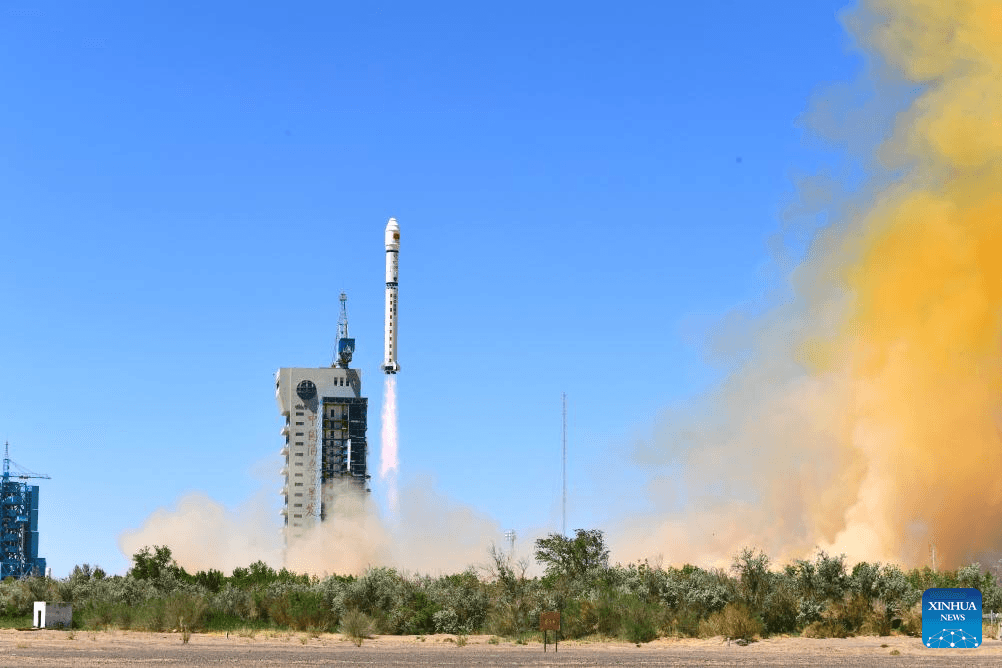
China's orbital-compute programs now include real in-orbit validation, but public evidence still separates credible engineering paths from constellation-scale claims.