
The Third Pole in Orbit: OneWeb's Soul, DayOne's Method
A Singapore-founded Indo-Pacific orbital-compute venture is buildable only as a phased, demand-anchored operating company whose multi-sovereign capital cannot control it.
Method & disclosure
Confidence: High for cited filings and official institutional facts; medium to low for the explicitly labelled venture design, cost model, market scenarios and probability judgments.
Review mode: Human + AI cross-check
Writing support: AI assisted
Singapore Space Agency
On this page · 12
- 011. The 90-Second Summary
- 022. The Strategic Gap: A Two-Horse Race With No Indo-Pacific Lane
- 033. The OneWeb Autopsy: What Multi-Sovereign Capital Bought, and What It Cost
- 044. The DayOne Inversion: Multi-Sovereign Money Without Multi-Sovereign Control
- 055. The Regional Resource Map: Who Contributes What, Priced
- 066. The Physics-and-Economics Reality Check: Does the Business Close in 2026?
- 077. The Business Plan
- 088. The Risk Register
- 099. The IRIS² Objection
- 1010. Conditions for a Viable Company
- 1111. What This Means for Singapore Specifically
- 1212. What to Watch — Falsifiable Signals, Dated
Key findings
The argument in brief
- A third orbital-compute pole can sell distributed jurisdictional dependence—no single external great power controls the whole stack—not freedom from law.
- The venture is viable only for power-constrained, jurisdiction-bound and latency-tolerant workloads; ordinary sovereign cloud remains cheaper and easier to service.
- OneWeb supplies the financing lesson and governance warning; DayOne supplies the inversion: multi-sovereign money can sit below control of one operating company.
- The first commercial gate is signed offtake, not satellite production; no sovereign equity enters before demand survives a terrestrial-alternative benchmark.
Orbital compute in mid-2026 has two credible poles: SpaceX's vertically integrated stack and China's state mobilisation. Both can sell capacity and technical isolation. Each still answers to one home state. A third pole has a narrower product: an orbital stack that no single external great power can shut down by itself. This design study tests whether a Singapore-headquartered operator could sell that product to Indo-Pacific governments, using capped non-controlling sovereign capital and competitive procurement across India, Japan, Korea and Taiwan. The model is buildable only in phases and only after customers sign. We estimate a 30–50% chance of reaching Phase 1 revenue under the stated gates. The decisive risk is sovereign offtake, not thermal physics: governments must buy a premium service before launch economics improve.
This report builds on, and should be read with, our earlier work: From DayOne to Orbital Compute (the trust-architecture framework), AI1 and SpaceX's $1.77 Trillion IPO and China's Orbital-Compute Mobilisation (the two poles), Orbit Is Architecture (the physics layer), and Spectrum Is the Balance Sheet (the rights layer).
Open the interactive 17-slide venture blueprint deck — demand test, governance, regional work-share, unit economics, cap table, risk gates and falsifiable timeline.
Disclaimer: This is an independent analytical design study, not a company announcement, an investment solicitation, a fundraising document, or advice. The Singapore Space Agency research platform is not building, brokering, or representing any venture described here, and is not affiliated with any government. Named companies, funds, and agencies appear as archetypes and analytical references only; nothing here implies their participation, interest, or endorsement. Where we model costs, market sizes, or cap tables, the numbers are ranges with stated assumptions, not offers or forecasts.
Method and evidence ladder: Every load-bearing figure is labelled on a five-step ladder — verified fact (filings, official documents, regulator records), company claim (stated but not independently confirmed), modeled estimate (our arithmetic from stated inputs), author inference, or scenario assumption. Launch prices, satellite costs, and market sizes are ranges. The build tables in Sections 5–7 publish the inputs so any reader can re-price the model.
1. The 90-Second Summary
The gap. SpaceX listed at $1.77 trillion in June 2026 with AI1, a 70-metre compute satellite and a claimed 1 GW annual deployment ramp.^[1] China answered with a defence-industrial feasibility study, a CAICT-convened industry committee and layered state capital.^[2] Either system can provide dedicated tenancy, encryption and customer-held keys. Neither removes home-state control. A US constellation remains subject to US law and export controls; a Chinese constellation is unacceptable to much of the region's capital and security establishment. The third product is distributed jurisdictional dependence: Singapore law, launch-state rules, chip-origin controls, ground-station jurisdictions and customer law all still apply, but no single external great power controls the full stack.
OneWeb supplies the precedent and the warning. Multi-sovereign capital financed a constellation no single market would fund, secured first-round spectrum priority, opened sovereign markets and survived bankruptcy. The same ownership structure produced mutual vetoes, slow decisions and weak cost discipline. By mid-2026 Eutelsat-OneWeb traded around €2.5, had cut capex, and was waiting for IRIS². Brussels added a 66-satellite early tranche to protect a 2029 initial service date while full capacity slipped to roughly 2032.^[3]^[66]
DayOne supplies the governance model: one operating company with real assets and customers, financed by sensitive-jurisdiction capital without granting it control.^[4] Applied here, sovereign investors become capped, non-controlling limited partners and anchor customers. Suppliers in India, Japan, Korea and Taiwan compete for priced work packages instead of board seats. Singapore provides the legal, trust and capital layer. Capital can be multinational; operating control cannot.
The unit economics force a premium sovereignty product. Section 6 puts non-SpaceX orbital compute at roughly 5–11× terrestrial cost per kW-year in 2026, 2.5–6× in 2028 and 1.1–2.4× by 2030 under a reusable-launch scenario. Phase 0 (2026–27) uses hosted payloads, optical ground stations and paid sovereign pilots. Phase 1 (2028–29) deploys 27–36 satellites in dawn-dusk SSO, delivering about 0.35–0.9 MW of usable accelerator power to fixed gateways with asynchronous, bounded latency. It does not promise continuous low-latitude coverage; that would require more than 500 satellites, and Phase 1 has only intra-plane optical links. Phase 2 (2029–32) reaches about 180 satellites and 5–8 MW only after launch falls below roughly $1,500/kg and signed annual offtake exceeds roughly $150 million.
We assign a 30–50% chance that a competently executed version reaches Phase 1 revenue; Section 10 shows the gates and correlations behind that structured judgment. A copycat bulk-compute fleet or a committee-run multilateral programme has little chance of closing. The order of operations is fixed: offtake before constellation, procurement competition before capacity, and governance locks before sovereign money. Silicon access remains exposed to US export policy throughout.
2. The Strategic Gap: A Two-Horse Race With No Indo-Pacific Lane
2.1 Where the two poles actually stand, July 2026
The two incumbent poles start from very different positions.
The US pole is real, listed, and unproven. SpaceX began trading on June 12, 2026 at a $1.77 trillion offering valuation, three days after unveiling AI1 — 150 kW peak compute per satellite, 110 m² of deployable radiators, roughly one GB300-rack-equivalent per spacecraft, two prototypes claimed for early 2027 and ~1 GW/yr claimed by late 2027.^[1]^[5] Its FCC application reserves up to one million satellites at 500–2,000 km.^[7] The same S-1 that carries the dream states orbital AI compute "may not achieve commercial viability."^[5] Around SpaceX, the merchant-silicon ecosystem moved faster than most expected: Starcloud flew an Nvidia H100 in November 2025, trained a small model in orbit in December, raised a $170 million Series A at a $1.1 billion valuation in March 2026, and targets an October 2026 Starcloud-2 with H100s, a Blackwell B200, and the largest commercial deployable radiator attempted in its class.^[8]^[9]^[10]^[11] Google's Project Suncatcher remains the field's most rigorous public systems argument — Trillium TPU radiation data, a 1.6 Tbps laboratory optical link, two prototype satellites with Planet targeted for early 2027, and an internal finding that launch must fall toward $200/kg before orbital energy economics compete.^[12]^[62]
The China pole is mobilised, and behind on unit economics. In Q2 2026 orbital compute entered Chinese state industrial planning: SASTIND opened a feasibility study for a space-based intelligent computing constellation in early April (announced April 5); the CAICT-convened Space Computing Power Professional Committee stood up April 3; regional consortia and monthly conferences followed.^[13]^[14]^[2] The verified in-orbit baseline is Zhejiang Lab's Three-Body constellation — 12 satellites, 744 TOPS each, 100 Gbps laser links, an 8-billion-parameter model in orbit — genuinely world-class integration at negligible commercial scale (~5 POPS, a few ground racks' worth).^[15] The operator with the most AI satellites flying disclosed a 7.62% gross margin; no Chinese operator has shown a paying, repeatable workload at scale; and China's launch cost (~$5,000–10,000/kg; no reusable vehicle in service yet, though the July 10, 2026 maiden-flight sea-net recovery of a Long March 10B first stage — re-flight targeted by year-end — has started the clock on that changing^[77]) makes its unit economics harder than SpaceX's even as its deployment is more politically funded.^[16]^[2]
The US pole is a priced option on physics without large-scale flight telemetry. The China pole is an institutional commitment running ahead of its cost curve. Both are national projects with commercial wrappers. This is an author inference based on the two companion teardowns.
2.2 The sovereignty hole neither pole can fill
The demand problem is not compute scarcity in general. It is whose cloud, whose laws — the same question the Indo-Pacific already answers badly on the ground.
- Southeast Asia's AI build-out is real and constrained: Malaysia's data-centre capacity doubles to ~2,055 MW by end-2026, Johor's committed maximum demand has reached ~3.8 GW against a state grid of 2.6 GW, and the government disclosed in February 2026 that approvals for non-AI data centres had been frozen for almost two years on power and water grounds — a constraint older and deeper than commonly assumed.^[17]^[18]^[19]^[70] Singapore rations capacity by design (a ~300 MW green-roadmap tranche plus a 200 MW call in December 2025).^[4]
- Five ASEAN states now run explicit sovereign-AI programmes — Malaysia's ~MYR 2.1 billion sovereign AI cloud budget line, Indonesia's 2026–2029 national AI roadmap and Danantara-managed sovereign AI fund, Vietnam's 2026 AI law with a "national AI infrastructure" mandate.^[20]^[21] (Programme-level details here rest on industry-aggregator sourcing — C-grade, and should be read as directionally correct rather than budget-precise.) These are votes, funded with real money, for the proposition that where compute sits and who controls it is now national policy.
- Meanwhile US export-control gravity keeps tightening around the region: the May 31, 2026 BIS guidance requires licences for advanced chips going to any entity with a Chinese ultimate parent wherever located, after a year of Singapore- and Malaysia-routed diversion cases.^[22]^[23] The region's compute supply is already conditional on Washington; its data increasingly cannot leave home jurisdictions by law.
Now put that demand profile against the two orbital poles. AI1-class capacity will be sold as a US product on US terms — the constellation, the silicon (Nvidia, or SpaceX's reported in-house alternative^[1]), the spectrum, and the kill-switch all sit under one flag and, post-IPO, substantially under one person. China's offer, when it matures, will be a G2G product on Beijing's terms — the Qianfan connectivity playbook extended to compute — structurally unavailable to Gulf funds that co-invest with Washington and to security establishments in Delhi, Seoul, Tokyo, Canberra.^[2] The terrestrial middle path already exists and is called sovereign cloud; DayOne is its purest capital-markets expression.^[4] In orbit, the middle path does not exist. That absence is the venture.
Orbital compute, specifically, is consolidating into a G2 market; broadband still has Kuiper, OneWeb and national programmes. No middle power can out-build either pole alone. Europe proved that pooled sovereign capital can sustain a constellation, and also that mutual vetoes, juste-retour procurement and regulatory maximalism can destroy its tempo. An Asian third pole must keep the pooled capital and reject the committee operating model.
One more structural fact makes the timing unusual: an orbital-compute constellation, unlike a communications constellation, can run its data plane on optical links that sit entirely outside the ITU radio regime — needing RF only for TT&C and gateway fallback. The scarce, decades-deep user-link spectrum moat that would make a new comms entrant hopeless simply does not bind a compute entrant.^[24] The regulatory door for a third pole is open in a way it never was for broadband.
3. The OneWeb Autopsy: What Multi-Sovereign Capital Bought, and What It Cost
The proposed venture's soul is OneWeb's, so the autopsy has to start from results. OneWeb is simultaneously the proof that multi-flag capital can will a constellation into existence and the definitive record of what that capital structure does to a company's metabolism.
3.1 The life, in one table
(Status of each line: verified fact from filings and press releases, except the strategic readings in the right column, which are author inference.)
3.2 What the multi-sovereign structure actually bought
Be fair before being brutal, because the venture we design must keep these four assets:
- Existence. No purely commercial investor base would have funded a Starlink competitor from Europe/India/Japan/Korea. Multi-flag capital did — twice (2015–19 and 2020–21). A third pole in orbital compute faces the same market failure: the pure-VC case does not close (Section 7 shows why), so sovereign-adjacent capital is not a nice-to-have, it is the financing model.
- Spectrum and priority. OneWeb's first-round ITU Ku priority survived bankruptcy intact and remains, per our spectrum analysis, one of only two truly global licensed LEO broadband rights stacks outside Starlink.^[24] Sovereign patience preserved a compounding asset a commercial liquidation would have scattered.
- Market access. Bharti delivered India; the UK share delivered government demand; Hanwha connected Korea; Eutelsat delivered Europe and a GEO distribution base. Flags opened doors that no sales team could.
- Survival through the valley. The 2020 rescue and the 2025 state recapitalisation are the same event repeating: when the business model lagged the build cost, sovereign shareholders paid the bridge toll. Starlink crossed its valley on Falcon 9 cash flow; OneWeb crossed it on state balance sheets. Crossing at all is the point.
3.3 What it cost — the disease, precisely diagnosed
The sceptic's one-line summary of multi-state governance — 各取所长,互相掣肘:take the best of each partner, and watch the partners hobble each other while execution speed loses to the integrated US and Chinese giants — is exactly right, and it deserves mechanism-level analysis, not a shrug.
Mechanism 1 — mutual veto turns strategy into treaty negotiation. Every consequential decision at OneWeb — Gen-2 architecture, merger terms, capex phasing — had to clear shareholders whose objectives were orthogonal by design: SoftBank wanted returns, Bharti wanted Indian market economics, the UK wanted sovereign capability and (for a period) even explored repurposing the constellation for navigation, Eutelsat wanted GEO-decline hedging, France ultimately wanted IRIS² industrial policy. When shareholders hold vetoes, the strategy space collapses to the intersection of their preferences, and the intersection is always "delay." Starlink's strategy space is one man's judgment; the difference in decision latency is not cultural, it is topological.
Mechanism 2 — golden shares reprice everything below them. The UK's golden share was cheap for the UK and expensive for everyone else: every subsequent investor priced in a counterparty who could block exits on non-commercial grounds. Golden shares are how a state buys permanent optionality with someone else's balance sheet. (The design answer in Section 4: none, ever — replaced with narrow, contractual negative controls.)
Mechanism 3 — no cost discipline, because no one's own money. OneWeb's satellites were bought, not made — Airbus JV manufacturing at costs a vertically integrated operator would never accept, and its launch was procured politically as much as commercially (Soyuz until 2022 made it geopolitically hostage; then SpaceX and ISRO's LVM3 in emergency substitution).^[32] When the shareholder base is strategic, the procurement function optimises for shareholder harmony, not $/kg. Sub-scale followed: 654 satellites against Starlink's 10,700+, a fleet whose replacement now needs export-credit guarantees.^[24]^[30]
The latency shows up in datable episodes. Through 2020–21 the UK government publicly explored repurposing OneWeb for positioning-navigation-timing — a shareholder trying to redesign the payload around a national requirement mid-flight, months of engineering attention spent on a mission the company never flew.^[25] Gen-2 architecture decisions slid for years across the SoftBank–Bharti–UK–Eutelsat transitions until the merger subsumed them; the eventual "Gen-2" is 440 Airbus satellites ordered primarily to maintain continuity until a state programme arrives.^[29] Compare the clock speeds: in roughly the time OneWeb's owners negotiated one merger and one recapitalisation, SpaceX designed, filed, unveiled and manifested an entirely new spacecraft class.^[1] That is Mechanism 1 measured in years.
Mechanism 4 — the state that rescues you eventually becomes you. The 2025–26 sequence is decisive: French state to 29.65% and largest shareholder, French export credit financing the fleet, a French multiyear defence contract bridging to IRIS², and OneWeb's Gen-2 ambitions subordinated to a €10.6 billion EU programme (60% publicly funded, Eutelsat committing ~€2B) whose reported System Requirements Review completion came only in January 2026 (a trade-press account, not an ESA primary — flagged as such) and whose schedule now reads: a 66-satellite early-delivery tranche launching from 2029 to hold an initial service date, full 264-satellite capacity around 2032.^[27]^[30]^[33]^[34]^[66] The multi-sovereign company degenerated into a single-sovereign instrument — the worst of both worlds: OneWeb now has Starlink's concentration of control without Starlink's speed, and a committee's speed without a committee's diversification. IRIS² itself is the terminal form of the disease: requirements written by twenty-seven governments, procurement allocated as industrial geography, timeline slipping before the first satellite is built. That is the failure mode this venture's constitution must make impossible.
Mechanism 5 — capital patience is not demand. OneWeb's deepest problem was never governance alone: its sovereign shareholders supplied capital but were slow to become customers at scale. The lesson generalises: a sovereign on the cap table who has not signed an offtake contract is pure governance risk with no revenue attached. The venture design below therefore makes anchor offtake, not board representation — the price of admission for sovereign money.
3.4 The lessons ledger
That ledger is the whole argument of this report in miniature: the soul is the capital and legitimacy; the disease is the control rights. OneWeb bundled them. One boundary on the autopsy, so it is not over-read: governance was not OneWeb's only pathology — terminal economics, the original consumer business model, launch dependence and Starlink's vertical integration all contributed, and fixing governance alone would not have saved that business. The inversion below fixes OneWeb's governance pathology; it does not import or repair OneWeb's broadband economics, which this venture deliberately avoids — different product (compute enclaves, not consumer connectivity), no mass-market terminal problem, government-grade ARPU, an optical data plane outside the spectrum fight. The next section is about unbundling.
4. The DayOne Inversion: Multi-Sovereign Money Without Multi-Sovereign Control
4.1 What DayOne actually proved
Our DayOne analysis established the pattern in the hardest possible test case — China-origin infrastructure seeking Western capital: GDS carved out its international business into a single operating company, deconsolidated it, and then kept diluting. By mid-2026 the Series C had closed at $4.5 billion (Coatue- and Hillhouse-led, with Indonesia Investment Authority among the participants) and GDS's retained stake had fallen to ~19.9% after a January share repurchase and an April $385 million secondary sale — real assets, real customers and real governance in Singapore and the SIJORI region, heading for a dual Singapore–US listing under the new MAS Global Listing Board framework.^[4]^[64]^[65]^[67] Note the direction of every update since our May analysis: further from parent control, with a sovereign LP (INA) added to the register — exactly the trajectory this venture's design assumes is fundable. The theorem it proved: capital whose nationality is a liability can still finance sensitive infrastructure, provided it is structurally severed from control, and Singapore's specific value is being the jurisdiction where that severance is legible, enforceable, and priced by capital markets.
TikTok's forced restructuring (ByteDance to ~19.9%, reported MGX among the new holders) proved the same theorem under coercion; Manus proved its converse — an address change without control restructuring protects nothing.^[4] The pattern is jurisdiction-agnostic. If it can make Chinese parentage investable in data centres, it can make plural sovereign parentage investable in orbit — an easier problem, because no single parent is adversarial to the customer base; the risk being engineered away is not one flag but any flag controlling.
A scope limit. DayOne's proof covers one layer: capital-control separation — that sensitive-origin money can be de-fanged into non-controlling economics that capital markets will price. It does not, by itself, solve security clearance (would a defence ministry accept a foreign-founder-controlled company operating its enclave), export-control classification (a licensed dual-use orbital asset carries obligations a terrestrial data-centre carve-out never faced), or market-access legitimacy (spectrum filings, launch licences, and orbital debris liability all attach to the operating company, not to any LP). Section 4.2's negative-control list and Section 8's export-control architecture exist precisely because DayOne-pattern capital governance is necessary for this venture but not sufficient — it solves who owns the equity, not who is allowed to operate the satellite.
4.2 The inversion, stated formally
OneWeb's architecture: sovereign capital above the company (board, vetoes, golden share), suppliers chosen by the shareholders. DayOne-pattern architecture, applied here:
One commercial operating company (Singapore), controlled by its board and management under a founder-weighted, independence-majority governance design. Sovereign and strategic capital sits below control: capped economic stakes, information rights, offtake priority, and capability-transfer programmes. Nation-state industrial bases sit outside the cap table entirely: they are competing vendors under fixed-price work packages. No golden shares. No procurement direction. No board seats for states.
The decision-rights matrix — the single most important table in this report:
The negative-control list is the necessary concession to sovereignty: sovereign LPs do get vetoes, but only over the four events that would destroy the reason they invested, and nothing operational. This is the precise inverse of the UK golden share, which was broad and unilateral; here it is narrow and collective.
A second, narrower rights layer — what an individual LP gets inside its own enclave. The reserved-matter list is deliberately company-wide and collective (75% of sovereign classes voting together, four events only). Left there, the design would under-serve the thing a real sovereign actually asks for on day one: protection of its own capacity, not influence over the whole company. So a second tier exists, exercised individually and bounded strictly to each LP's own contracted enclave — never aggregating into company-wide control:
Two implementation constraints apply to this tier. First, the continuity step-in cannot be delivered by contract language alone — insolvency law does not respect a bare promise of priority. The workable structures (each a known instrument, none exotic) are: per-enclave service cells held in bankruptcy-remote SPVs, pre-funded continuity escrow, source-code and key escrow, and customer-funded standby operations agreements — all flagged here as subject to legal structuring, a Phase-0 legal-engineering deliverable, not a solved problem. Second, the anti-coalition mandatory-conversion remedy raises real enforceability questions (who adjudicates alignment, at what evidentiary standard, is forced conversion expropriative under any LP's investment treaty) — it should be read as the designed deterrent whose final form emerges from negotiation, likely arbitration-gated (SIAC) with graduated remedies before conversion. Design intent is stated; a signed shareholders' agreement is the proof.
One deliberate softening from the pure model, because full rigidity is a negotiating fiction: non-voting board observer seats (confidentiality- and conflict-walled) are offerable to anchor LPs without breaching the control architecture — what remains non-negotiable is the absence of state-appointed voting directors, procurement direction, and budget/architecture vetoes. And the founder-weighted voting that anchors the whole structure carries its own stated sunset: it steps down at Phase-1 completion or IPO, whichever is earlier, with a misconduct trigger before either — the answer to the fair charge that this design cures committee paralysis by installing a single-person regime of exactly the kind Section 2 criticises at SpaceX. It does install one; the difference is that it is time-boxed, misconduct-gated, and sitting under Singapore fiduciary law rather than a controlling shareholding.
These rights are individually held and non-aggregating by design: exercising a data-boundary veto over one's own enclave cannot be combined with another LP's veto to constrain the company generally. That is precisely what keeps this tier from regrowing OneWeb's disease — every protection a sovereign actually needs is granted; no protection that would let one sovereign block another's service or the company's strategy is granted. This is the answer to the fair objection that "information rights and offtake priority" alone would never satisfy a real ministry of defence or central bank: sovereigns are not getting less, they are getting something narrow, real, and non-transferable.
Hard caps, and what stops them being circumvented. Applied at every round: no single non-founder holder ≥20%; no single state bloc (fund plus affiliates) >20%; aggregate sovereign-linked capital <49%; Chinese state-linked capital 0% (Section 8.5 explains why this is structural, not political posturing); Taiwan participates as supplier and vendor-financier, not equity (Section 5.4). State their legal nature directly: these are shareholders'-agreement covenants and articles-of-association thresholds enforceable in Singapore courts against transfer, not a statutory requirement, and only as strong as the documents that create them. The obvious end-run is a coalition: sovereign LPs voting in alignment to exceed the cap's intent without exceeding its letter — precisely how France became Eutelsat's de facto controller without ever holding 50%. The design closes it with a standstill covenant: no sovereign-linked holder may enter a voting, proxy, or economic-alignment agreement with another sovereign-linked holder outside the single collective reserved-matter vote; an undisclosed coalition triggers mandatory conversion of the offending holdings to non-voting shares. Caps without an anti-coalition clause are caps in name only.
4.3 Why would sovereigns accept this after OneWeb and IRIS²?
The obvious objection: states just watched the UK golden share and French recapitalisation work — OneWeb exists because states took control. Why would PIF, a Japanese strategic fund, or Temasek-archetype capital accept capped, non-controlling positions?
Four reasons, each grounded in observed 2024–26 behaviour:
- What sovereigns actually want has changed. The 2020 UK purchase was about owning an asset. The 2024–26 pattern — PIF building Neo Space Group as a services and investment champion, Mubadala/G42 building Space42 as a listed operating company, Gulf funds taking reported minority positions in TikTok USDS, GIC co-leading Skyroot's ~$60M unicorn round with no board control — is capability access, offtake, and co-investment economics, not management.^[35]^[36]^[4]^[37] Sovereign wealth in 2026 is professionally allergic to operating-control entanglements in politically exposed assets; control is what triggers CFIUS-class review, and non-control is what MGX bought in TikTok.
- They watched control fail. IRIS² — the maximal-control model — is the region's cautionary tale: years late, budget-inflated, and still pre-hardware while Starlink compounds.^[34] OneWeb — the golden-share model — delivered a share price of ~€2.5.^[3] The empirical record now favours the DayOne trade: give up control, get an asset that actually compounds.
- The offtake seat is worth more than the board seat. A board seat gives a sovereign influence over a company; an anchor-offtake contract gives it guaranteed sovereign compute capacity, in its own jurisdictionally ring-fenced enclave, with audit rights — the thing it actually wanted. This venture prices admission accordingly: anchor LP tickets come bundled with capacity reservations and capability-transfer programmes (secondee engineers, joint mission labs, ground-segment localisation) that transfer competence without transferring control.
- Mutual exclusion is self-enforcing. Each sovereign accepts caps because the caps bind its rivals too. A Gulf fund will not accept Indian control; India will not accept Gulf control; nobody accepts Chinese control; everyone accepts no control. The equilibrium is the same one that makes Singapore itself work as a jurisdiction, and it only holds if the founding documents make the caps effectively unamendable (75% reserved-matter threshold with sovereign classes voting separately).
This equilibrium has never been demonstrated in a constellation company. DayOne proved it for data centres, where physical data boundaries make separation cheap; our own DayOne analysis flagged orbital systems as the hardest endpoint of the framework, with segregation costs "the most underestimated variable."^[4] The design above is the best available answer, not a proven one, and Section 9 stress-tests it against the "IRIS² with extra steps" critique.
5. The Regional Resource Map: Who Contributes What, Priced
The venture's industrial thesis, stated with the precision it needs: the Indo-Pacific already contains every major industrial precursor of an orbital-compute supply chain — launch, satellite manufacturing lines, the world's HBM concentration, packaging, optical heritage, sovereign capital, a data-centre ecosystem, but not the integrated, space-qualified system: no qualified 25–40 kW compute bus, no volume deployable-radiator line, no certified multi-tenant orbital isolation stack, no regional OGS network exist as products today. What is missing is both the integration and the will to integrate; keeping contributors in competing-supplier roles converts fragmentation from weakness into pricing power, but the qualification gap is real work the capex in Section 7 must buy, not a checkbox the region has already ticked. Here is the map, priced, with evidence grades.
5.1 India — launch volume, cost gravity, and a maturing private tier
Verified facts. India's state launch offer is operational and commercially proven at constellation scale: LVM3 flew 72 OneWeb satellites across two dedicated missions when Western capacity closed in 2022–23.^[32] NSIL markets SSLV (~500 kg to LEO), PSLV (~1,750 kg to SSO), and LVM3 (~8,000 kg to LEO) commercially.^[38] The February 2024 FDI reform allows 100% automatic-route foreign investment in satellite component manufacturing, 74% in satellite manufacturing/operation, 49% in launch vehicles.^[39] The private tier is at an inflection: Skyroot's Vikram-1 — India's first private orbital launch attempt — has a July 12–August 4, 2026 window, and Skyroot reached a $1.1B pre-money valuation on a ~$60M round co-led by Sherpalo Ventures and GIC — roughly $50M primary equity plus ~$10M of BlackRock-managed structured debt, so GIC's own cheque is a fraction of the headline (note the flag regardless: Singapore sovereign capital is already underwriting Indian launch).^[40]^[41]^[37] Agnikul has flown a suborbital demonstrator from its own private pad. Satellite manufacturing: Tata Advanced Systems (with Satellogic) built and launched India's first private sub-metre EO satellite in 2024; Ananth Technologies has integrated ISRO spacecraft for decades.^[42] Pricing (modeled estimates from public figures). SSLV ~$5–7M/launch → ~$10–14k/kg; PSLV ~$15–31M → ~$9–18k/kg to SSO; LVM3 commercial pricing unpublished, modeled $5,000–8,000/kg for dedicated LEO missions.^[43]^[38] Indian pricing is not cheap per kg against Falcon 9 — its value is non-US capacity, dedicated-orbit control, and political acceptability to every customer this venture serves, plus engineering talent at 25–40% of US cost (author inference from industry salary data). What India wants in return: manufacturing work-share, technology absorption, and Indian-flag payload capacity — all deliverable through work packages and offtake, none requiring equity control.
5.2 Japan — the expensive, indispensable quality layer, with a $6.7B chequebook
Verified facts. H3 is now a working heavy vehicle with a low-cost variant, but its record includes failures at both ends: a 2023 debut loss, a run of successes across 2024–25, a mission failure in December 2025, and a June 12, 2026 return to flight that successfully debuted the stripped-down H3-30 configuration.^[44] Its cost target is ~¥5 billion per flight (≈$33–50M by FX) — roughly half of H-IIA — set explicitly to compete commercially.^[45] Japan's ¥1 trillion (~$6.7B) ten-year Space Strategy Fund, administered through JAXA, exists precisely to buy Japanese industry into next-generation space value chains.^[46]^[47] The industrial base — MELCO, NEC, IHI — holds decades of rad-tolerant electronics, precision thermal, and optical-terminal heritage. Pricing (modeled). H3 at ¥5B for ~4–6.5t class missions ≈ $6,000–12,000/kg — more expensive than Falcon 9 list, competitive with Indian dedicated pricing, and expensive relative to what reusables promise. Japan does not win this venture's bulk-launch contract on price, and after December 2025 it cannot claim an unblemished reliability record either. What it wins is precision components (radiators, loop heat pipes, optical terminals), flagship-grade quality assurance, and co-funding — Japan's distinctive behaviour is that it invests and flies: SSF development grants to Japanese vendors (MELCO/IHI-class) can lower their marginal cost of bidding into this venture's work packages without touching its governance — an inference from the fund's technology-commercialisation mandate,^[47] not a stated policy, but exactly the shape this venture wants. What Japan wants: flagship relevance for H3's commercial book, component export volume, and standards influence — again, all purchasable with work packages.
5.3 Korea — the memory nobody else has, plus an emerging launch tier
Verified facts. Nuri's fourth flight succeeded on November 27, 2025, deploying 13 satellites — the first launch executed under Hanwha Aerospace's lead as systems integrator, the explicit start of Korea's "private-led space era" under KASA.^[48]^[49] The commercial tier is earlier-stage: Innospace's first HANBIT-Nano failed in December 2025; the return flight is slated for Q3 2026 from Alcântara.^[50]^[51] Perigee is at sounding-rocket stage. The decisive Korean asset is not launch: SK hynix supplies roughly two-thirds of Nvidia's HBM4 for the Rubin generation and holds >50% of the HBM market; HBM4 entered mass production in February 2026.^[52]^[53] Every AI accelerator this venture will ever fly is, in mass terms, substantially Korean memory. Hanwha Systems, recall, already owns ~8.8% of OneWeb — Korea has bought the multi-sovereign thesis once before.^[25] Pricing. Nuri is a capability programme, not a market offer (per-flight cost far above commercial rates; author inference from programme budgets); Korea's near-term sellable layers are HBM supply assurance, satellite manufacturing (KAI, Hanwha buses), and ground/terminal electronics. A Korean strategic LP position paired with an HBM-continuity side letter is worth more to this venture than any Korean rocket before 2029. What Korea wants: anchor demand for its space industrialisation and a compute-sovereignty hedge of its own — Seoul is as exposed to "whose cloud, whose laws" as Jakarta is.
5.4 Taiwan — the mass-manufacturing option, priced with its political cost
Verified facts. TASA's Beyond-5G LEO programme launches its first domestic communications satellite in 2026 (second in 2028), and TASA has stood up an ~$81M LEO industrialisation programme plus the iSPARK accelerator to push Taiwanese electronics into the global satellite supply chain.^[54]^[55] Foxconn's second-generation PEARL-1A/1B satellites launched in May 2026 — a consumer-electronics giant explicitly rehearsing satellite mass production.^[56] Taiwan's PCB, power-module, and advanced-packaging base (ASE, PTI) is the world's densest. The answers to the two hard questions. (a) Can a Singapore venture actually get TSMC leading-edge allocation for custom silicon? No, not in 2026–28, at any realistic volume. Leading-edge allocation is consumed years ahead by Apple/Nvidia/AMD-class customers and is now itself an instrument of US-Taiwan policy. The silicon strategy (5.7) therefore does not assume custom leading-edge access. (b) Is Taiwanese participation a geopolitical liability? Partially. Taiwan as an equity participant would complicate the venture's China-risk narrative for some LPs and invite pressure on Gulf and ASEAN relationships; Taiwan's own satcom programme has struggled with exactly these dependencies.^[57] Taiwan as a supplier — bus electronics, power modules, packaging, possibly Foxconn-line bus assembly at $1–2M/bus marginal cost at volume (modeled estimate; scenario assumption for Phase 2) — captures the industrial value while containing the political surface. Hence the design rule: Taiwan sells and finances trade; it does not hold equity.
5.5 The Gulf — the anchor chequebook that now buys structure, not just exposure
Verified facts. PIF created Neo Space Group in May 2024 as a wholly-owned satellite/space champion with an investment mandate; independent reporting has been blunt that NSG is capital-rich and capability-young ("$2 billion and blank sheets of paper").^[35]^[58] Mubadala/G42's Space42 (Yahsat–Bayanat merger) is a listed, AI-forward operator with five SAR satellites operational by June 2026 and a Viasat direct-to-device partnership.^[36]^[59] MGX anchors UAE AI infrastructure and appears in reported TikTok-USDS-class de-control structures — Gulf capital is demonstrably comfortable with exactly the non-controlling, trust-architecture positions this venture offers.^[4] PIF's Humain runs the Saudi sovereign-AI build-out. What the Gulf wants (author inference, from observed portfolios): guaranteed regional coverage and capacity (Gulf enclaves in the constellation), capability transfer into NSG/Space42-class national champions, and co-investment optics with a neutral, non-US-non-China platform. Cheque size: the Gulf is the only regional pool that routinely writes $200–500M single-asset infrastructure tickets — the natural anchor of the Phase 1 sovereign round, capped at <20% per state bloc by the Section 4 rules. The risk to price in: Gulf capital increasingly co-moves with Washington on AI (chip-access deals, US data-centre commitments). A Gulf LP is therefore also a channel for US policy expectations — one more reason the export-control architecture (8.1) must be designed in from day one, not retrofitted.
5.6 Singapore — the keystone: law, capital, spectrum administration, and limits
Verified facts. Singapore now has a national space agency: NSAS, launched April 1, 2026, with a mandate spanning capability development, industry growth, legislation and international partnerships; the state already co-owns three EO satellites with ST Engineering.^[60] The MAS/SGX Global Listing Board — legislated May 2026 — was built for precisely this class of asset (Singapore-governed, US-listed, regionally-operated).^[4] GIC is already in this sector's supply chain (Skyroot).^[41] ST Engineering has two decades of satellite manufacturing; Transcelestial gives Singapore a flown optical-ground-station capability.^[62] IMDA administers spectrum and has an active data-centre capacity regime.^[4] Singapore's real contributions: (1) the jurisdiction — common law, arbitration (SIAC), the GLB exit path, and the trust-layer credibility that lets Gulf, Indian, Japanese, Korean and Western capital coexist in one cap table; (2) the administration — ITU filings for TT&C and gateway RF via IMDA, with Singapore as notifying administration (plan, not established practice at constellation scale — flagged as such); (3) anchor capital (GIC/Temasek/EDBI archetypes) and anchor demand (government EO/maritime/compute workloads via NSAS); (4) HQ, mission control, and the primary optical gateway. The limit, consistent with our prior analysis: a city-state of ~6 million cannot staff a constellation programme alone — engineering depth must come from India, Korea, Japan and diaspora hiring; Singapore has no launch, no leading-edge fab, and should not pretend otherwise.^[4] Its role is control layer, not factory.
5.7 The silicon question — who can actually design and supply the compute payload
This is the layer with the highest execution risk, so we rank the options by realism:
The strategy that follows (author position): a dual-stack payload. The performance stack flies merchant Nvidia-class silicon under full US export compliance, serving customers and enclaves Washington permits — accepting, explicitly, that this stack gives the US a regulatory shareholder position in part of the fleet (Section 8.1). The sovereignty stack flies non-US silicon (Korean NPU + rad-tolerant FPGA, later possibly Indian-integrated) at N−2 performance for customers whose requirement is jurisdictional cleanliness, not FLOPs. Radiation reality check: LEO at 500–600 km for 3–5-year missions with architectural hardening (TMR, ECC, scrubbing, graceful degradation) is now a demonstrated regime for commercial silicon — Starcloud-1 and Google's Trillium data closed that question for this orbit class; it is not closed for 1,200 km+ or for decade-life missions, which is one reason the constellation design (7.2) stays low.^[62]^[6] SEU/TID management is an engineering budget line (~15–25% silicon overhead for redundancy — modeled estimate), not a research problem, at this altitude.
And the quiet Korean lock on the whole question: whatever logic flies, the memory is HBM, and two-thirds of the leading supply is SK hynix.^[52] A venture that makes Korea a strategic LP-plus-supplier has hedged the single most concentrated input in AI hardware.
5.8 The demand side — what the Indo-Pacific will actually pay for
Pull the demand threads from 2.2 into buyable products:
- Sovereign AI enclaves in orbit — jurisdictionally ring-fenced compute (satellite subsets cryptographically and contractually dedicated to one government), for workloads that are latency-tolerant but sovereignty-critical: national EO exploitation, defence-adjacent analytics, model fine-tuning on state data that cannot legally leave — sold to the five ASEAN sovereign-AI programmes, India, the Gulf, Korea, Japan, Australia.^[20]^[21]
- In-orbit EO/maritime preprocessing and relay — the workload our technical brief identifies as the physics-native fit: process at the sensor, downlink the answer, cut raw-data haul by ~90%; the Indo-Pacific's maritime-domain-awareness demand (from the Malacca Strait to the Gulf) is the world's densest.^[6]^[62]
- Data-locality arbitrage — orbital enclaves as the answer where terrestrial sovereign capacity is power-gated (Singapore's ration, Johor's grid ceiling): not cheaper than Johor, but available and sovereign when Johor's queue is 2029 and the workload cannot cross a border.^[17]^[18]
- GPU-scarcity arbitrage — assessed directly: weak as a standalone (terrestrial GPU supply is normalising), real only as a bundled premium during allocation crunches. We do not build the model on it.
Bottom-up serviceable market (modeled estimate, assumptions stated). Government line: ~12–15 plausible government/parapublic anchor customers × $8–30M/yr mature contract values (sovereign-cloud and national-EO contract comparables) = $96–450M/yr. Commercial line: maritime/energy preprocessing-and-relay, modeled at 300–800 tasked vessels, platforms and installations × $75–300k/yr equivalent task revenue ≈ $25–240M/yr (scenario assumption — the widest-error line in this report; re-price it freely). Total: a 2030–32 serviceable market of roughly $120M–690M/yr for sovereign-edge orbital compute in the Indo-Pacific, inside the $15–30B 2030 APAC orbital-data-centre base case we published in April.^[61] First-mover capture of 30–50% — defensible for as long as this is the only third-pole supplier — implies $40–350M/yr revenue by 2031–32. Note what this number is: enough to sustain a focused constellation company; nowhere near enough to justify a bulk-compute fleet. The venture must be sized to the market that exists, which is precisely what Section 7 does.
5.9 The question this report cannot dodge: why not just build the data centre on the ground?
Every number in 5.8 answers "is there a data-sovereignty problem." None of them yet answers the harder question a real customer's procurement office will ask first: why does solving it require putting the hardware in orbit? This section exists because our own companion pieces (Sections 5.1–5.6, and the India and Japan launch-tier teardowns cited throughout) prove the supply-side case — that no single Indo-Pacific country can feed its own launch or compute industry, and it would be circular reasoning to let that supply-side proof stand in for a demand-side one. It doesn't. Say plainly what is proven and what is not.
Proven, with citations, in this report and its companions: single-country commercial demand cannot sustain a national launch or compute-hardware tier (India and Japan teardowns); terrestrial sovereign capacity is genuinely power- and water-gated in exactly the markets this venture targets (Johor, Singapore, §2.2); five ASEAN governments have funded sovereign-AI budget lines, meaning the policy demand for jurisdictional control over compute is real and funded (§2.2, C-grade on specifics but directionally solid); US export-control gravity is tightening in a way that makes "whose chip, whose law" a live and worsening problem (§2.2).
Not proven, and not provable from public information today: that any government will pay a 1.5–4× premium for orbital delivery specifically, rather than solving the same jurisdictional problem on the ground; that the premium closes against the actual cheapest terrestrial alternative rather than against Johor's list price; that "sovereign" and "orbital" are complements rather than substitutes in a buyer's mind.
The alternatives matrix, (author framework; scored qualitatively against the same requirement set a real ministry would use):
Read the matrix for what it actually says: orbit wins decisively on exactly one row — power and water availability, and loses or draws on every other row, including the row (export-control exposure) that the sovereignty pitch implicitly claims to solve and does not, fully (§8.1's dual-stack is a mitigation, not an escape). That narrows the true product definition to one sentence, which should function as the company's commercial filter for every prospective deal: power-constrained, jurisdiction-bound, latency-tolerant sovereign workloads — all three conditions simultaneously, or the ground wins. Applied as a screen, three workload classes survive it (and "general sovereign LLM inference" notably does not — a local data centre remains cheaper and serviceable for that):
The first class is the revenue floor (it works regardless of the power argument); the second is the premium upside this report's enclave pricing assumes; the third is an option customers historically fund at low utilisation precisely because it is insurance. That is not a reason to abandon the thesis; it is its actual scope. The venture is not "sovereign cloud, but better" — it is the specific, narrow answer to buyers whose terrestrial capacity is physically capacity-constrained (power-gated) at the same moment their data cannot legally leave the jurisdiction, which 2.2 shows is a real and growing set of buyers, not all of them. Reframe 5.8's product list accordingly: Products 1 and 3 (sovereign enclaves, data-locality arbitrage) are strongest exactly where Johor-style power gating binds; Product 2 (EO/maritime preprocessing) does not depend on the power argument at all, because it monetises a physics-native advantage (process at the sensor, cut the downlink) no terrestrial data centre can replicate regardless of its power supply, which is why it is, and should remain, the revenue floor this business is underwritten on, with the enclave business as the premium upside.
Pricing the premium against a comparable, not just asserting it. The 1.5–3× sovereign-cloud premium cited in 5.8/6.4 needs a real anchor, not just precedent-by-inference. Build one: a government building its own air-gapped national data centre — the orbital enclave's true substitute, not commodity cloud — pays roughly 2–5× commodity hyperscaler pricing once security certification, dedicated staff, physical hardening, and low utilisation (national facilities rarely run above 30–40% load, versus 60%+ commercial) are priced in (modeled estimate from public government-cloud and sovereign-data-centre procurement patterns; no single clean comparable exists, which is itself the point — this is a thin, opaque market on the ground too). Against that substitute, not against Johor's commercial list price, a 1.5–3× orbital premium is not exotic — it sits inside the range governments already demonstrably pay for the terrestrial version of the same requirement. The caveat: this comparable proves governments pay a premium for sovereignty, not that they will pay it for orbit specifically, which is why offtake-before-equity (Section 10) is designed to force that exact question onto a signature before any satellite flies, rather than assume the answer in a spreadsheet.
Willingness-to-pay haircut, shown rather than assumed. Even a customer with a genuine avoided-cost case will not hand the supplier 100% of the value it captures. Apply capture-rate sensitivity to the 5.8 total: at 30% capture of the modeled avoided-cost value, the serviceable market and every downstream revenue line in Sections 7 and 10 should be read as their stated range's bottom quartile; at 50% capture, the stated ranges hold as printed; at 70% capture (optimistic — this venture is a new, unproven counterparty with real technology risk, not an established vendor with negotiating leverage), the stated ranges sit near their top quartile. The financials in Section 7.4 are built at the implicit ~45–55% capture rate consistent with the enclave P&L's contribution margins — a mid-case assumption, not a floor, and the single input a diligence process should stress-test hardest.
6. The Physics-and-Economics Reality Check: Does the Business Close in 2026?
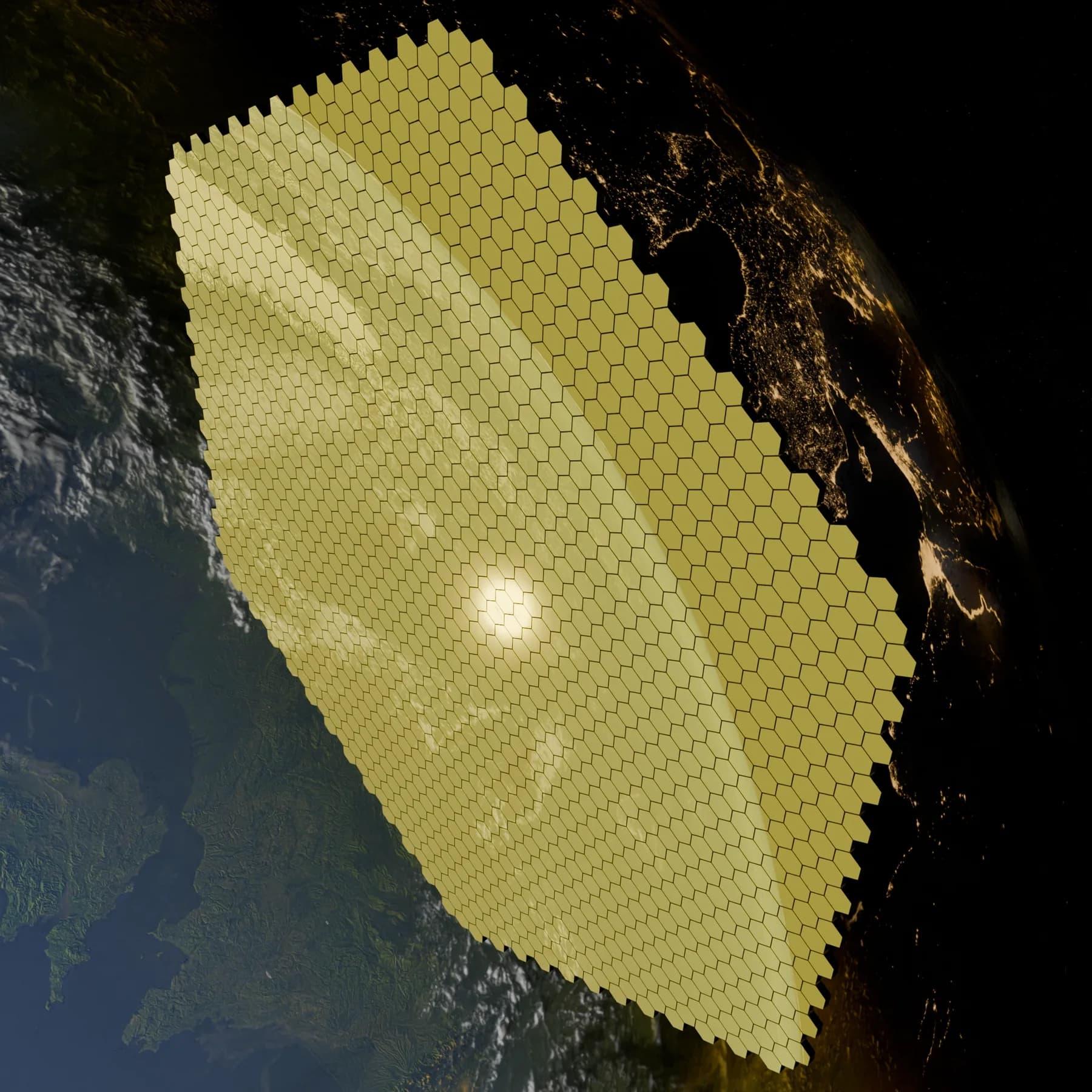
This section decides the verdict, so it does not get skipped or softened. The constraints are established in our companion technical work; here we compress them, price them, and run the model.
6.1 The four constraints, in binding order
- Bandwidth bars training. Optical inter-satellite links carry 25–100 Gbps per channel against the 800 Gbps–1.6 Tbps GPU-to-GPU fabric a synchronised training run assumes; distributed frontier training across orbiting nodes craters utilisation. The near-term fit is inference, preprocessing, and communication-light workloads — exactly the sovereign-edge product set in 5.8.^[1]
- The refresh cycle runs backwards. Terrestrial operators forklift chips through a 30-year shell and recover residual value; orbital operators relaunch the whole structure every 4–6 years and recover nothing. Cheaper launch shrinks this penalty; nothing eliminates it.^[1]
- Thermal is an area budget, not a mystery. A 20°C radiator sheds ~376 W/m²; ~27 m² per 10 kW ideal; a 30–40 kW satellite needs Starcloud-2-class deployable radiators (~50–150 m² with real view factors) — hard engineering with a flight test due in October 2026, not exotic physics.^[6]^[62]
- Launch is the trigger condition. At Falcon-9-class ~$2,700/kg the economics are premium-only; Google's own threshold for energy-competitiveness is ~$200/kg; every scenario below is, underneath, a launch-price scenario.^[1]^[12]
6.2 The multi-vendor launch table (the procurement input)
Two implications. First, nobody in Asia beats SpaceX on price today — Indian and Japanese launch costs 2–5× Falcon 9 per kg. The venture buys them anyway, for dedicated-orbit control, schedule sovereignty, political acceptability, and negotiating leverage against SpaceX, while still using US rideshare where compliance and prudence allow. Second, competition is arriving on the right schedule: Vikram-1's window opens this month; H3-30 just flew; a 2028 Phase-1 procurement will face at least four credible non-Chinese bidders plus SpaceX, which is precisely the buyer's market OneWeb never had.
6.3 The model: dollars per kW-year in orbit, 2026 → 2030
Bottom-up, all assumptions visible (all rows modeled estimates; scenario assumptions flagged):
* Scenario assumptions: 2030-R assumes priced reusable heavy lift (Starship-class or equivalent) at $500–1,500/kg with competitive bidding; 2030-S assumes reusability slips and the floor is set by expendable competition. † Benchmark build: GB300-class rack ~$6M/120 kW ≈ $50k/kW silicon amortised over 4 years ($12.5k) + facility capex ~$10–14M/MW over 15 years (~$0.8k) + energy at ~$0.09/kWh × PUE 1.3 (~$1.0k) + opex — consistent with the terrestrial baseline in our AI1 teardown.^[1]^[17] ‡ Multiple convention: the printed orbital multiples divide both ends of the orbital range by the $17k upper terrestrial endpoint; dividing by the $14k lower endpoint would print ~6–13×. We use the conservative denominator throughout, including in the Summary.
Sensitivity — what actually moves this model. Rank the inputs by leverage. (1) Launch $/kg dominates 2026 (55–65% of delivered capex) but falls to 15–30% by 2030, which means the popular framing "orbital compute is a launch-cost story" is true early and false late. (2) By 2030 the binding input is platform hardware $/kW — bus, thermal, solar at volume, which is precisely the layer the Section 7 work packages attack with Taiwanese/Korean manufacturing; if hardware stalls above ~$80k/kW, even $500/kg launch leaves orbital at ~1.5× and the sovereignty premium remains mandatory forever. (3) Life extension is the quiet lever: stretching useful life from 4 to 6 years cuts every $/kW-year figure by a third — worth more than halving launch prices in the 2028 column, which is why the venture should trade a little mass for consumables, shielding and graceful degradation rather than chase minimum-mass designs. (4) Utilisation below ~35% breaks every scenario; no cost curve rescues an empty constellation, which is the financial restatement of the offtake-first rule.
Cross-checks: our 2026 multiple (5–11×) sits comfortably inside the published range of independent estimates (from "a few ×" for optimists to ABI's up-to-78× for full-stack TCO at equivalent scale) and is more conservative than SpaceX's implied claims, less damning than the maximal bear case, which is where a build-table with visible inputs should land.^[1] The crossover condition, stated once and used as the Phase-2 gate in Section 7: orbital approaches terrestrial parity only when launch < ~$1,000/kg AND platform hardware < ~$40k/kW AND life ≥ 5 years AND utilisation > 60% — no earlier than 2029–30, and only in the reusable-works scenario.
6.4 What business survives this maths
Three conclusions, none of them comfortable, all of them load-bearing:
- Bulk orbital compute is not investable for a non-SpaceX builder this decade. At 2.5–6× terrestrial in 2028, selling generic FLOPs from orbit against Johor is value destruction. Anyone pitching an "Asian AI1" is pitching a subsidy program.
- A sovereignty-priced niche closes from ~2028. Governments pay 1.5–3× commercial rates for sovereign, air-gapped, jurisdictionally ring-fenced compute (author inference from sovereign-cloud procurement patterns — no clean public price comparable exists, so treat the premium as a modeled input, not a market fact), and pay more where terrestrial capacity is power-gated and data cannot legally move.^[17]^[20] A 2–4× orbital premium for a product whose terrestrial substitute is unavailable in-jurisdiction is a viable price, not a fantasy — provided the operator sells sovereignty, availability and physics-native workloads (EO preprocessing, relay), never raw $/FLOP.
- Phase structure is not caution; it is the only rational design. Phase 0 must be terrestrial-anchored and hosted-payload-based because 2026 economics reward learning, not deploying. Phase 1 (2028–29) deploys into the niche the premium supports. Phase 2 scales only when the crossover conditions fire. The company's constitution should hard-code these gates — the discipline OneWeb's shareholder map made impossible.
6.5 The launch supply curve, 2026–2032: commoditisation, the China export wave, and the market this venture creates
The 6.2 table is a snapshot. The strategy has to be built against the curve, and three forces are bending it at once. Each changes a different part of the plan, so take them in order.
6.5.1 Launch is commoditising, but commodities trade in politically segmented markets. The direction of travel is not in dispute, and its clearest statement comes from the incumbent himself: in May 2026, Musk wrote that "SpaceX launches hundreds of satellites for competitors with fair terms and pricing," offering it as the model for how the company will sell orbital compute.^[71] The record backs the launch half of the claim — OneWeb, Kuiper prototypes, and rival constellations have all flown on Falcon 9 at prices their operators accepted (verified fact; whether antitrust positioning ahead of the IPO motivates the framing is author inference and changes nothing about usability). The venture should take the offer at face value short-term: fly rideshare, use the SpaceX bid as permanent price discipline in every work package, exactly as WP-L1 already does. What it must never do is mistake a commodity price for a commodity market. Read the rest of the same post: "we reserve the right to reclaim the compute if their AI engages in actions that…" — fair terms on the layer SpaceX is commoditising, discretionary control explicitly reserved on the layer it is monopolising.^[71] That single sentence is this report's Section 2 argument, written by the counterparty. And even a genuinely commodity launch market stays politically segmented: ITAR/EAR content rules already split the market into compliance zones (Section 3's rideshare analysis), and a US-controlled commodity is still a US-controlled input. Commoditisation lowers the venture's costs; it does not supply the venture's product, which is precisely the thing a commodity cannot be — jurisdictional assurance. Design consequence: buy the cheap tier opportunistically, qualify the sovereign tier deliberately, and let the two-supplier-minimum rule in 7.3 absorb the difference.
6.5.2 The China export wave: the EV movie, re-run — dated. China's commercial launch sector is following the industrial sequence its EV sector just completed, closely enough to model. Anchor the analogy on verified EV dates: founding wave 2014–15 (NIO, XPeng, Li Auto); brutal domestic price war from early 2023; an estimated $69B of industry revenue erased 2023–25; exports exploding two to three years after the price war began — BYD overseas sales alone ran 56k (2022) → 243k (2023) → 417k (2024) → a 1.5M target for 2026, with China's NEV exports passing 2M in 2025.^[72]^[73] The pattern: subsidised founding wave → domestic overcapacity → price war → shakeout → the survivors flood outward with costs no incumbent can match. Treat the analogy for what it is — a heuristic sequence, not a forecast engine: launch differs from EVs in ways that could break the mapping (demand is state-concentrated, a single flight failure can kill a company, ranges and pads are state-controlled, the market is orders of magnitude smaller), and the sequence has an explicit non-occurrence mode — if domestic constellation procurement stays administratively locked to CASC vehicles, the price war never ignites and the export wave never forms. With that flagged, map launch onto it (modeled timeline; the mapping logic is the claim, the years carry ±12-month error bars):
The modeled call, stated for falsification: Chinese commercial launch becomes a genuinely exportable commodity — priced below every non-SpaceX Western alternative, marketed the way CGWIC already markets Long March slack — in the 2029–31 window, conditional on a recovered Chinese stage re-flying by 2027. That gate is now half-open: on July 10, 2026, CASC's Long March 10B recovered an orbital-class first stage by sea-platform net capture on its maiden flight, with re-flight of the recovered stage targeted by year-end; Zhuque-3's second attempt follows around August.^[77] The export-wave clock now runs on re-flight alone, which makes the 2029–31 window more likely than when this section was first drafted. This venture cannot buy any of it — the China rule (8.5) is absolute, but it is affected twice, in opposite directions. Favourably: a Chinese export curve at $2,000–4,000/kg forces every Indian and Japanese bid down and makes the Phase-2 gate (launch contracted <$1,500/kg by ~2030) more plausible, because WP-L2 bidders will be pricing against it even though it never wins. Unfavourably: the same curve makes the rival pole's G2G compute offer exportable and cheap on exactly the venture's timeline — one more reason the offtake cold-start clock (Section 10) cannot be allowed to slip into 2029.
6.5.3 The third tier's payload famine, and the market that only aggregation creates. Between SpaceX's commodity tier and China's coming export tier sits the layer this venture actually procures from: the Indian, Japanese and Korean startup tier, which is technically real and commercially starving. India: Skyroot's Vikram-1 window opens this month; Agnikul has flown its private-pad demonstrator; and Astrobase — founded 2024 — is hot-firing an 80-tonne-class full-flow staged-combustion methalox engine this year at India's first private high-thrust test facility, targeting a 2029 maiden orbital flight of a seven-engine reusable medium-lifter.^[40]^[74] Japan: Honda flew and landed a VTVL hopper in June 2025; Innovative Space Carrier — whose attempt to shortcut the engine problem by buying American ended with its US test campaign cancelled in December 2025 — is now hopping on an in-house engine with an Ebara electric turbopump (first ignition March 2026); Toyota is funding Interstellar Technologies for exactly the mass-production scaling this venture would buy.^[75]^[76] Korea: Innospace's return flight is slated for Q3 2026.^[50] (The full teardowns are the companion pieces already published on this platform: India's launch-startup tier and Japan's; this section states only what this venture needs from them.)
Here is the structural problem every one of those companies shares, and the reason the tier is investable only from outside any single country: the domestic payload base beneath each of them is too small to feed even one of them. India's commercial launch demand outside ISRO's own manifest is a handful of smallsats a year; Japan's institutional demand is contractually anchored to H3 and MHI; Korea's national manifest fits inside Nuri's government programme. Model it bluntly: a small/medium launch company needs on the order of 6–12 paid flights a year to survive commercially (author inference from published startup cost bases); no Indo-Pacific domestic commercial market currently supplies even half of one such manifest, let alone one per country. Each national tier survives today on state R&D money, which buys capability, not a business. The EV analogy's dark half applies: a subsidised tier with no demand base doesn't get a price war, it gets quiet deaths.
What changes the arithmetic is aggregation, and this is where the venture stops being merely a customer of the regional tier and becomes part of its market structure. Phase 1 alone is a real manifest: 27–36 satellites ≈ 4–8 dedicated medium launches plus options, competitively awarded across exactly these suppliers (WP-L1). Phase 2 is 20–40 more. That does not feed an industry — this venture is the marginal international anchor customer, not the market, but it is the first competitively awarded, multi-national, export-credit-financeable manifest in the region, and it arrives precisely when Astrobase-class vehicles (2029) and ISC-class reusables need a first commercial book. Add the demand the venture's own existence catalyses — the sovereign constellations, EO systems and follow-on compute shells that Indo-Pacific governments fund once a third-pole operator proves the procurement model, and the aggregated regional manifest plausibly crosses the survival threshold for one to two suppliers per weight class by 2030–31 (modeled scenario, and the mechanism matters more than the point estimate). Note the symmetry with the venture's own thesis: when launch commoditises globally, the regional tier survives only on politically segmented demand — sovereign payloads that will fly neither American nor Chinese. The venture aggregates exactly that demand. It is to the regional launch tier what sovereign cloud is to the hyperscalers: the buyer that exists because the commodity cannot be trusted with everything. One flywheel, three turns: aggregated payloads anchor regional launch; competitive regional launch drops the venture's $/kg toward the Phase-2 gate; a cheaper Phase 2 deepens the payload base. OneWeb's cap table tried to build this flywheel with equity and vetoes; this design builds it with a manifest.
7. The Business Plan
Everything above compresses into a build plan. This section is deliberately deck-grade: structure, roadmap, sizing maths, procurement, money.
7.1 Corporate structure and the cap table
Structure. A single Singapore-incorporated operating company ("OpCo") holding all assets, IP, licences and contracts; a Singapore holding vehicle above it admitting sovereign/strategic LPs under the Section 4 caps; ring-fenced customer enclave subsidiaries (one per anchor jurisdiction) holding local ground assets and data-boundary obligations — the SIJORI/DayOne topology applied to orbit: control layer in Singapore, capacity and gateways distributed.^[4] Governance constitution per the Section 4 decision-rights matrix; exit path GLB (SGX–Nasdaq).^[4]
Cap table by Phase-1 close (archetypes, % ranges — modeled design targets, not any real party's intention):
Aggregate sovereign-linked: target 38–48%, under the <49% hard cap. No golden shares anywhere. Every sovereign ticket is contractually bundled: equity admission requires a signed capacity-reservation/offtake term sheet — the Mechanism-5 fix.
7.2 Phased technical roadmap, with the sizing maths shown
Phase 0 — 2026–27: fly payloads, not promises.
- Two hosted compute payloads (5–10 kW class, one performance-stack, one sovereignty-stack) on rideshare/hosted platforms — the Loft Orbital pattern our western review documents — plus two optical ground stations (Singapore + one Gulf or Australian site).^[62]
- Paid sovereign pilots on hosted capacity: a national EO-preprocessing pilot and a sovereign-enclave inference pilot, $2–8M each.
- Deliverables that gate Phase 1: flight heritage for both silicon stacks; measured optical downlink availability across monsoon seasons (the Indo-Pacific's real weather question); two signed anchor-offtake term sheets.
Phase 1 — 2028–29: the sovereign edge shell.
- Orbit: dawn-dusk SSO, ~570 km, three planes (LTAN 05:30/06:00/06:30), 9–12 satellites per plane → 27–36 satellites. Dawn-dusk buys near-continuous solar power and a stable thermal boundary — the highest-value orbit per kW for latency-tolerant compute, per our orbital-design brief — at the cost of intermittent ground and gateway contact, which the asynchronous relay service model below is designed for, not against.^[6]
- Coverage maths, shown. At h = 570 km and a 20° minimum elevation, the coverage cap half-angle is λ = arccos(R꜀·cos ε / (R꜀+h)) − ε = arccos(6371 × 0.9397 / 6941) − 20° ≈ 30.4° − 20° = 10.4°, a footprint radius of ~1,160 km — an along-track angular extent of ~20.8°, less than the ~30–40° spacing between the plane's own satellites. Ground coverage is therefore intermittent even along a single plane's own repeating track, before Earth's rotation is even considered, and that is deliberate: this is not a coverage constellation.
- Service model, precisely, and corrected from an earlier draft's overclaim. Each plane is an OISL ring (adjacent-satellite links within flown optical ranges), so data can relay within a plane to whichever of that plane's satellites currently sees a gateway. But Phase 1 has no cross-plane relay, and a sun-synchronous plane's ground track sweeps roughly 24° of longitude westward every orbit (~96 min) as Earth rotates beneath it — so a fixed gateway is in view of any satellite in a given plane only during the few-minute windows when that plane's precessing track happens to pass nearby, recurring on an orbit-to-multi-orbit cadence (order of tens of minutes to a few hours between windows, not continuously), and gateway diversity (8–12 sites) helps only for traffic that can route to any gateway — a jurisdictionally ring-fenced enclave's data usually cannot, because it must land at its own jurisdiction's gateway, which tightens the window further. The accurate product description is therefore bounded-latency asynchronous relay — store, carry, and forward on the next viable contact, not continuous real-time service, and Phase 1's economics and the workloads named in 5.8/5.9 (EO preprocessing, batch inference, maritime relay) are chosen specifically because they tolerate exactly this latency class; a real-time interactive product is not what 27–36 satellites with intra-plane-only links deliver. True near-continuous service would require cross-plane OISL relay — an explicit, costed Phase 2 upgrade (more terminals, onboard routing complexity), not something Phase 1's capex in Section 7.4 assumes.^[62]^[24]
- Why not blanket coverage — the rejection maths. Continuous single-fold coverage of the ±30° latitude band at this altitude requires street-of-coverage geometry: 18 satellites/plane gives a street half-width of only ~2.9° (cos c = cos 10.4°/cos 10°), forcing plane spacing near ~11.5° and ~30 planes × 18 ≈ 550+ satellites. That is a $4–7B fleet serving no workload our demand map requires before 2030. Any plan that starts there is building AI1 without SpaceX's balance sheet. We show this arithmetic precisely so the reader can see the discipline: the constellation is sized by contracts, not by coverage vanity.
- Capacity, with the power budget shown rather than assumed. 25–40 kW average is generated power per satellite, not delivered compute power — it still has to pay for bus housekeeping, attitude control, thermal pumps, comms and battery charging before silicon sees a watt. Modeled split at this class (scenario assumption, consistent with the platform-mass-efficiency inputs in 6.3): ~65–75% to the compute payload after overhead, i.e. ~16–30 kW of usable accelerator power per satellite, further derated for radiation-hardening duty cycling and thermal throttling margin (§6.1's ~15–25% SEU/TID overhead) to ~13–25 kW effective. Fleet-wide: 27–36 satellites → ~0.35–0.9 MW of usable accelerator-kW, which is the correct denominator for revenue math, not the 0.7–1.4 MW nameplate figure. Expressed against a GB300-class rack (~120 kW IT load) this is ~3–7 rack-equivalents of usable accelerator power under orbital duty cycle — smaller than a nameplate comparison suggests, and still sufficient for the $120–690M/yr serviceable market in 5.8/5.9, because the product is enclaves and physics-native workloads sized in the tens-of-kW range per customer, not bulk FLOPs at datacentre scale.^[1] (The 7.4 enclave P&L already prices a 200 kW dedicated enclave as a Phase-2-scale anchor, not a Phase-1 default — flagged there as such.)
- Links: 100–200 Gbps-class OISLs (flown technology class); optical downlink to the gateway network with Ka-band RF fallback; TT&C in conventional RF via the Singapore administration (8.2).
The sellable-capacity waterfall — from generated watts to contracted revenue, one auditable chain (all rows modeled; mid-case in brackets):
The Phase-1 product card — what a customer actually signs (service parameters are design targets / scenario assumptions, published so a procurement office can mark them up rather than guess):
The latency numbers follow directly from the §7.2 orbital mechanics (pass cadence tens of minutes to hours per plane-gateway pair, monsoon-season optical availability to be measured in Phase 0, which is precisely what Phase 0's two OGS exist to measure); an SLA the physics can't meet is a lawsuit, so these are set from the geometry, not from marketing.
One workload priced end-to-end, because infrastructure economics is not customer economics. Take the revenue-floor product — sovereign EO preprocessing, and build the customer's business case (all inputs scenario assumptions, stated for re-pricing):
Read the punchline: the floor product closes its own economics without invoking any sovereignty premium at all — the avoided-downlink arithmetic alone pays for the enclave at mid-case, which is why it underwrites the business while the premium enclave product carries the upside. If a customer's EO programme is smaller (1–2 satellites), the case thins toward break-even and the sale becomes sovereignty-led; that gradient, not a uniform TAM, is what the sales pipeline actually looks like.
Phase 2 — 2029–32: scale on triggers, not on hope.
-
Add a ~30°-inclination shell with cross-plane OISL relay (the continuity upgrade Phase 1 explicitly deferred) for genuinely continuous low-latitude gateway visibility and denser regional tasking: 6–8 planes × 18–24 satellites (108–192), plus Phase-1 replacement — fleet of ~150–230 satellites, generated 5–8 MW nameplate. Run the same usable-capacity discipline as Phase 1 (§7.2): at a similar ~55–65% payload/derating retention for second-generation silicon (modestly better than Phase 1's on improved thermal and radiation-hardening maturity), that is ~3–5 MW usable accelerator power — the defensible basis for the 2032 revenue line below, not the nameplate figure.
-
Entry gates (hard-coded): signed offtake ≥ $150M/yr run-rate; launch contracted < ~$1,500/kg; Phase-1 fleet availability ≥ 95% and enclave-audit acceptance by at least two sovereign customers. If the gates don't fire, the company stays a profitable niche operator at Phase-1 scale — an acceptable outcome the constitution must protect, against both founder ego and LP ambition.
7.3 Procurement: the OneWeb inversion, operationalised
Every subsystem is a competed, fixed-price work package with ≥2 qualified bidders and annual re-compete on replacement batches; no bidder nation holds equity leverage over award decisions (reserved-matter covenant). The map:
Sum: $290–585M Phase-1 procurement, consistent with the capex build below. (Reconciliation with 6.3: work-package budgets include NRE, qualification and first-unit costs; the model's hardware-$/kW band is the recurring cost at batch volume — the two converge only at Phase-2 quantities.) The strategic point: India, Japan, Korea and Taiwan each capture real work-share — by winning it. Capability-transfer programmes for sovereign LPs run through contracted secondments and joint labs, never through procurement direction. This is the entire OneWeb/IRIS² inversion in operating form: work-share is an output of competition, not an input of diplomacy.
7.4 Financials
Capex and opex (modeled estimates):
Revenue model. Three lines: (1) sovereign enclave compute at $100–160k/kW-yr (a 2–4× premium on the 2028 orbital cost base, defensible per 6.4); (2) EO/maritime preprocessing and data relay priced per task/Gbit (the physics-native line, margin-rich because it monetises downlink scarcity); (3) pilot/NRE and capability-transfer programme fees. Utilisation assumption 40–60% of usable accelerator-kW (the 7.2 power-budget figure, not fleet nameplate). Trajectory (modeled): 2027 $5–15M (pilots) → 2029 $20–50M (first service year) → 2030 $30–95M → 2032 $120–300M if Phase 2 fires — matching the 5.8/5.9 serviceable-market capture range at the disclosed capture-rate assumption. Break-even on operating cash flow: ~2031 in the mid case. State it plainly: on pure DCF terms this is a bad venture-capital bet and a reasonable strategic-capital bet, which is exactly why the OneWeb soul (sovereign capital) is required at all, and why the DayOne method (that capital de-fanged) is the only way to take it without dying of it.
An illustrative enclave P&L, so the revenue model is auditable. Take one mid-size sovereign customer buying a 200 kW dedicated enclave in 2029 (all figures modeled from the 6.3 mid-case):
Utilisation, defined once so the arithmetic closes: the sold fraction of usable fleet capacity (0.35–0.9 MW per 7.2, not the 0.7–1.4 MW nameplate), with dedicated enclaves counting as fully sold whether or not the customer saturates them. At the model's 40–60% base-case utilisation, sellable capacity is 0.14–0.54 MW — at the low end, literally 0.7 of a 200 kW anchor, which is not a company. At the low end, the low case is not "one anchor," it is zero dedicated 200 kW anchors and the tasking/relay line alone; the base case only reaches a first full 200 kW anchor at the middle-to-upper end of the utilisation band. The base-to-upper case supports zero to three such 200 kW anchors (blended with the always-available tasking/relay line, which is why the low case is not zero revenue even when it is zero anchors) — or, at the upper build, four to five smaller 75–150 kW enclaves — alongside the tasking and relay lines: a $30–95M/yr revenue business at maturity, which is exactly what the corrected 2030 trajectory line assumes, and which is earned mostly by the tasking/relay line at the bottom of the range and by dedicated enclaves at the top. This is a materially smaller near-term number than a nameplate-based estimate would suggest, and that is the point of doing the power-budget arithmetic explicitly rather than skipping it: a fleet this size is a real, fundable niche business at these numbers, not a rounding error dressed up as a bigger one. The four-to-six-anchor case ($110–190M/yr) is explicitly a fleet-expansion scenario requiring either the top of the Phase-1 build running near-saturated (~80%+ utilisation) or the first Phase-2 tranche. That is the entire commercial thesis in one table, and it stands or falls on whether the first one to two signatures exist — a lower bar than the original framing implied, and, on the evidence in Section 10, still unmet. Nothing in the physics prevents it; nothing in the physics compels a government to sign. Hence Section 10.
Funding plan (modeled design):
The last line deserves emphasis: Eutelsat just showed the template — €975M of French export credit financing Airbus-built satellites.^[30] The identical machinery exists in Tokyo, Seoul and Delhi, and it finances procurement (which this venture distributes across those countries) rather than equity (which it caps). Export credit is how supplier nations fund the venture heavily while staying off the cap table — the financial expression of the whole design.
8. The Risk Register
Every risk below carries a named mitigation and an residual. The summary table first, then the four risks that deserve prose.
8.1 The Nvidia question: US chips on a non-US constellation
Fly US-origin advanced accelerators and every satellite carrying them becomes an EAR-controlled item: re-export rules attach, end-user screening attaches, and the provision of compute services from that hardware to sanctioned or restricted parties becomes a US-law question wherever the satellite flies. The May 31, 2026 BIS guidance — licensing chips by ultimate parent nationality, worldwide — shows the direction of travel: control follows the chip, not the territory.^[22] There is no clever structure that removes this; pretending otherwise is how ventures die in enforcement actions, and the region has just watched the diversion indictments to prove it.^[23]
The workable architecture: accept the US as a regulatory stakeholder in the performance stack, and design the sovereignty stack to owe Washington as little as the real supply chain allows — a lower-performance, lower-policy-concentration stack, not an "independent" one. Precision matters here: even a Korean-NPU/FPGA stack likely touches US-origin EDA tools, HBM supply channels, semiconductor manufacturing equipment lineage, and possibly encryption and networking IP — residual threads Washington could in principle pull, at escalating diplomatic cost. What the sovereignty stack removes is the concentrated, routine dependency (a licensable US accelerator as the beating heart); what it cannot remove is every thread. And one structural disclosure the model owes its readers: if the performance stack ends up carrying the majority of revenue — plausible, since it serves the customers with the most money — then the company's independence is real at the governance layer and partial at the technology layer, and it should say so to its own customers rather than let them discover it. Performance-stack enclaves serve customers Washington will license (Gulf states inside their US AI frameworks, ASEAN allies, India, Japan, Korea, Australia); the sovereignty stack — Korean/FPGA silicon, N−2 performance — serves the subset of workloads where jurisdictional cleanliness outranks FLOPs. Customers choose their stack with eyes open; the constellation's control plane (TT&C, mission software, scheduling) is built ITAR/EAR-free so no US part can ground the fleet. Residual: a future US administration can still throttle the performance stack's growth. That is a bounded, disclosed dependency — categorically better than OneWeb's discovery in 2022 that its launch programme was hostage to Roscosmos.
Why Washington might tolerate this rather than block it (author inference — a read on incentives, not a policy prediction). A structurally non-Chinese, transparently EAR-compliant third pole is not obviously against US interests: it is a buffer that keeps Gulf, ASEAN and Indian sovereign-compute demand inside a US-adjacent compliance perimeter instead of pushing it toward China's G2G offer, which is the actual alternative on the table if this venture does not exist. That does not mean BIS grants favourable treatment — the performance stack still answers to Washington on Washington's terms, as stated above, but it is a reason a licensing regime tolerates a structure like this rather than moving to foreclose it outright, and it is why the venture's constitution insists on EAR-free control planes and named exclusion lists: the pitch to Washington is "this keeps the region's sovereign-compute demand compliant," not "this evades your rules," and the two pitches produce very different regulatory receptions.
8.2 Spectrum and ITU: who files
The data plane is optical — outside the ITU Radio Regulations entirely, which is the single largest regulatory advantage a compute constellation holds over a comms constellation.^[24] What still needs RF: TT&C and gateway fallback. Plan: file through the Singapore administration (IMDA) as notifying administration — modest filings (TT&C bands plus Ka gateway) that a small, credible administration can carry, with a parallel filing via a partner administration as insurance against coordination congestion. The limitation: Singapore has administered GEO filings but never a LEO constellation of this class; treating IMDA's capacity as a plan requiring early engagement, not an established fact, is part of why Phase 0 exists. Gateway market access is then per-country licensing — 8–12 negotiations with mostly-friendly administrations, each bundled into the corresponding sovereign relationship. The unpriced novelty is optical-ground-station regulation (laser safety, aviation coordination), where almost no Asian administration has precedent; first-mover rule-shaping here is cheap and compounding.^[24]
8.3–8.4 Partner frictions and insurance (briefly)
The partner nations restrict each other: Korean space-grade items carry Korean controls, Japanese METI licensing applies to sensitive components, India controls launch-adjacent technology, and Taiwan-sourced electronics raise their own flags in some customer states. Mitigation is architectural: work packages are interface-defined boxes, integrated in Singapore, so no partner needs another partner's controlled technology — modularity as compliance strategy (cost: the +5–10% integration overhead in the table). Insurance: the space market has hardened and novel compute payloads have no actuarial base; assume launch-plus-first-year rates of 8–15% of insured value (modeled), insure the launches and the first plane, then follow the Starlink/OneWeb pattern — fleet-level redundancy (10–15% spares) as self-insurance.
8.5 The China question, answered without euphemism
This venture must be structurally clean of Chinese control — capital, critical supply, and data paths — from incorporation, for three compounding reasons. First, investability: the named LP archetypes (Gulf funds inside US AI frameworks, GIC/Temasek-class, Japanese and Korean strategics) cannot hold a China-entangled orbital asset — our DayOne analysis established that "no Chinese control" is now the minimum threshold for sensitive-infrastructure capital on both sides of the Pacific, and orbital compute is that framework's hardest case.^[4] Second, customer trust: the product is jurisdictional cleanliness; one Chinese-controlled subsystem in the control plane and the sovereignty pitch is dead. Third, the Taiwan supply relationship makes ambiguity impossible: you cannot simultaneously run Foxconn bus lines and leave the China question open. Cost of the rule, stated: China is the region's cheapest satellite manufacturer and its state constellations may become the cheapest non-US launch; walking away from that supply curve costs real money (author estimate: +15–30% on bus/launch versus a hypothetical China-inclusive procurement^[16]^[2]), and it is the price of existing at all. The venture competes with China's orbital-compute pole for third-country demand; it does not buy from it, sell control to it, or route data through it. That is also, precisely, the symmetric application of the DayOne rule that makes the venture credible when it tells Washington the same thing about US control.
8.6–8.7 Talent, and the governance-speed risk itself
Talent: Singapore supplies the control layer (systems engineering, mission ops, compliance, capital) and imports depth — a Bengaluru software/AIT centre, Seoul payload team, Tokyo thermal partnership, and aggressive diaspora hiring. This is the DayOne division of labour and its known overhead.^[4] The governance-speed risk deserves its own line because this report has spent thousands of words on it: the design mitigations are the decision-rights matrix, founder-weighted voting through Phase 1, the 75% reserved-matter list (four items only), offtake-before-equity, and annual re-competed procurement. The residual is unavoidable: this structure trades OneWeb's veto paralysis for key-person risk concentrated in a founder-CEO under Singapore law. Starlink's record favours concentrated operating authority in this industry, but the choice still carries a cost.
9. The IRIS² Objection
The strongest critique of everything above runs: multi-state money, sovereign customers, a politically balanced industrial map, launch bought from state providers at above-market prices — you have described IRIS² and added a Singapore holding company. Take it seriously; it is the failure mode with the highest prior probability.
Where the critique is right, concede it. (1) The economics do not close on commercial terms alone; like IRIS², this venture exists because states want something markets don't price. (2) The supplier map is politically legible, and supplier nations will lobby for work-share exactly as EU member states do. (3) Sovereign LPs will test the caps at every round — the French-state absorption of Eutelsat happened one capital increase at a time, not in one coup.^[27] Anyone who claims a constitution is self-enforcing has not watched one fail.
Where it is wrong, the differences are structural, not cosmetic. First, demand-side versus supply-side sovereignty: IRIS² is a procurement programme — governments specify, industry builds, users are conscripted; this venture sells contracts to sovereign customers who can refuse to buy, which forces product discipline no requirements committee faces. Second, one balance sheet, one procurement authority: work packages are awarded by a management team spending its own investors' money against published criteria, not allocated by juste retour across member states, and the awards re-compete annually. Third, the kill switch: IRIS²-class programmes cannot die; they slip — a 66-satellite early tranche bolted on mid-programme to hold a 2029 initial-service date, full 264-satellite capacity around 2032, costs at €10.6B and counting^[33]^[34]^[66], and note that the mitigation itself proves the point: the programme's answer to delay was more procurement, not a kill-gate. This venture's constitution contains dated gates — no anchor offtake by end-2027, no sovereign round; no crossover conditions, no Phase 2, and a company that can die is a company that can be disciplined. Fourth, the caps have teeth because of mutual rivalry (4.3): no participant wants control more than it fears rivals having it, which is a stabler equilibrium than Europe's, where one state (France) was always the natural absorber.
We estimate a 50–65% chance that this governance design survives sovereign pressure through Phase 2. If it breaks, the venture converges on OneWeb-2028: alive, sub-scale and absorbed by state interests. A purely commercial version runs out of capital because venture funds will not underwrite 2.5–6× economics; a treaty-style programme inherits IRIS²'s delays. The DayOne pattern is risky. It is also the only structure here with a plausible path.
10. Conditions for a Viable Company
Is this buildable? Yes — conditionally, and the conditions are specific. Our call, recalibrated in this revision and stated with its structure visible: a competently executed version of this blueprint has roughly a 30–50% probability of reaching Phase-1 revenue service (2029) — down from an earlier 40–55% draft figure, and the reason for the cut is instructive, and perhaps 18–30% of reaching a Phase-2-scale, durably profitable company by 2032–33 (author estimates). The gates, each given a low/base/high rather than a false-precise point:
The earlier draft's 85–90% technical factor was the error the recalibration fixes: it priced subsystem heritage, not integration novelty. And the gates are correlated, not independent — a technically shaky programme depresses offtake; weak sovereign rights depress financing; a US export-control turn hits customers, capital and silicon simultaneously — so the naïve product understates the tails in both directions. The defensible headline is a band, not a point: ~30–50%, "roughly one-in-three to one-in-two under the stated conditions," with the single biggest swing factor being whether one sovereign LOI exists before the sovereign round is attempted. Treat every figure in this paragraph as structured judgment calibrated against comparables (OneWeb, Starcloud, sovereign-cloud procurement cycles), not a statistically estimated probability — no base-rate dataset exists for this asset class; the decomposition's value is forcing assumptions into the open and making each factor separately falsifiable, not percentage-point precision. Against that: a copycat "Asian AI1" bulk-compute play has near-zero probability of being anything but a subsidy bonfire, and a treaty-based multilateral programme has near-zero probability of beating IRIS²'s timeline pathology. If the third pole gets built, it gets built approximately like this.
What makes it a real company versus a diplomatic vanity project — five bright lines:
- Offtake contracts precede sovereign equity — a signed capacity reservation is the ticket price, every round, no exceptions.
- No golden shares, no state board seats, single-state blocs capped at 20%, sovereign aggregate under 49% — locked behind a 75% reserved-matter wall.
- Procurement awarded by published criteria and re-competed annually; the day a work package is awarded for diplomatic reasons is the day the company has begun becoming IRIS².
- Phase gates that can kill the programme, with dates: anchor offtake by end-2027; crossover conditions (launch <$1,500/kg contracted, hardware <$40k/kW, ≥95% availability) before Phase 2.
- The constellation is sized by contracts (27–36 satellites, ~1 MW), not by coverage vanity (the 550-satellite blanket we priced and rejected in 7.2).
The single hardest problem, named: the sovereign-offtake cold start. The physics is characterised, the supply chain exists, the capital pools exist, the governance design exists on paper. What does not yet exist anywhere on Earth is a government paying real money, on a repeatable contract, for orbital compute — the demand side is entirely pre-commercial, in China as in the West.^[2]^[16] This venture must therefore sell a premium product to the world's slowest buyers before the cost curve arrives, while its silicon supply hangs on US policy, and every month of sales slippage compounds into financing slippage. Silicon access and unit-economics timing are the second and third problems, and both are survivable with the dual-stack and phase-gate designs; an empty order book is not.
The de-risking sequence, in order, 2026–28: incorporate and lock the constitution before any sovereign money arrives (governance is cheap to fix at zero revenue, impossible at Phase 1); fly hosted payloads within 12 months so pilots sell against telemetry, not renders; convert two governments — most plausibly one Gulf state and one ASEAN state whose terrestrial sovereign-AI budget is already appropriated — into paid pilots in 2027; let Starcloud-2, AI1's prototypes and the Vikram-1/H3-30 launch curve de-risk the sector narrative at others' expense; raise the sovereign round in 2028 only against signed offtake. Eighteen months of disciplined sequencing buys what OneWeb never had: a company whose sovereign capital arrived after its customers did.
11. What This Means for Singapore Specifically

Singapore is not the only plausible jurisdiction for this company. The UAE, Australia, Japan and Luxembourg each supply a subset of the same ingredients: Gulf capital and trust for the UAE; Five-Eyes legal predictability for Australia; industrial depth for Japan; fund-domiciliation infrastructure for Luxembourg. Singapore alone combines simultaneous legibility to Gulf, Indian, Japanese, Korean and Western capital, a common-law/SIAC dispute-resolution stack, a listing venue purpose-built for exactly this asset class (the GLB), and enough independent security-establishment distance from all three great powers to be trusted by each of their rivals at once. That combination is the moat. Hosting this company, rather than building a national constellation, is the correct Singaporean ambition. The ecosystem already controls several useful moves: NSAS can anchor demand through EO-preprocessing and sovereign-compute pilots, squarely inside its stated satellite and multi-agency operations mandate^[60] (see our NSAS assessment); IMDA can begin the TT&C-filing and optical-ground-station rule-making groundwork now, cheaply, ahead of any operator; the GLB gives the exit venue that makes the whole cap table underwritable^[4]; GIC/Temasek-class anchors can do for this what GIC already did for Skyroot.^[41] The boundary is consistent with everything this platform has argued: Singapore's win condition is the control layer—HQ, law, capital, mission control, integration and standards—with the factories and launch pads in India, Japan, Korea and Taiwan where they belong.^[4] If no founder picks this up, the assets Singapore should build anyway (optical ground stations, filing precedents, enclave-audit standards) are exactly the ones every compliant constellation will need: the no-regrets version of the same bet.
12. What to Watch — Falsifiable Signals, Dated
- Vikram-1's window (open as of publication, July 12–August 4, 2026; the maiden attempt has already been postponed within it), and Astrobase's full-scale FFSC hot fires later this year.^[40]^[74] Vikram-1 success adds a fifth credible non-Chinese launch bidder and validates the India cost tier; failure or further slips delay, but do not break, WP-L1 competition (PSLV/LVM3 stand regardless). A clean 80-tonne FFSC hot fire is the leading indicator for the 2029–31 regional reusable tier §6.5.3's flywheel depends on.
- Starcloud-2, October 2026.^[11] The first 30–40 kW-class deployable-radiator flight in this venture's exact payload class. Clean thermal telemetry compresses Phase-1 engineering risk by a full design cycle; a failure pushes the Phase-1 payload spec down toward 15–20 kW.
- AI1 prototypes and priced Starship missions, 2027.^[1] Every dollar off $/kg moves the 6.3 model; equally, watch whether SpaceX offers orbital compute to foreign governments on sovereignty terms — the one move that would attack this venture's niche directly.
- China's re-flight clock. LM-10B's first stage — netted at sea on its July 10, 2026 maiden flight — targets re-flight by year-end; Zhuque-3's second flight and recovery attempt follows around August, gating LandSpace's own Q4 reuse target.^[77]^[63]^[68] The first successful Chinese re-flight starts the 2029–31 export-wave clock in earnest (§6.5.2) and sets how fast the rival pole's G2G compute offer becomes exportable.^[2]
- The first sovereign orbital-compute offtake anywhere — a Gulf, ASEAN, or Korean government signing a paid, multi-year orbital enclave or EO-preprocessing contract with anyone. This is the cold-start thesis's falsification test in both directions: its occurrence proves the demand; three more years of its absence breaks the 2028 sovereign-round timeline.
- GLB's first listings and the DayOne IPO.^[4] The exit venue this cap table assumes must demonstrate liquidity with a DayOne-class asset before the 2030–31 Phase-2 financing can underwrite it.
- BIS treatment of exported orbital deployments of controlled accelerators — the first licence precedent (or refusal) for advanced US silicon flown by a non-US operator will define the performance stack's real boundary.^[22]
A compound scenario, worked through, because single-signal watch lists understate correlated risk. Suppose Astrobase's 2026 full-scale FFSC hot fire ends in a test-stand loss and, in the same window, SpaceX announces sovereign-sliced Starlink/AI1 compute hosting for allied governments (item 3, the move flagged above as the one direct attack on this niche). Neither event is fatal alone — item 1 above already treats an Astrobase failure as a Phase-2, not Phase-1, setback, since WP-L1's Phase-1 launch bidders (PSLV/LVM3/H3-30) don't depend on Astrobase, and Japan's and Korea's reusable tracks remain independent shots on the Phase-2 gate. But together they compound: the Phase-2-scale probability (base 18–30%, Section 10) should be marked down toward its lower end or below — call it roughly 10–18%, not simply averaged, because the SpaceX move attacks demand at the exact moment the regional supply story weakens, and the two are correlated (a credible SpaceX sovereign offer makes Gulf and ASEAN buyers more willing to accept a US flag if the "third pole" looks execution-risky, which is precisely when Astrobase-class setbacks read as execution risk). The correct response is not to abandon the design but to sharpen the differentiation that survives a SpaceX sovereign-slice offer: single-company, single-flag control persists in any SpaceX product regardless of how the slice is sold, so the sovereignty-stack's silicon and control-plane independence (§8.1) becomes the entire remaining argument, and the venture's Phase-2 gates would need to tighten (higher offtake bar, later triggers) rather than relax, precisely because the bar for "why not just buy the sovereign slice from the party that actually owns its cost curve" would have gone up.
All data from public sources, including: SEC and FCC filings; Eutelsat, KASA, JAXA, NSIL, PIF, Mubadala, TASA, Foxconn, SK hynix, and NSAS official materials and disclosures; reporting by SpaceNews, Nikkei, The Washington Post, The Korea Herald, Business Standard, Via Satellite, European Spaceflight, Light Reading, TrendForce, DigiTimes, Wood Mackenzie, The Edge Malaysia, Asia Times, Tom's Hardware, TechCrunch and CNBC; and this platform's own prior verified analyses, cross-referenced throughout. All cost models, cap-table structures, constellation designs, market sizes and probability estimates in Sections 4–10 are the author's modeled estimates and inferences from stated assumptions, labelled as such in the text. This report is an independent analytical design study; it is not investment advice, not a solicitation, not a company or fundraising announcement, and not an endorsement of any company or government programme.
Sources77 entries with source notes and links
Companion teardown: IPO facts, AI1 specifications, bandwidth/refresh/launch/thermal constraint analysis, terrestrial cost baseline, Morningstar option framing. Prior SSA analysis built on A/B-grade primary sources; not an independent primary source.
Companion analysis: Q2 2026 institutional mobilisation, capital layers, launch-cost and silicon constraints, Qianfan export pattern. Prior SSA analysis; not an independent primary source.
- Euronext Paris — Eutelsat Communications (ETL) quote page(live.euronext.com)
Share price ~€2.5 as of July 8, 2026, roughly half the May 2026 peak; time-sensitive market data, as-of date pinned in text. B-grade source (exchange data).
The trust-architecture framework: the GDS/DayOne non-controlling carve-out (GDS stake since reduced to ~19.9% — see refs 64–65), TikTok/MGX, Manus, MAS Global Listing Board, IMDA data-centre capacity, Singapore trust-layer limits. Prior SSA analysis; not an independent primary source.
Segment financials; orbital-data-centre risk language ("may not achieve commercial viability"); Starship dependency disclosure. A-grade source.
- Singapore Space Agency — Orbit Is Architecture: Why Orbital Compute Is First an Orbit-Design Problem
Radiative heat-rejection arithmetic (376 W/m² at 20°C, ε=0.9), dawn-dusk SSO power/thermal geometry, downlink and disposal constraints. Prior SSA technical brief; calculations independently derivable from stated formulae.
- FCC — Public Notice DA 26-113: SB Accepts For Filing SpaceX's Application for Orbital Data Centers(docs.fcc.gov)
Up to 1,000,000 spacecraft, 500–2,000 km, 30° and sun-synchronous shells, optical inter-satellite links. A-grade source.
- Data Center Frontier — Starcloud Launches Orbital AI Data Center With NVIDIA H100 GPU(datacenterfrontier.com)
November 2025. Starcloud-1 launch and H100 payload. B-grade source.
December 10, 2025. First in-orbit model training on Starcloud-1. B-grade source.
March 30, 2026. Series A size and $1.1B valuation. B-grade source.
- NVIDIA Blog — How Starcloud Is Bringing Data Centers to Outer Space(blogs.nvidia.com)
Starcloud-2 October 2026 manifest: multiple H100s, Blackwell B200 integration. B-grade source (company-affiliated claim about future mission).
- Google Research — Project Suncatcher: exploring a space-based, scalable AI infrastructure system design(research.google)
2025. Trillium TPU radiation testing, 1.6 Tbps laboratory optical link, ~$200/kg launch-cost competitiveness threshold, 2027 prototype plan. A-grade source (primary technical publication; forward plans are company claims).
- Xinhua — China starts feasibility study for space-based intelligent computing constellation(english.news.cn)
April 5, 2026. SASTIND feasibility study; MIIT support for radiation-tolerant chips and laser links. A-grade source.
- China News Service — 业界首个太空算力产业协同平台"太空算力专业委员会"成立(chinanews.com.cn)
April 3, 2026. CAICT-convened Space Computing Power Professional Committee. B-grade source (Chinese-language, state-affiliated reporting).
- Sina Finance — 之江实验室:三体计算星座进入组网阶段(finance.sina.com.cn)
May 14, 2025. Three-Body constellation: 12 satellites, 744 TOPS/satellite, 5 POPS, 100 Gbps laser links, 8B-parameter in-orbit model. B-grade source (Chinese-language).
Guoxing 7.62% gross margin, player scoring, China thermal and silicon gaps. Prior SSA analysis; not an independent primary source.
- The Edge Malaysia — Malaysia's data centre capacity to double to 2,055MW by 2026 — JLL(theedgemalaysia.com)
Capacity doubling; Johor Bahru 850 MW completed, 1,800 MW under construction. B-grade source.
Johor data-centre maximum demand ~3.8 GW vs state demand ~2.6 GW; ~40% of electricity demand by 2035 scenario. B-grade source (research-house estimate).
- TechNode Global / AMRO — AI data center boom tests Malaysia's power, water and talent limits(technode.global)
July 7, 2026. February 2026 restrictions on non-AI data-centre approvals; transmission constraints. B-grade source.
- Digital in Asia — Who is Building AI Data Centres in Southeast Asia in 2026?(digitalinasia.com)
ASEAN sovereign-AI programme map, including Malaysia's ~MYR 2.1B sovereign AI cloud budget line and Vietnam's 2026 AI law. C-grade source (industry aggregator; country programme details flagged as partially corroborated).
Indonesia 2026–2029 national AI roadmap; Danantara-managed sovereign AI fund. C-grade source (single-source detail; directionally corroborated by multiple outlets).
June 2026. May 31, 2026 BIS guidance: licences required for advanced chips to entities with Chinese ultimate parents, worldwide. B-grade source.
- Tom's Hardware — Nvidia's biggest Southeast Asia customer exposes the limits of U.S. AI export controls(tomshardware.com)
2026. Singapore/Malaysia-routed GPU diversion cases and indictments. B-grade source.
ITU rights-stack framework; optical links outside the Radio Regulations; OneWeb's first-round Ku priority and 654-satellite fleet; Starlink >10,700 satellites; the compute-constellation exit from the RF regime. Prior SSA analysis built on A/B-grade primary sources.
- Wikipedia — Eutelsat OneWeb(en.wikipedia.org)
Consolidated corporate history: pre-bankruptcy fundraising (~$3.4B; SoftBank ~$1B/~40%), investor roster, 2021 SoftBank return, 2023 Eutelsat merger. B-grade source (tertiary but multiply-sourced; used for uncontested historical facts only; investment-round specifics cross-checked against contemporaneous reporting — see ref-26, ref-69).
- SpaceNews — British government and Bharti Global buy OneWeb, plan $1 billion investment to revive company(spacenews.com)
July 2020. The $500M + $500M rescue, ~42% stakes, UK golden share over future sales. B-grade source.
- Smart Maritime Network — Eutelsat to raise €1.35bn to support OneWeb and wider LEO strategy(smartmaritimenetwork.com)
June 24, 2025. €1.35B capital increase; French state €750M for 29.65%, becoming largest shareholder. B-grade source.
- Light Reading — Europe moves ahead with strategies to take on Starlink(lightreading.com)
UK government participation (~€163M) lifting the raise to ~€1.5B; European LEO strategy context. B-grade source.
- European Spaceflight — Eutelsat Taps Airbus To Build 340 OneWeb Satellites(europeanspaceflight.com)
January 2026. Order expansion to 440 satellites total; bridge role until IRIS² service in the early 2030s. B-grade source.
- Via Satellite — Eutelsat Secures French Export Credit Financing to Fund New OneWeb Satellites(satellitetoday.com)
February 11, 2026. €975M French export-credit agreement backing the Airbus order. B-grade source.
February 13, 2026. H1 revenues €591.6M; LEO revenue €111M (+~60%); capex guidance cut to ~€900M; net-debt reduction. A-grade source.
- Payload — OneWeb Launch Shows ISRO's Budding Commercial Opportunities(payloadspace.com)
LVM3's two dedicated 36-satellite OneWeb missions; NSIL commercial positioning. B-grade source.
French defence bridge contract; IRIS² timeline dependence. B-grade source.
- Electronics Weekly — Eutelsat: equity raise to fund OneWeb, IRIS² constellations(electronicsweekly.com)
November 2025. Capital raised against both OneWeb refresh and Eutelsat's ~€2B IRIS² commitment within the €10.6B, 60% EU-funded SpaceRISE programme; IRIS² System Requirements Review completion reported January 2026. B-grade source.
- PIF — PIF launches Neo Space Group (NSG) to boost Saudi Arabia's satellite and space industries(pif.gov.sa)
May 2024. Wholly-owned national space champion with investment mandate. A-grade source (primary, promotional).
- Mubadala — Space42 (portfolio page)(mubadala.com)
Space42 ownership (G42, Mubadala, IHC), Yahsat–Bayanat merger structure. A-grade source (primary, promotional).
May 7, 2026. ~$60M round co-led by Sherpalo Ventures and GIC (~$50M primary equity + ~$10M BlackRock-managed structured debt) at a $1.1B pre-money valuation. B-grade source.
- NSIL — Launch services (SSLV, PSLV, GSLV-Mk-II and LVM-3)(nsilindia.co.in)
Official commercial launch offer and vehicle classes. A-grade source.
- UNCTAD Investment Policy Monitor — India: Allowed up to 100 per cent FDI in the space sector(investmentpolicy.unctad.org)
February 2024. FDI tiers: 100% components, 74% satellites, 49% launch vehicles. A-grade source.
- Business Standard — Skyroot sets launch window for India's first private orbital rocket Vikram-1(business-standard.com)
July 2, 2026. July 12–August 4, 2026 window; Mission Aagaman; ~350 kg to LEO class. B-grade source.
- Business Standard — Vikram-1 nears launch: Who's building India's next-gen private rockets?(business-standard.com)
July 2026. Skyroot/Agnikul landscape; GIC-led round context. B-grade source.
TASL–Satellogic private sub-metre EO satellite (2024); Indian private manufacturing landscape. B-grade source (official US market analysis).
- New Space Tracker — Launch Service Providers: A Comparison 2025(newspacetracker.com)
PSLV ~$15–31M and SSLV ~$5–7M per-launch ranges. C-grade source (aggregator; used for pricing ranges only, flagged as modeled inputs).
- The Washington Post (AP) — Japan's struggling flagship H3 rocket returns to flight with the debut of a low-cost variant(washingtonpost.com)
June 12, 2026. H3-30 configuration debut; flight record. B-grade source.
- Nikkei Asia — Japan enters low-cost rocket competition against SpaceX with H3 launch(asia.nikkei.com)
~¥5B per-flight cost target, half of H-IIA. B-grade source.
- SpaceNews — Japan creates multibillion-dollar space strategic fund to boost space industry(spacenews.com)
¥1 trillion (~$6.7B), 10-year JAXA-administered fund. B-grade source.
- JAXA — Overview of the Space Strategy Fund (SSF) (PDF)(fund.jaxa.jp)
Fund structure and technology-commercialisation mandate. A-grade source.
November 27, 2025. Nuri fourth flight success; CAS500-3 and 12 cubesats deployed. A-grade source.
November 2025. Hanwha Aerospace's first lead-integrator launch; next two launches assigned. B-grade source.
- SpaceNews — Innospace plans second launch in 2026 after failure of first Hanbit-Nano rocket(spacenews.com)
December 2025 failure; 2026 retry plan. B-grade source.
- Space & Defense — INNOSPACE to integrate SpaceBey satellite deployer for Q3 2026 HANBIT-Nano launch(spaceanddefense.io)
Q3 2026 launch from Alcântara. B-grade source.
- TrendForce — SK hynix Reportedly to Supply About Two-Thirds of NVIDIA HBM4; Samsung Targets Early Delivery(trendforce.com)
January 28, 2026. HBM4 supply allocation; Korean HBM dominance. B-grade source.
HBM4 mass-production status and market positioning. A-grade source (company; market-share claims cross-checked against ref-52).
- DigiTimes — Taiwan Space Agency launches $81m LEO satellite program to boost local industry(digitimes.com)
August 2025. TASA LEO industrialisation programme. B-grade source.
First B5G communications satellite scheduled 2026, second 2028. A-grade source.
May 2026. PEARL-1A/1B second-generation satellites launched on the CAS500-2 rideshare. A-grade source (company).
- Aviation Week — Taiwan Struggles To Replace SpaceX In Satcom Plan(aviationweek.com)
Taiwan's satcom dependency and procurement difficulties. B-grade source.
- Space Intel Report — Saudi Neo Space Group, an entrepreneur's fantasy: 12 people at 2 conference tables with blank sheets of paper and $2 billion(spaceintelreport.com)
Independent characterisation of NSG's capital-rich, capability-young status. B-grade source.
June 2026. Five-satellite Foresight SAR constellation operational. A-grade source (company).
NSAS mandate (April 1, 2026): capability development, industry growth, legislation, partnerships; co-ownership of three EO satellites with ST Engineering. A-grade source.
APAC orbital-data-centre scenario sizing ($15–30B base case, 2030); value-chain and thermal/optical supplier analysis. Prior SSA analysis; not an independent primary source.
Starcloud/Suncatcher/Loft/Kepler layer analysis, Starcloud-2 radiator class (~52–156 m² estimates), In-Q-Tel capital-sovereignty flag, Transcelestial optical assets, rideshare ~$6,000/kg to SSO. Prior SSA analysis; not an independent primary source.
- Xinhua — China's LandSpace plans new recovery test for Zhuque-3 reusable rocket in 2026(english.news.cn)
February 25, 2026. Zhuque-3 December 3, 2025 maiden flight (orbit reached, recovery failed); Q2 2026 recovery test and Q4 2026 recovery-and-reflight plan. A-grade source.
Series C final close at $4.5B, Coatue/Hillhouse-led, Indonesia Investment Authority participation. B-grade source.
- GDS Holdings — GDS Announces Sale of US$385 Million of DayOne Shares (press release)(gdsholdingsltd.gcs-web.com)
April 2026 secondary sale taking GDS's retained DayOne stake to ~19.9%. A-grade source (company primary).
- Space Intel Report — Europe's IRIS² constellation adds 66 early-delivery satellites, to launch in 2029, to mitigate delay in full-performance network(spaceintelreport.com)
The 2026 mitigation plan: 66-satellite early tranche from 2029; full 264-satellite capacity ~2032. B-grade source.
Primary source for the SGX–Nasdaq Global Listing Board framework; SFA Amendment Bill passed May 7, 2026. A-grade source.
- China-in-Space — Zhuque-3, Long March 10B Aiming for Booster Recovery in July(china-in-space.com)
Zhuque-3 Y2 static fire June 29, 2026; second flight and recovery attempt imminent as of the report date. B-grade source.
- Via Satellite — Korean Company Hanwha Invests $300M into OneWeb(satellitetoday.com)
August 12, 2021. Hanwha Systems' $300M investment for ~8.8% with a board seat; contemporaneous primary reporting for the §3.1 table. B-grade source.
- Data Center Dynamics — Proposals for non-AI data centers rejected for "almost two years," says Malaysian PM(datacenterdynamics.com)
February 2026. PM Anwar's disclosure that the non-AI data-centre approval freeze had been in place since ~2024. B-grade source.
May 2026. Both halves quoted in §6.5.1: the commodity-launch claim and the reserved reclaim right. A-grade source (primary statement; a claim about own conduct, not an independent fact).
December 30, 2025. Price-war chronology from early 2023, shakeout dynamics, export acceleration. B-grade source.
- Carbon Credits — China's EV Export Explosion: How a Domestic Price War Is Reshaping the Global Auto Market(carboncredits.com)
BYD overseas 56k (2022) → 243k (2023) → 417k (2024); NEV exports >2M in 2025; ~$69B industry revenue erased 2023–25. B-grade source (figures cross-consistent with CNBC/Bloomberg reporting).
- Astrobase Space Technologies — High Thrust Full Flow Staged Combustion Engine (product page)(astrobase.in)
with Indian Defence News — Astrobase Unveils India's First Private FFSC Engine Test Facility, April 2026. 80-tonne/800 kN FFSC LOX-methane engine; 200-tonne-class private test facility at Anantapur; full-scale hot fires 2026; seven-engine reusable medium-lifter targeting a 2029 maiden orbital flight. A-grade for the company's own claims; timeline is a company target, flagged as such.
Corroborating linksIndian Defence News — Astrobase Unveils India's First Private FFSC Engine Test Facility
- Honda — Honda Conducts Successful Launch and Landing Test of Experimental Reusable Rocket(global.honda)
June 17, 2025. 6.3 m VTVL demonstrator to 271 m with landing, Taiki. A-grade source (company primary).
June 2025. Context roundup: Innovative Space Carrier's then-planned US reusable-prototype test on an American engine (campaign subsequently cancelled December 2025 — the Japan launch-tier companion carries the full arc); Toyota's investment in Interstellar Technologies for launch-vehicle mass production; Space One's failures. B-grade source.
- SpaceNews — China becomes second country to recover orbital booster with Long March 10B(spacenews.com)
July 10, 2026. Maiden flight from the Hainan commercial site; first stage recovered on a sea platform via net capture ~11 minutes after liftoff; re-flight of the recovered stage targeted by end-2026. Corroborated by Space.com. B-grade source.
Corroborating linksSpace.com
Continue reading
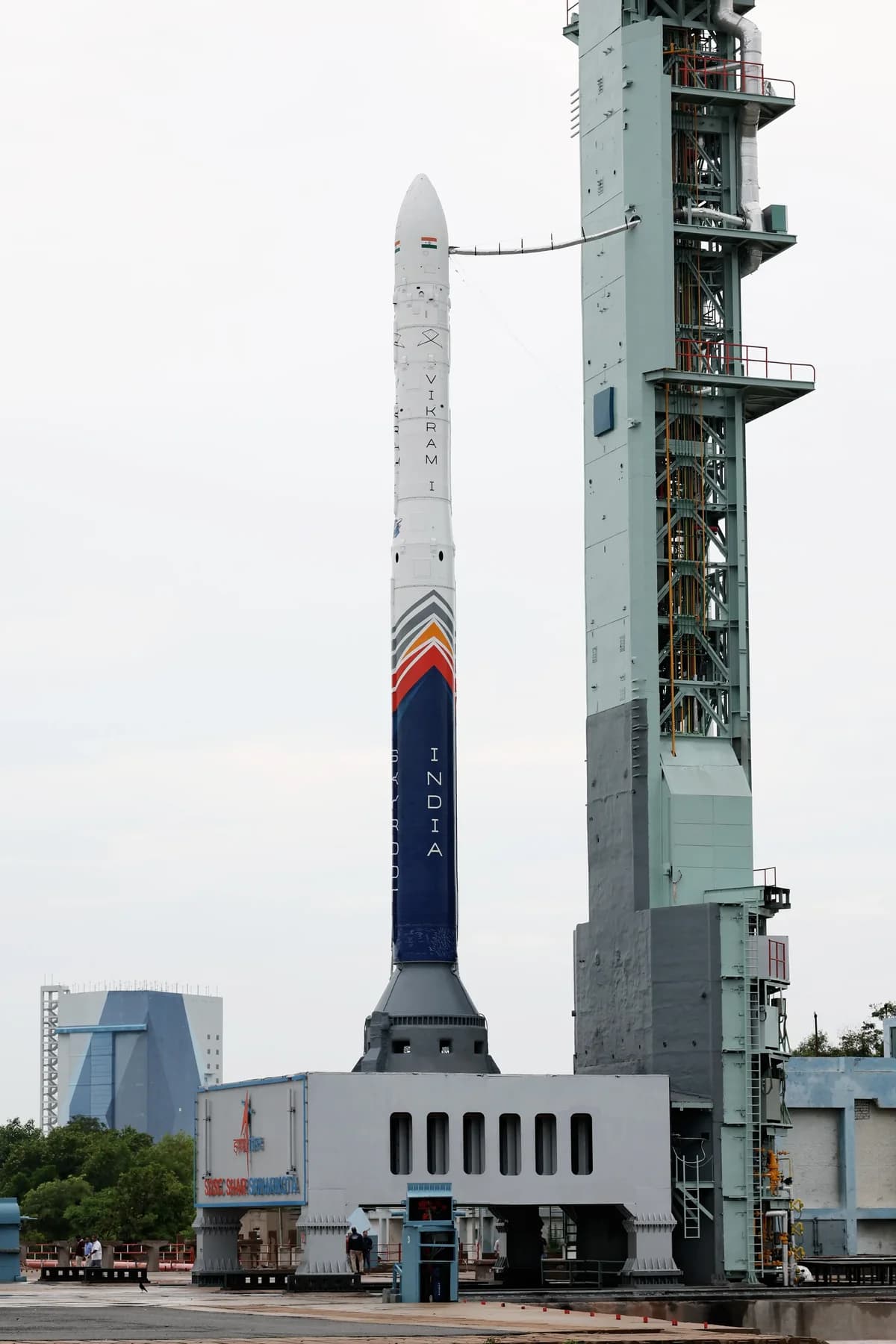
22 Aug 2026 · 49 min read
India's Launch Privatization, Audited: Two Flights, Then More Than Six
Vikram-1 proved India's private launch engineering; Parliament's own two-then-six planning figure shows that the missing manifest remains the business test.
22 Jun 2026 · 42 min read
AI1 and SpaceX's $1.77 Trillion IPO: What the Orbital-Compute Option Is Actually Worth
AI1 is a credible engineering option, not a proven business: the gap between Musk's unveiling and SpaceX's own S-1 risk language is the investment case.

28 Apr 2026 · 45 min read
The Orbital Compute Contest: US-China Space Data Centers and Three Windows for Asia-Pacific
US and Chinese orbital-compute plans could reshape AI infrastructure, but APAC's near-term openings lie in validation, standardized subsystems, and rule-setting.