
SpaceX Is Apple. Now Someone Needs to Build Android.
SpaceX has built a closed, vertically integrated orbital stack; the opening is an interoperable “Space Android” spanning launch, satellites, networks, and compute.
Method & disclosure
Confidence: High for market structure analysis. Medium for orbital compute timeline — Musk's timelines have historically run late. Medium for the blueprint specifics — treat as reference architecture, not a vendor procurement guide. The directional logic will outlast the specific numbers.
Review mode: Human + AI cross-check
Writing support: AI assisted
Singapore Space Agency
On this page · 9
- 01What "Space Android" Means Here
- 02Part One: SpaceX Is Apple, And That Is Exactly the Problem
- 03Part Two: The Orbital Compute Thesis
- 04Part Three: The Competitors Are All Playing the Wrong Game
- 05Part Four: Space Android Is Already Forming — In the Compute Layer
- 06Part Five: The Economic Case For Space Android
- 07Part Six: A Reference Architecture for Space Android
- 08Part Seven: Who Should Build It and Where
- 09Conclusion: Build the Boring Layer
Key findings
The argument in brief
- The article frames SpaceX as the Apple-like closed stack of orbital infrastructure, with Space Android as the missing open platform layer for compute in orbit.
- The key opportunity is not open-source rockets or generic GPU cloud in space, but standardized payload interfaces, orbital runtimes, mission APIs, and multi-vendor governance.
- Loft Orbital, Kepler, DARPA Blackjack, and Amazon Leo each show pieces of the architecture, but none yet aggregates them into a neutral developer-facing ecosystem.
- The reference architecture is deliberately boring: commercial satellite buses, F Prime, SatCat5, OpenMCT, Docker/K3s boundaries, and outcome-priced early missions.
SpaceX Is Apple. Now Someone Needs to Build Android.
Two statements, made five months apart, define the moment we are in.
On February 4, 2026, Elon Musk told an audience that included John Collison and Dwarkesh Patel: "In 36 months, but probably closer to 30 months, the most economically compelling place to put AI will be space. Five years from now, my prediction is we will launch and be operating every year more AI in space than the cumulative total on Earth."^[1]
On May 5, 2026, Jensen Huang told a ServiceNow conference in Las Vegas that the compute required for agentic AI is approximately 1,000 times higher than generative AI — his framing was explicit: the world was spending roughly $300-400 billion per year on classical computing infrastructure, and AI's demand multiple means the implied infrastructure build is not incremental. "So the amount of token generation capability that the world needs is a lot more than $700 billion," Huang said. "And I'm fairly confident that we're going to continue to generate tokens, we're going to continue to invest in compute capacity from this point out."^[2]
These two statements are not independent. They are about the same thing viewed from different altitudes. Jensen is describing an Earth-bound infrastructure demand that cannot be satisfied cheaply on Earth. Musk is describing where part of the solution eventually goes.
What neither of them is describing is the governance question that follows: who controls the infrastructure layer, and on what terms?
That question is where this article starts.
Author's note: This is an opinion and analysis piece. Musk's orbital AI timelines are stated as his prediction — his track record on timelines is mixed at best. Jensen Huang's 1,000x figure is drawn from direct media quotes; some reports use "1,000 percent" (technically 10x) and others "1,000 times" (1,000x). The directional argument holds under either reading. Blueprint specifics in Part Six should be treated as a reference architecture, not a procurement guide.
What "Space Android" Means Here
Before going further: this article will use "Space Android" in a specific technical sense, not a metaphorical one.
Space Android is NOT:
- Open-source rockets
- A cheap clone of SpaceX
- A national satellite constellation
- Generic GPU cloud in orbit
- A consumer satellite internet alternative
Space Android IS:
- A standard payload interface
- An orbital compute runtime
- A mission API accessible to developers
- Multi-vendor hardware compatibility across satellite bus providers
- A developer-facing application ecosystem that does not require satellite engineering expertise
- A governance layer credible to governments and enterprises from multiple geopolitical regions
The Apple/Android analogy works precisely because Android's value was not in the hardware — it was in the abstraction layer that let any developer build applications without understanding the underlying silicon. The question this article is asking is: does an equivalent abstraction layer exist for orbital compute, and if not, what would it take to build one?
Part One: SpaceX Is Apple, And That Is Exactly the Problem
The Analogy That Industry Keeps Making
In May 2023, DigiTimes ran a report quoting Taiwanese satellite component suppliers calling for an "Android-like ecosystem" to counter what they explicitly described as SpaceX's "Apple-like strategy."^[3] Three years later, that framing has become received wisdom across the commercial space industry.
The analogy is correct. What is less discussed is that it is correct in ways people do not find comfortable.
Apple's vertical integration works because Apple controls the experience. Every pixel of iOS, every nanometer of the M-series chip — Apple owns it because Apple believes (correctly) that the experience degrades when someone else makes decisions. The result is a product people pay a premium for, a supply chain that depends on Apple more than Apple depends on it, and a competitor environment in which everyone else is perpetually chasing a target that keeps moving.
SpaceX has achieved the same thing in a different market with different underlying logic. The numbers bear this out: SpaceX accounts for more than 90 percent of mass launched to orbit by commercial providers. Falcon 9's per-kilogram cost to LEO is roughly $2,700 — compared to $10,000-plus for alternatives from a few years ago.^[4] The vertical integration that makes this possible is extraordinary: Merlin and Raptor engines developed internally, avionics built in-house, Starlink satellites manufactured at scale at Redmond, user terminals designed from the antenna array to the baseband chip by SpaceX teams. The Falcon 9 booster turnaround record stands at 72 days between recovery and re-flight — a pace inconceivable if a single critical subsystem were sourced externally.^[5]
Starlink closes the loop. SpaceX launches its own satellites on its own rockets, services its own customers with its own hardware, and generates the revenue that funds the next generation of rockets that serve even more satellites. It is not a supply chain. It is a closed thermodynamic system.
Where the Apple Analogy Actually Predicts SpaceX's Vulnerability
Apple's competitive moat is ecosystem lock-in — iOS, the App Store, iCloud, the M-series silicon. Switching costs are genuine and high. SpaceX's competitive advantage is primarily cost leadership, not ecosystem lock-in. If a competitor achieves equivalent cost at equivalent reliability, SpaceX's market position is contestable in a way Apple's is not.
The orbital compute inflection specifically amplifies the lock-in risk. When the infrastructure being competed for is not rockets but AI compute in orbit, SpaceX+xAI's potential vertical stack encompasses the launch layer, the orbital hardware layer, the chip manufacturing layer, and the AI application layer simultaneously. That is a category of concentration that markets and governments have not previously had to confront.
Enterprise and government customers have a specific set of values that differ from consumers: they want redundancy, supply chain sovereignty, and the ability to switch providers when geopolitical circumstances change. They do not pay a premium for elegance; they pay a premium for resilience. This structural preference is the space in which Space Android can compete — not on cost against SpaceX's flywheel, but on openness and governance.
Part Two: The Orbital Compute Thesis
The Power Problem Is Real
Musk's February 2026 statement deserves analytical attention, independent of questions about his timeline accuracy. The physics argument he made is directionally correct.
At a March 2026 event in Austin, Musk's core argument was about power density: "You're power constrained on Earth. Space has the advantage that it's always sunny."^[6] A satellite in a sun-synchronous orbit receives approximately 1.4 kilowatts per square meter of unobstructed solar irradiance. Ground data centers face genuine power constraints — Jensen Huang noted that a single 500-megawatt data center now requires 30,000 truckloads of equipment to build, plus a separate power plant, and the four largest cloud providers are reported to have collectively committed more than $710 billion in AI infrastructure capex for 2026 alone.^[7]
The power constraint is real. Whether orbital deployment is the economically viable solution, and when, remains genuinely uncertain.
The Thermal Problem Is Also Real
Orbital thermal management is not free cooling. This point deserves directness.
The absence of atmospheric convection in vacuum means the only mechanism for rejecting waste heat is thermal radiation. The Stefan-Boltzmann equation governs radiative power output as a function of emitting surface area, temperature, and emissivity. For a 12U CubeSat running a 20-watt GPU payload, the available radiating surface area is roughly 0.02 square meters — as an illustrative order-of-magnitude estimate, not a precise engineering calculation, which depends on orbit, attitude, materials, coatings, and internal thermal paths. At typical operating temperatures, this constrains effective radiative heat rejection to single-digit watts, creating a thermal budget that is tightly binding for compute-intensive applications.
Scaling to gigawatt-class orbital data centers requires large deployable radiator panels — a mass, volume, and engineering challenge that is non-trivial. The SpaceX orbital data center illustration released in March 2026 shows deployable radiator arrays substantially larger than the compute modules themselves.^[6] This does not make orbital compute infeasible; it means thermal engineering is one of the binding constraints on the timeline and economics. The solar power advantage is real; the thermal advantage is conditional on solving radiator deployment at scale.
Musk's 30-Month Claim in Context
"You can mark my words, in 36 months but probably closer to 30 months, the most economically compelling place to put AI will be space," Musk said in February 2026.^[1] This is his prediction. His previous timelines for Starship, full self-driving, Mars colonization, and various other initiatives have generally run 2-5 years late.
Google's internal analysis is reported to conclude that launch costs need to fall to approximately $200/kg before orbital data centers achieve economic parity with ground facilities.^[8] Starship's cost trajectory, if development proceeds as designed, could reach that range by 2028-2030. The orbital compute thesis is not inevitable. It is a serious infrastructure scenario worth modeling for the first time — that is the appropriate confidence level.
The SpaceX+xAI Strategic Context
According to multiple reports including Fortune and TechCrunch, SpaceX and xAI completed a formal corporate combination in January 2026, creating a unified entity bringing together SpaceX's launch and satellite infrastructure with xAI's AI capabilities.^[9] At a March 2026 event in Austin, Musk outlined the Terafab project: producing one terawatt of processors annually — described as 50 times the combined production rate of all current manufacturers of advanced AI chips.
If this vertical stack is built as described — chip manufacturing, launch, orbital satellites, and AI applications — it would represent a structural concentration of technological infrastructure without precedent in the history of general-purpose computing. The question is not whether SpaceX wins the launch competition. It has. The question is whether the next competition — orbital compute infrastructure — produces the same outcome, or whether the platform economics of compute force a different structure.
Part Three: The Competitors Are All Playing the Wrong Game
Rocket Lab Is Competing Inside SpaceX's Frame
Rocket Lab's trajectory illustrates the strategic challenge facing most SpaceX competitors.
Starting as a small launch provider, Rocket Lab has expanded into spacecraft manufacturing (Photon satellite bus), satellite components through acquisitions, and is developing Neutron for medium-lift launch. The 2025 annual report documented $602 million in revenue, $1.85 billion in backlog, and 21 completed missions.^[10] This is serious execution.
The strategic challenge is not execution quality — it is direction. To be fair: Rocket Lab's Photon platform does have standardized payload interfaces, and Rocket Lab serves customers who need integrated launch and satellite services that SpaceX does not offer. This is genuine differentiation. But the logic of vertical integration — building more internal capability to reduce external dependency — means the competitive frame remains SpaceX's. Competing primarily within SpaceX's strategic frame, at a cost structure that may never achieve SpaceX's launch cadence, limits the addressable market. The more interesting question is what capabilities exist outside SpaceX's frame.
Blue Origin Is a More Expensive Problem
Blue Origin's New Glenn and SpaceX's Falcon 9 serve overlapping but not identical markets — New Glenn is a heavier-lift vehicle. But the reported cost gap illustrates a development approach that did not benefit from SpaceX's years of rapid commercial iteration.^[11] Blue Origin has a real role as a redundancy option for national security launch customers who cannot fully depend on a single provider. It is not building an alternative paradigm.
Terran Orbital Is the Warning
Terran Orbital (NYSE: LLAP) claimed 85 percent internal manufacturing, sustained quarterly losses of tens of millions of dollars, and demonstrated the limits of vertical integration without the launch cadence flywheel that makes SpaceX's model work.^[12] Vertical integration without the economics that justify it is just expensive manufacturing.
The OneWeb Exception That Proves the Rule
OneWeb's supply chain strategy is the most important precedent for what open space architecture might look like in practice.
Rather than in-sourcing production, OneWeb built a distributed supply chain using regional Tier 2 component manufacturers in Europe and Asia, with subassembly at specialized facilities and final integration at a dedicated factory.^[13] The result: a supplier ecosystem with real capabilities, a cost structure more resilient to single-point failures, and a market signal to component manufacturers that scale orders were available outside SpaceX's closed procurement.
The Taiwanese satellite component industry's 2023 call for an "Android-like ecosystem" was partly a response to this: SpaceX is nearly impossible to sell components to because it makes everything internally. OneWeb created a genuine supply chain opportunity. The missing piece above that supply chain is a platform layer that aggregates demand, standardizes payload interfaces, and makes the orbital hardware environment accessible to application developers.
Part Four: Space Android Is Already Forming — In the Compute Layer
The Real Question Is Not Hardware
The instinct when people say "Space Android" is to think about hardware — standardized satellite buses, open-source avionics, common mechanical interfaces. These matter at the component level. But they are the wrong frame for understanding where the actual platform opportunity lives.
Android did not win because it was an open smartphone hardware specification. Android won because it was an open software platform that let any hardware manufacturer build devices and any developer build applications without understanding the underlying silicon. The value was in the abstraction layer and the application ecosystem, not the silicon.
In space, the equivalent is the compute and application interface: the ability to deploy a software payload to a standardized hardware environment in orbit without understanding the underlying satellite engineering. A single-sentence test: can you deploy a container to an orbital compute node with a standard API call?
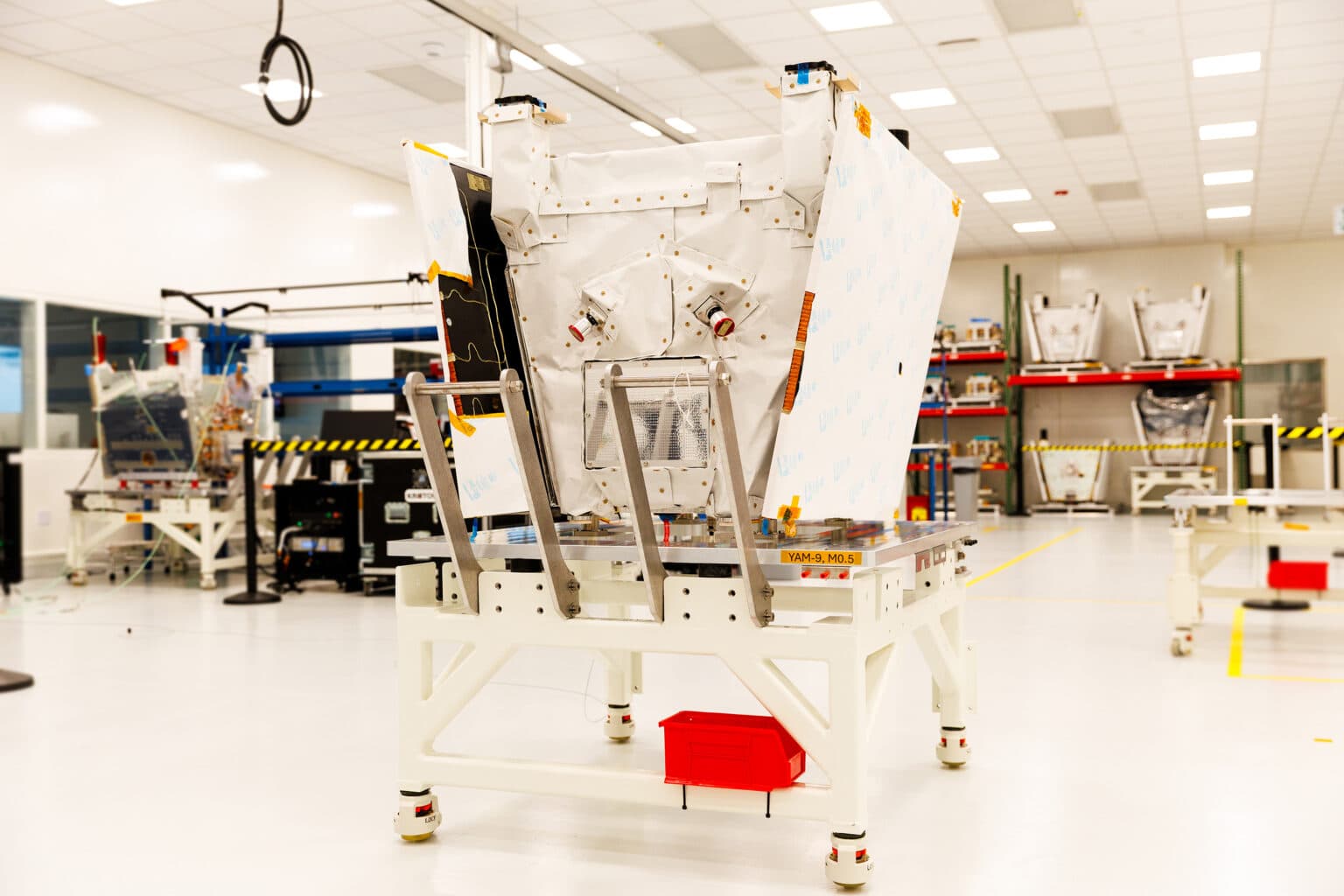
This is exactly what Loft Orbital's Hub+Cockpit+Hub Compute architecture is building toward.
Loft Orbital: The Platform Candidate
Loft Orbital's model deserves more analytical attention than it receives, because it is the first genuinely platform-native business in commercial space.
The Hub is a standard physical and electrical interface allowing any customer payload to connect to any compatible satellite bus without custom integration work. The Cockpit is a browser-based mission control interface letting payload operators command their hardware without a dedicated ground station team. The Hub Compute, first demonstrated in orbit on YAM-9 in December 2025, is a multi-node heterogeneous computing environment allowing multiple AI applications to run simultaneously on a shared orbital platform.^[14]
Loft is AWS-like in abstraction, not in scale. It does not develop applications; it provides the platform on which others develop applications. Its partners — SkyServe for wildfire detection, Little Place Labs for maritime situational awareness, Wyvern for hyperspectral imaging, Helsing for defense AI — are ecosystem participants, not subsidiaries. The €170 million funding round in 2025 suggests this model is demonstrably working, not just theoretically viable.^[15]
What Loft is not: it is not AWS in 2006. It is closer to the Android Open Source Project in 2008 — the architecture is right, the developer tools are early, the ecosystem is embryonic, and the economics require scale that has not yet been achieved. The comparison to Android is useful precisely because Android's early period was marked by exactly this combination of architectural correctness and commercial fragility.
Kepler Communications: The Network Layer
Kepler's optical data relay network provides inter-satellite communication at optical wavelengths — high bandwidth, no spectrum licensing for relay links. The business model extends beyond relay: Kepler sells and leases edge computing hardware deployed on its relay satellites, creating distributed compute nodes at strategic orbital positions.^[16]
Axiom Space's purchase of Kepler on-orbit compute payloads for its planned orbital data center is the first concrete instance of the ecosystem functioning: a platform company buying compute capacity from an infrastructure provider, to be deployed in an asset serving application developers.^[17] Three-layer abstraction in practice, at early and highly constrained scale.
The DARPA Blackjack Blueprint
DARPA's Blackjack program was the first serious government specification for what open space architecture at the payload level could look like: commoditized satellite buses combined with low-cost, interchangeable payloads, each unit targeting costs below $6 million. The mission — a military intelligence constellation assembled from commercially available buses, refreshable with new sensors as threat environments changed, replenishable in weeks rather than years.^[18]
Blackjack produced two lasting outputs: a specification for what standardized payload interfaces could look like, and proof that government customers would pay for access to open architecture constellations. The Space Development Agency's Proliferated Warfighter Space Architecture (PWSA) is the commercial-scale implementation — multi-vendor bus procurement, standardized interfaces, multi-vendor competition at each stack layer. PWSA is creating the market conditions that make commercial Space Android economically viable.
What Amazon Leo's Kuiper Deadline Reveals
Amazon Leo (formerly Project Kuiper) is instructive not for what it is building, but for the pressure it is under.
Amazon's FCC license requires deployment of at least 1,618 satellites — half the Amazon Leo constellation — by July 30, 2026. As of April 2026, Amazon Leo had approximately 239-302 satellites in orbit according to public tracking sources.^[19] This means Amazon must launch hundreds more satellites in roughly three months or risk FCC action on its license — an extremely tight timeline given launch manifest constraints.
This is an existential execution constraint on the only well-capitalized alternative to SpaceX in the LEO broadband market. The fact that Amazon's hybrid approach — proprietary Prometheus chip, AWS cloud integration, multi-launcher procurement — is under this much pressure in 2026 illustrates precisely how difficult it is to compete with SpaceX's closed-loop cost structure when dependent on external launch providers. Amazon Leo may succeed. But the FCC deadline stress test is a real data point about the difficulty of building at-scale orbital infrastructure outside SpaceX's flywheel.
Part Five: The Economic Case For Space Android
Why Compute Is Different From Comms
The market for space-based compute across on-board computing, edge computing, and cloud categories is reported at approximately $108 billion annually, growing toward $300 billion by 2035 at roughly 15 percent CAGR.^[20] A caveat: these figures capture broad "space computing" — including conventional satellite on-board control and ground-side data processing — not solely the "general-purpose orbital compute platform" revenue that Space Android would capture. The addressable fraction for a Loft/Kepler-style open platform is likely smaller, and market sizing should be treated as directional.
The more interesting number is the addressable market that does not yet exist: applications that would be viable on a standardized orbital compute platform at reasonable cost, but are not viable today because building a dedicated satellite requires $20-50M and 2-3 years. An open platform that drives that floor toward $1-3M and 6 months creates markets that currently cannot form.
The AWS parallel is relevant here. When AWS launched in 2006, the enterprise computing market already existed. What changed was the economics of participation. A startup could deploy server capacity for hundreds of dollars per month that would have cost millions to build internally. The result was not a larger slice of an existing pie — it was an explosion of applications that had never existed because the cost floor was too high.
A critical qualifier: orbital compute does not replicate ground cloud computing. Its distinctive value is in applications where the combination of continuous global sensor access and low-latency processing creates outcomes impossible to achieve with ground-based processing of downlinked data. Wildfire detection where minutes matter. Maritime domain awareness for developing-nation coastguards without ground infrastructure. Edge inference for autonomous systems beyond cellular coverage. These are real use cases. "Orbital compute for general-purpose AI workloads competing with AWS on price" is not a near-term use case — it depends on Starship economics that do not yet exist.
The Musk Self-Contradiction
If space becomes the most economically compelling place for AI in 30 months, and SpaceX+xAI controls the launch layer, the orbital hardware layer, the chip manufacturing layer, and the AI application layer simultaneously — the entity controls a monopoly on the infrastructure underpinning the global AI economy.
This creates the strongest possible incentive for every government, hyperscaler, and large enterprise to support an alternative. Amazon is building Amazon Leo partly because it does not want Starlink to be the default infrastructure for AWS customers. The French and British governments hold shares in OneWeb/Eutelsat as sovereign hedge. China is building its own orbital compute stack. None of these individually constitute Space Android. Together, they are the demand signal that Space Android needs to form around.
China's Contribution to the Android Case
China's orbital compute ambitions are both the strongest evidence for Space Android's market opportunity and the clearest example of what happens when you build the wrong version.
Guoxing Yuhang (国星宇航) has 27 satellites in orbit, 21 of which carry AI processing payloads, with a "Star Computing Plan" targeting 2,800 satellites carrying AI inference hardware.^[21] The Zhijiang Lab collaboration deployed 12 compute satellites in 2025 with aggregate capacity of 5 POPS and 100 Gbps inter-satellite laser communication, with 1,000 POPS as the stated target.^[22]
Orbital Chenguang (轨道辰光), incubated from a Beijing research institute in late 2024, is targeting gigawatt-scale space data centers in dawn-dusk orbits, with RMB 57.7 billion in strategic credit intent from 12 banks — a figure whose signal value exceeds its financial certainty, as this platform has previously analyzed in detail.^[23]
To date, the publicly visible architecture of these Chinese initiatives looks more like vertically managed national infrastructure than a developer-facing open platform. This does not mean it will remain so — Orbital Chenguang has described visions of open access to orbital compute capacity. But as currently structured, if China's orbital compute buildout remains a closed national stack, it is a Chinese Apple rather than a contribution to Space Android.
Part Six: A Reference Architecture for Space Android
This section describes a practical technical approach using currently available open-source components and commercial hardware. Treat this as a reference architecture — directional guidance, not a vendor procurement recommendation. Cost estimates are rough orders of magnitude that exclude integration, testing, regulatory compliance, insurance, launch deployer fees, payload safety review, and operational staffing costs that can substantially change actual mission economics.
The Architecture in Three Layers
- Layer 0: The Kernel — standardized satellite hardware with open interfaces.
- Layer 1: The OS — software stack that abstracts hardware complexity and provides standard APIs.
- Layer 2: The Application Interface — developer-facing tools for deploying without satellite engineering expertise.
Layer 0: The Kernel
Do not build a satellite bus. Several high-quality commercial standardized buses are available:
- GomSpace NanoPower P31u (6U): Danish, widely adopted, open electrical interface specification.
- EnduroSat 6U/12U: Bulgarian, strong COTS philosophy, lower cost, documented payload connector standard. For non-US operators, avoids ITAR complications at the bus level.
- ISIS Space CubeSat platforms: Dutch, standard 6U/12U frames, strong academic mission heritage.
- York Space S-class bus: US, ESPA-class, designed explicitly for multi-payload missions, DARPA Blackjack heritage.
On-board computing — three current options:
- Unibap iDPU-15: Swedish, rad-tolerant, based on NVIDIA Jetson Xavier NX, approximately 21 TOPS AI inference throughput. Multiple in-orbit demonstrations. The most proven commercial space GPU module currently available.
- Mercury Systems VPX: US, ITAR-controlled, highest performance for government-adjacent missions supporting NVIDIA A100-class GPUs in hardened form factor.
- Kubos Major Tom / NanoAvionics M6P: Lower-cost general-purpose compute for applications not requiring AI-specific inference silicon.
Thermal engineering: For a 12U platform with an iDPU-15 running at full load in a sun-synchronous orbit, practical thermal management requires careful duty-cycling and may require deployable radiator panels for sustained high-compute workloads. Thermal simulation is a first-order design step, not an afterthought. The 0.02m² radiating surface estimate cited earlier is illustrative — actual thermal performance depends on orbit geometry, attitude, coating properties, and internal thermal paths. No orbital compute deployment should proceed without a credible thermal analysis.
Physical interface: Use the Slingshot "Handle" specification from The Aerospace Corporation — a documented "space USB" design enabling plug-and-play payload connection with automatic identification and configuration.^[24]
Internal communication: Use SpaceWire (ECSS-E-ST-50-12C) for high-speed internal data communication. This is an ESA standard with available IP cores for FPGA implementation.
Rough directional cost (order-of-magnitude only): 12U CubeSat with Unibap iDPU-15, hardware before integration and testing: $300,000-$500,000. SpaceX Transporter rideshare launch at $6,000/kg to SSO: $50,000-$120,000 for a 12U. Total mission cost including first year of operations: $1-3 million directionally, before the costs noted above that can substantially increase actual mission budgets.
Layer 1: The OS
Flight Software: Use F' (F Prime) from NASA JPL, available on GitHub under Apache 2.0. F Prime has flight heritage on multiple NASA missions including Mars Helicopter Ingenuity. It provides payload isolation from bus drivers, a command and telemetry framework compatible with CCSDS standards, and a ground system interface.
Critical architectural note: Orbital software is not terrestrial cloud software. Radiation-induced bit flips, storage corruption, high-latency and intermittent connectivity, power scheduling constraints, deterministic fault recovery, safe/arm command authorization, watchdog architectures, and safety-critical bus separation are requirements with no equivalents in ground-based systems. The developer-facing abstraction in Layer 2 can look cloud-native. The flight-side Layer 1 implementation must be treated as a constrained, safety-bounded, deterministic runtime — not a general Kubernetes cluster floating in orbit. Container isolation and orchestration at Layer 2 is a developer experience abstraction; it requires a hardened, fault-tolerant execution substrate beneath it that K3s alone does not provide.
Satellite Ethernet: Use SatCat5 from The Aerospace Corporation — open-source (MIT license), FPGA-deployable, with in-orbit demonstration on Slingshot 1.^[25] SatCat5 implements standard Ethernet frames over SpaceWire and UART links, meaning any device with an Ethernet interface can communicate on the satellite network.
Containerization: Run payload applications as Docker containers on the iDPU-15's Linux environment, managed by K3s (lightweight Kubernetes). The K3s control plane runs on the ground; K3s agents run on each orbital compute node. Payload operators deploy workloads using standard kubectl commands. This model is appropriate for non-safety-critical payload applications isolated from flight-critical bus operations. It must not be used for bus control or mission-critical functions.
Ground control: Use OpenMCT (Open Mission Control Technologies) from NASA Ames, Apache 2.0. Pair with CCSDS Space Packet Protocol (SPP) for telemetry and CFDP for file transfer.
Ground station access: Three options in increasing operational complexity:
- AWS Ground Station: $1.50-$3.00 per contact minute, globally distributed, direct AWS compute integration. Best for data-intensive missions.
- Azure Orbital: Similar model, Azure integration.
- SatNOGS: Open-source global network, free for non-commercial use, limited throughput, excellent coverage for telemetry collection.
Layer 2: The Application Interface
Orbital Container Registry (OCR): Build using Harbor (open-source, CNCF-graduated). Add validation checking compute requirements, power envelope compliance, and standard input/output interface declarations.
Orbital Scheduler: K3s-based with custom node labels for orbital properties. Reads ephemeris data from Celestrak GP element sets — free, continuously updated, public domain — to compute node positions for workload placement.
Data Interface Standard: For Earth observation applications, use Cloud-Optimized GeoTIFF (COG) for imagery and SpatioTemporal Asset Catalog (STAC) for metadata. For non-imaging sensor data, a standard JSON schema with timestamp (UTC), sensor type, geographic position, data payload, and quality indicators.
Ground API: FastAPI (Python, open-source), documented with OpenAPI 3.0 specification. Authentication via JWT tokens, authorization scoped to individual payload deployments.

The Business Model Reality Check
The economics of this platform are hard, and honesty about this matters.
A 12U satellite with iDPU-15 running at 40% average utilization across multiple customer payloads, at $1.00/compute-hour, generates roughly $87,000 per year in compute-hour revenue. Against total operating costs of $200,000-$500,000/year per satellite (ground station contacts, personnel, orbital operations), this is well below breakeven. At 20 satellites with 60% utilization at $1.50/compute-hour, annual revenue is approximately $2.4 million — approaching breakeven before research and development amortization and satellite replacement costs.
The point is not that the model is proven — these numbers show it is not, at early scale. The point is what it takes to make it viable: more satellites driving coverage continuity, higher utilization driven by mission-value applications, and pricing based on mission outcomes rather than compute-hour resale.
Early revenue must come from government demonstration contracts and strategic customers paying for mission outcomes — wildfire detection response capability, coastguard maritime awareness, disaster response imagery — not from generic cloud GPU economics. This platform reaches economic viability the same way AWS did: by aggregating demand from many early mission customers and using that scale to drive down per-unit infrastructure costs.
This is why Loft Orbital needed €170 million. It is an infrastructure business that requires scale before unit economics work. The argument for an open standard is precisely that aggregating demand across multiple operators, rather than each building their own closed stack, is the path to achieving that scale.
Three Fastest Paths to First Customers
Path A: Government environmental monitoring
National forest services and disaster response agencies in the US, Australia, Canada, and EU spend heavily on satellite data for wildfire detection and flood monitoring. On-orbit processing reduces time-to-detection for active fire response — minutes versus hours — which has direct operational value.
Key question: does the application genuinely need orbital processing? For active wildfire detection, yes. For agricultural monitoring with a 2-3 hour acceptable latency, no. Mission selection for early demonstration should be disciplined around use cases where orbital latency reduction creates unambiguous value.
Target: a technology demonstration contract with a national forest service or coastguard. Revenue: $200,000-$500,000. Partnership model: the platform provides infrastructure, a partner provides the application software (SkyServe's STORM platform is the natural candidate), the customer pays for mission outcomes.
Path B: Maritime domain awareness
Coastguard and naval operations in Southeast Asia, West Africa, and South America have significant demand for vessel tracking, illegal fishing detection, and port monitoring without the budget for dedicated satellite programs. AIS data combined with optical imagery enables meaningful monitoring at reasonable cost when processing happens on-orbit before downlink.
Target customers: Philippine Coast Guard, Nigerian Maritime Administration, Chilean Navy. Procurement pathway: defense attaché relationships and multilateral development bank maritime security programs.
Path C: Research and university developer grants
Offer $10,000-$50,000 compute grants to AI researchers at universities and startups who commit to publishing results and open-sourcing their orbital AI models. Published results become case studies. Target partners for grant funding: ESA's Phi-Lab, NASA's In-Space Validation of Earth Science Technologies, Airbus Ventures.
Part Seven: Who Should Build It and Where
The Missing Organizational Form
If Space Android does not get built, the default is that SpaceX+xAI's vertical stack becomes self-defining for orbital AI infrastructure. This is not a consumer electronics market share question. The iPhone's closed ecosystem is acceptable because you can buy a Samsung. If there is no Space Android, there is no Samsung for orbital AI infrastructure — there is one entity controlling the physical layer of the global AI economy.
The entity that builds the neutral platform layer needs to satisfy several conditions simultaneously: technically credible enough that developers trust the runtime; capitalized by sources whose interests do not align against each other; governed in a way that prevents any single national interest from dominating over time; and politically positioned such that governments from multiple major regions will participate.
This is not a company that a US defense contractor, a Chinese state-linked enterprise, or a European national champion can credibly anchor alone. Each brings the wrong political profile.
Geography and Its Real Constraints
Singapore is one of the more credible domiciles for a neutral orbital platform layer. The case is structural: rule of law credible to international counterparties, access to East Asian and Western capital, physical connectivity to both supply chains, and a track record of hosting infrastructure that multiple competing interests can use.
This argument connects to the broader analysis this platform has published on sovereign deployability. The same structural logic that explains Singtel's selection of Mistral AI and Singapore's maritime connectivity partnerships with OneWeb — credible legal framework, governance that neither bloc controls — applies to orbital compute governance.
However, the "neutrality" claim deserves a direct qualifier. Singapore is a US security partner, subject to ITAR compliance obligations for controlled technologies, and participates in information-sharing agreements that constrain how fully neutral it can be in defense-adjacent contexts. An orbital compute platform hosted in Singapore that serves Chinese defense customers, or that uses US-controlled chip technology in ways that would require export licenses, would face real regulatory constraints. This does not disqualify Singapore — it means the neutrality is partial, which is the honest framing.
Singapore is not the only credible option. Luxembourg, the UAE, and Japan have analogous attributes in different respects. The point is that the domicile for a neutral orbital platform layer should be chosen for governance qualities, not for proximity to the largest engineering talent base.
What Proves This Thesis Wrong
Six conditions under which the Space Android thesis fails:
-
Starship development stalls and launch costs do not reach $200/kg. Orbital compute remains uneconomic for most applications; the concentration concern does not materialize.
-
Ground-based alternatives solve the power problem. Small modular reactors, offshore data centers, or HVDC transmission satisfy AI power demand without orbital deployment.
-
Thermal management remains an unsolved bottleneck. High-density orbital compute requires deployable radiator systems so complex and expensive that the economics never close.
-
SpaceX opens its platform. If SpaceX offers genuine third-party payload APIs and multi-vendor hardware compatibility — becoming the Android — the demand for an alternative platform substantially weakens.
-
Orbital compute customers refuse to put sensitive workloads in orbit. Regulatory, insurance, and security concerns prevent commercial and government customers from deploying anything mission-critical to infrastructure they do not fully control.
-
No entity funds the boring platform work. The application opportunity always looks more fundable than the infrastructure layer. Nobody builds the standard payload interface and the open-source orbital runtime, and the ecosystem never forms around a common standard.
Any one of these could be sufficient. Investors and policymakers considering this space should model which failure mode they find most likely and think clearly about what would have to be true for it not to occur.
Conclusion: Build the Boring Layer
Musk said 30 months. Jensen said 1,000 times. The four largest cloud providers are reported to have committed more than $710 billion in AI infrastructure capex for 2026 alone.
The directional pressure is enormous: AI demand is growing faster than Earth-based infrastructure can economically satisfy, and the physics argument for orbital compute strengthens as launch costs fall. Whether the timeline is 30 months or 10 years, the structural incentive to build the open platform layer is the same — and the window to establish the standard before SpaceX+xAI defines it by default is finite.
The SpaceX+xAI combination is operating at full speed, making credible technical claims about orbital compute on a visible timeline.
The Android counterpart has the technology components. The open-source tools — F Prime, SatCat5, OpenMCT, CCSDS, Docker, K3s — are mature and available. The commercial hardware supply chain — GomSpace, EnduroSat, Unibap, ISIS Space — is ready. The demand signal is the largest in the history of computing infrastructure.
What is missing is the entity willing to build the platform layer rather than the application layer. Every investor wants to fund the AI application on the satellite. Nobody wants to fund the payload interface standard and the orbital container runtime that make a thousand applications possible.
This is the exact dynamic that almost meant Linux never happened, that almost meant Android never happened, that almost meant the internet's TCP/IP stack was replaced by proprietary protocols. In every case, the platform technology required either academic institutions or companies willing to invest in the infrastructure to gain on applications.
The same calculus applies here.
The boring layer is still available to build.
All data cited in this article is drawn from public sources, company disclosures, regulatory materials, and industry reporting listed below. Analysis represents the author's independent views.
Sources25 entries with source notes and links
- Elon Musk on orbital AI timeline — TechCrunch, February 6, 2026(techcrunch.com)
Cheeky Pint podcast with John Collison and Dwarkesh Patel; "In 36 months, the most economically compelling place to put AI will be space"
ServiceNow Knowledge 2026 — Glitchwire, May 2026 — Note: some reports quote "1,000 percent" (technically 10x), others "1,000 times" (1,000x); the Fortune article carries a direct quote
Corroborating linksServiceNow Knowledge 2026 — Glitchwire, May 2026
- DigiTimes, "Taiwan satellite suppliers call for an Android-like ecosystem as SpaceX pursues an Apple-like strategy"(digitimes.com)
May 2023
- SpaceX Official Rideshare Pricing(spacex.com)
Falcon 9 per launch pricing; Transporter rideshare $6,000/kg to SSO
- SpaceX Launches(spacex.com)
Falcon 9 booster turnaround data; multiple mission records 2023-2025
March 21 Austin event; Terafab 1 TW processor production; deployable radiator illustration
$710B capex — Fortune, February 2026 — Reported figures; actual committed spend may differ
Corroborating links$710B capex — Fortune, February 2026
Internal analysis threshold for orbital data center economic viability
- SpaceX and xAI corporate combination — TechCrunch, February 2026(techcrunch.com)
Fortune, February 2026 — Multiple reports confirm January 2026 formal combination; Terafab chip manufacturing initiative announced March 21, 2026
Corroborating linksFortune, February 2026
- Rocket Lab 2025 financial results(investors.rocketlabcorp.com)
$602M revenue, $1.85B backlog, 21 completed missions
- Blue Origin New Glenn vehicle overview(blueorigin.com)
Industry pricing comparisons, Aviation Week 2024-2025; note New Glenn and Falcon 9 serve overlapping but not identical market segments
- Terran Orbital SEC filings(sec.gov)
Quarterly financial disclosures 2023-2024
- TrendForce satellite supply-chain analysis(trendforce.com)
OneWeb distributed supply chain model
- Loft Orbital YAM-9 Hub Compute in-orbit demonstration, December 2025(loftorbital.com)
First commercial satellite with Hub Compute architecture
- Loft Orbital €170M Series C funding round, 2025(loftorbital.com)
- Kepler Communications Kepler Network, Q4 2025(keplercommunications.com)
Optical data relay constellation; on-orbit compute hardware lease and sale
- Axiom Space purchases Kepler on-orbit compute payloads — Data Center Dynamics, 2025(datacenterdynamics.com)
First commercial orbital data center compute procurement
- DARPA Blackjack Program(darpa.mil)
Commoditized bus + interchangeable payload; sub-$6M per-unit cost target
- Amazon Leo FCC license conditions(docs.fcc.gov)
Amazon Leo (formerly Project Kuiper) 1,618 satellite deployment requirement by July 30, 2026; approximately 239-302 in orbit as of April 2026 per public tracking sources including SatNews and SpaceNews
- Market sizing — Fortune Business Insights(fortunebusinessinsights.com)
DataIntelo, Cervicorn Consulting; figures capture broad space computing, not solely open-platform orbital compute revenue
- 国星宇航招股书 (Guoxing Yuhang IPO prospectus, Hong Kong Stock Exchange, 2026)(www1.hkexnews.hk)
27 satellites in orbit, 21 AI payloads; Star Computing Plan
- 财新周刊, "竞夺太空制高点"(weekly.caixin.com)
March 2026 — Zhijiang Lab × Guoxing Yuhang; 5 POPS, 100 Gbps ISL; 1,000 POPS target
- 轨道辰光融资与授信报道(finance.eastmoney.com)
and spacesgp.com, "The Orbital Compute Contest," April 2026 — RMB 57.7 billion strategic credit intent from 12 banks; credit non-binding per prior analysis
Plug-and-play payload connection standard
- SatCat5 — The Aerospace Corporation GitHub(github.com)
MIT license; FPGA-deployable; in-orbit demonstration on Slingshot 1
Continue reading
6 Jun 2026 · 31 min read
Orbit Is Architecture: Why Orbital Compute Is First an Orbit-Design Problem
Orbit choice sets the limits of orbital compute: illumination, heat rejection, radiation, downlink, lifetime, and regulation change across LEO, MEO, GEO, and SSO.
20 May 2026 · 38 min read
China's Orbital Compute Reality Check: Who Is Actually in Orbit?
China's orbital-compute programs now include real in-orbit validation, but public evidence still separates credible engineering paths from constellation-scale claims.
27 May 2026 · 40 min read
Western Orbital Compute, Under Review: Starcloud Moves Fastest, Google Reasons Best
A layered assessment of Starcloud, Google Suncatcher, Axiom, Kepler, and NVIDIA against the thermal, bandwidth, radiation, and sovereignty constraints that decide commercialization.