
Western Orbital Compute, Under Review: Starcloud Moves Fastest, Google Reasons Best
A layered assessment of Starcloud, Google Suncatcher, Axiom, Kepler, and NVIDIA against the thermal, bandwidth, radiation, and sovereignty constraints that decide commercialization.
Method & disclosure
Confidence: High for first-party company pages, official technical papers, and public product announcements. Medium for financing reports, customer utilization, cost timelines, and the author's progress scoring, because several company claims still lack independently verified in-orbit data.
Review mode: Human + AI cross-check
Writing support: AI assisted
Singapore Space Agency
On this page · 14
- 011. The 90-Second Summary
- 022. Methodology and Fact Status
- 033. Why Orbital Compute Became a Capital Story in 2025-2026
- 044. The Layered Ecosystem: Not a Single Progress Ranking
- 055. Starcloud: A 17-Month Unicorn and the H100-First Bet
- 066. Google Project Suncatcher: System Engineering Before Spectacle
- 077. Three Technical Walls: Heat, Radiation, Bandwidth
- 088. NVIDIA's Strategic Board: Capturing the Ecosystem Before Space Android Exists
- 099. Capital Geopolitics: Compute Has a Nationality
- 1010. Cowboy Space: The Power-Beaming Problem Behind a $2 Billion Valuation
- 1111. Axiom Space ODC: The Underestimated Operational Route
- 1212. What Would Falsify This Report
- 1313. Asia-Pacific Founders: Four Traps and Four Structural Openings
- 1414. The Data Points That Matter Over the Next 12 Months
Key findings
The argument in brief
- Western orbital compute is a four-layer ecosystem spanning compute nodes, optical networks, payload platforms, and component infrastructure; ranking every participant together obscures more than it reveals.
- Starcloud has moved fastest in hardware, while Google Suncatcher has published the strongest system-level engineering case and radiation evidence.
- Thermal rejection and useful space-to-ground bandwidth, not headline accelerator performance, are the constraints most likely to govern commercial scale.
- For Asia-Pacific, the strongest openings are thermal systems, optical components, orbital runtimes, and neutral governance rather than another undifferentiated GPU satellite.
The real bottlenecks are thermal control, bandwidth, and the nationality of capital - a layered map from Starcloud to Google Suncatcher, two deep technical dissections, and structural implications for Asia-Pacific founders.
This is the mirror report to “China's Orbital Compute Reality Check.” The methodology is identical; the two pieces are designed to be read together.
Disclaimer: The progress scores in this report measure publicly verifiable progress, not investment value or the probability of future returns. Every numbered factual citation maps to the source list below. Claims that could not be independently verified are labelled accordingly. Nothing in this report constitutes an endorsement of any orbital-compute company.
Methodology: As in the China report, the score weights verifiable in-orbit facts at 35%, regulatory and official documents at 20%, commercial customers and revenue validation at 20%, the scaling engineering path at 15%, and financing and capital signals at 10%.
1. The 90-Second Summary
Western orbital compute is not one market. It is four overlapping layers: compute-node operators such as Starcloud and Axiom; optical-network providers such as Kepler; payload-platform companies such as Loft Orbital; and infrastructure suppliers such as Spacebilt and Sophia Space. Ranking all four on one progress table produces a false comparison.
Starcloud: the first high-performance GPU validation in orbit. The business model is not yet closed, and thermal management is its most important genuine differentiator.
Google Suncatcher: the most complete technical argument in the field. Its Trillium TPU radiation test is the strongest public hardware-reliability dataset so far. Yet its 1.6 Tbps inter-satellite link is constrained by a much narrower atmospheric downlink. That gap is the sector's most underappreciated technical limitation.
Axiom Space: the largest number of operational ODC nodes in orbit, at two. Its route is space-station infrastructure, not a general-purpose AI cloud.
NVIDIA Space-1, built around the Vera Rubin Module: no delivered hardware yet, but NVIDIA has already pulled almost every leading Western participant into CUDA. It is conducting a preventive ecosystem capture before a neutral “Space Android” can form.
Cowboy Space: a $2 billion valuation with no orbital compute and no demonstrated power-beaming system. At roughly 5-8% end-to-end efficiency, the energy-transfer proposition is close to absurd on ordinary commercial economics.
The Asia-Pacific opportunity: not another Starcloud clone, but thermal subsystems, laser-communications components, orbital inference software, and a neutral compute platform that is not constrained by U.S. sovereign capital such as In-Q-Tel.
2. Methodology and Fact Status
This report gives the highest weight to demonstrated in-orbit facts and the lowest weight to financing announcements and future plans.
- Confirmed: official announcements, academic papers, Axiom and Google pages, and YC company materials.
- Media reported: TechCrunch, SiliconAngle, SpaceNews, IEEE Spectrum, and comparable publications. Credible, but their framing still matters.
- Author inference: independent analysis derived from public facts and clearly identified as such.
3. Why Orbital Compute Became a Capital Story in 2025-2026
Before comparing companies, the underlying drivers need to be sized honestly.
Terrestrial data centers are running into a historic convergence of constraints. The International Energy Agency estimates that global data centers consumed about 415 TWh in 2024, or 1.5% of worldwide electricity, and projects roughly 945 TWh by 2030.^[1] In Northern Virginia, California, Germany, and other core markets, grid-connection queues have become materially longer. This is no longer only a capital problem; it is a physical-infrastructure problem.
Jensen Huang's directional point is more important than the disputed number. Huang has described agentic AI as much more compute-intensive than conversational generation. Some reports rendered the increase as “1,000 times,” others as “1,000%,” or roughly ten times.^[2] The multiple is debatable. The direction of travel is not.
The physical advantage is real, but conditional. In a sun-synchronous dawn-dusk orbit, satellites can remain illuminated for most of each orbit. They avoid terrestrial weather, night, and atmospheric losses. Some studies estimate an energy-yield advantage near five times, depending on system boundaries. Vacuum also permits heat rejection through radiation. But “space is cold” is not an engineering solution; the radiator problem becomes harder as power density grows.
The cost threshold is unforgiving. Google's internal work suggests launch prices need to fall toward roughly $200/kg before orbital data centers can compete economically on energy.^[3] Starship might approach that range in the mid-2030s if commercialization and reuse work as intended.
4. The Layered Ecosystem: Not a Single Progress Ranking
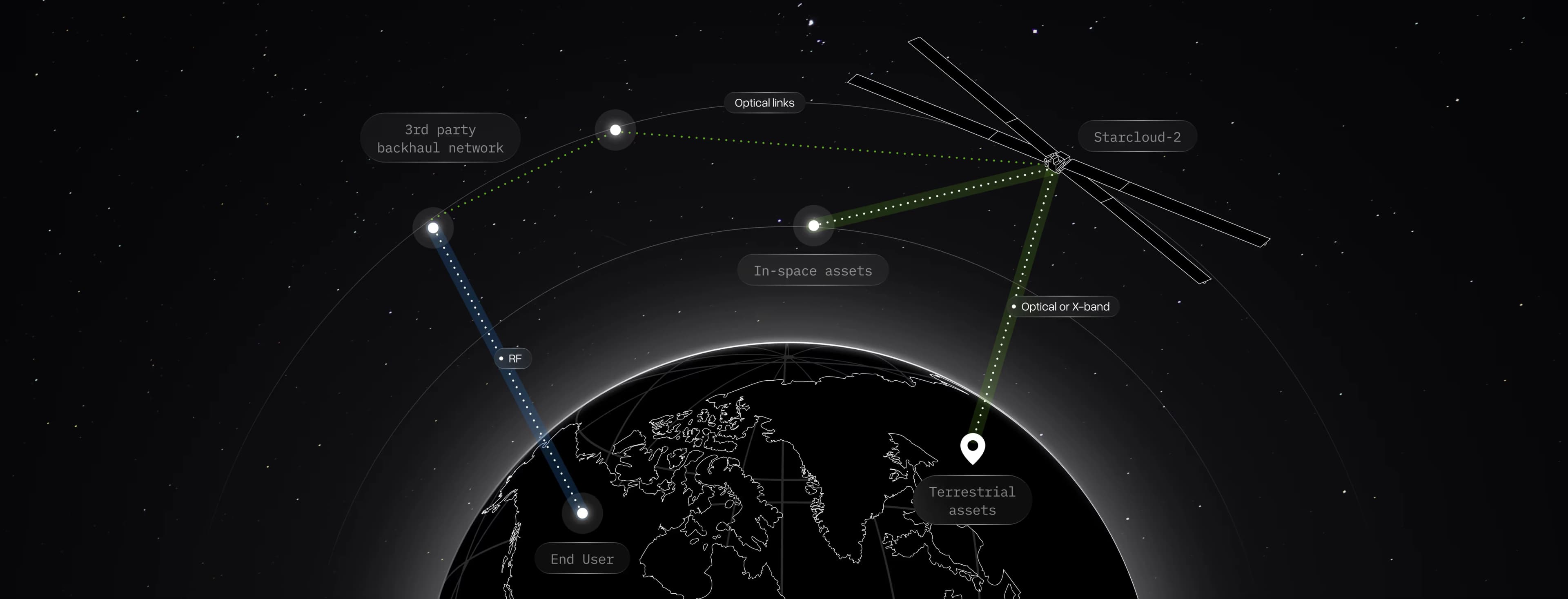
Kepler Communications and Starcloud are not direct comparables. Kepler is building an optical relay network; Starcloud is operating GPU spacecraft. A useful map separates the layers first.
4.1 Four Layers
SpaceX+xAI may eventually span all four layers if the reported corporate integration and orbital-data-center plans mature. Today, however, it is still more strategic intent than operational compute hardware.
4.2 Compute-Node Progress
SpaceX is used as a 100% benchmark for integrated control capacity, not as a claim that it has already commercialized orbital compute.
4.3 Network, Platform, and Component Players
5. Starcloud: A 17-Month Unicorn and the H100-First Bet
5.1 History: Recognizing a Convergence
Starcloud did not begin with a singular technical breakthrough. It began with a timing thesis: around 2024, the launch-cost curve and the AI-compute-demand curve were starting to intersect.
Philip Johnston identified the opportunity while advising government space organizations at McKinsey. His logic was straightforward: if terrestrial data centers are constrained by electricity and heat rejection, and orbit offers structural advantages in both, then falling launch costs make the economics worth calculating for the first time.
The founding team combines three deliberately complementary backgrounds:
These role descriptions are external inferences from public biographies, not internal company definitions.
In-Q-Tel is not a footnote. As the U.S. intelligence community's venture investor, its participation signals that orbital compute has sovereign value: sensitive data can be processed on nationally controlled spacecraft without passing through foreign-influenced ground infrastructure.
5.2 Six Subsystems
Thermal Management
Thermal control is the hardest physical constraint and Starcloud's most credible differentiator. In vacuum, waste heat cannot leave through atmospheric convection. It must be radiated.
Stefan-Boltzmann relation:
P = ε × σ × A × T⁴, whereεis emissivity,σ = 5.67 × 10⁻⁸ W/(m²·K⁴),Ais radiator area, andTis temperature in kelvin. Atε = 0.9andT = 350K, ideal heat rejection is about766 W/m².^[16]
Starcloud-1's roughly 400 W H100-class load could use body conduction and passive surface radiation. Starcloud-2 claims the largest commercial deployable radiator attempted in this category.^[4] The hundred-fold increase in power generation requires a qualitatively different thermal system. That challenge maps directly to Feilden's Airbus experience in large deployable structures.
The inferred architecture uses heat pipes from processors to radiator panels, high-emissivity coatings around ε = 0.85-0.92, anti-solar radiator orientation, and eventually multi-square-kilometer structures for hyperclusters. Passive heat pipes and radiators have decades of space heritage. Active liquid cooling is denser, but pumps, seals, and leakage introduce reliability risks that have not been validated for this use at scale.
Compute Hardware
Starcloud chose not to design a dedicated space chip. It put leading terrestrial accelerators into space. Johnston summarized the bet plainly: the H100 may not be the ideal space chip, but the company wanted to prove that state-of-the-art terrestrial hardware could operate there.^[5]
The benefits are immediate CUDA compatibility, genuine data-center performance, and a shorter development cycle. The costs are radiation exposure, thermal shock, single-event upsets, and a heavier dependence on software ECC and fault recovery.
The separate A6000 damaged during launch is an important negative data point.^[5] Launch vibration and shock, roughly 20-100g in relevant events, make mechanical hardening and isolation first-order design requirements.
Starcloud-2 is described as carrying H100 and Blackwell B200 accelerators, plus Bitcoin ASICs to monetize otherwise idle power. A lower-grade report says AWS, Google Cloud, NVIDIA, and Crusoe delivered hardware to the Redmond integration facility; that detail remains unconfirmed.^[6]
Satellite Platform
Starcloud builds its own bus rather than purchasing a standard GomSpace- or EnduroSat-class platform. Conventional commercial buses are designed for much lower thermal loads. The Redmond payload-manufacturing facility gives the company tighter control over quality and iteration.
The likely orbit is a 500-600 km sun-synchronous orbit, chosen for high illumination, a stable radiator view to deep space, roughly 5 ms propagation latency, and a manageable lifetime.
Software and Operations
Oltean's Azure and Starlink background appears in three architectural choices: containerized deployment for minimally modified CUDA workloads; disconnected operation because ground-station windows are intermittent; and a software fault-tolerance layer to detect and recover from radiation-induced errors.
Communications
This is the least disclosed subsystem. Four commercial customers need meaningful uplink and downlink capacity. Plausible paths include mature but narrower Ka/Ku-band radio, higher-capacity laser links, and third-party networks such as AWS Ground Station.
The unresolved question is simple: what sustained downlink can Starcloud-2 deliver? The answer determines which AI workloads make economic sense.
Launch
SpaceX Transporter rideshare, around $6,000/kg to SSO, is the most economical reliable option currently available. It also creates strategic dependence on a supplier that is planning its own orbital data centers. If SpaceX prioritizes Starship capacity for internal AI spacecraft, the impact on Starcloud would be direct.
5.3 What the Business Can Sell Now
Bitcoin ASICs are cash-flow engineering, not merely compromise. A 10%-utilized H100 costs the same to orbit as a 90%-utilized one but can produce one-ninth of the revenue. Mining can absorb unused electrical output while the AI customer base develops.
5.4 Real Moats and Questionable Ones
6. Google Project Suncatcher: System Engineering Before Spectacle
6.1 Starcloud Proves It Can Fly; Google Models the Whole System
Google is not proving that an accelerator can run in orbit; Starcloud already did that. Google is testing whether self-designed TPUs, formation flying, optical networking, radiation reliability, and launch economics can form one coherent system.
The DeepMind and Google Research paper makes Suncatcher the most technically transparent project in the sector and gives its published parameters unusually high credibility.^[7]
6.2 Four Critical Design Decisions
Trillium TPU v6e Instead of a Commodity GPU
Google owns the TPU stack. That offers better AI performance per watt, the possibility of radiation-aware design, and native integration with JAX and TensorFlow.
Its radiation test is the strongest public hardware-reliability result in the field.^[7]
This result benefits the entire sector, including H100-based systems.
An 81-Satellite Distributed Compute Unit
A single spacecraft is constrained by mass and dimensions. Google's answer is an 81-satellite cluster flying hundreds of meters apart and connected by lasers.
If demonstrated, the satellites could operate like servers in a rack while remaining independently flying vehicles.

1.6 Tbps Between Satellites, Then a Narrow Exit to Earth
Google demonstrated a 1.6 Tbps free-space optical link between a transmitter and receiver in the laboratory.^[7] The widely quoted number is inter-satellite bandwidth. Results still need to cross the atmosphere.
Commercial optical downlinks can reach tens of Gbps in clear weather, but average usable throughput after weather and availability may be closer to 1-10 Gbps, particularly in tropical regions. That is one to three orders of magnitude below the internal cluster link.
Google's response is in-space reduction: do most processing in orbit and downlink the result rather than the raw data, potentially reducing traffic by 85-95%. That is sensible, but it also means orbital compute is a specialized tool before it becomes a general-purpose cloud.
Sundar Pichai has been unusually direct that the project still requires solving many complex engineering problems.^[8]
A Precise Economic Condition
Google's analysis places competitiveness near $200/kg launch.^[3] Historical learning curves suggest the mid-2030s as a plausible window only if Starship commercialization proceeds well.
6.3 Google's Moats
Google's weakness is speed. Starcloud moved from formation to launch in 22 months; Google announced in 2025 and targets two prototypes in 2027. That is not a moral judgment. It is a structural difference in learning cadence.
7. Three Technical Walls: Heat, Radiation, Bandwidth
7.1 Thermal Wall
Passive radiation is the most mature route today. Its area requirement makes scale equivalent to constructing progressively larger structures in orbit. Active liquid cooling may matter for dense systems later, but long-duration reliability is unproven.
7.2 Radiation Wall
Google's Trillium test and Starcloud's H100 operation together show that commercial AI chips can work in mainstream LEO for a reasonable mission duration without traditional radiation hardening.
Unresolved questions remain: degradation beyond five years; altitude and inclination differences; shielding mass versus dose; and chip-to-chip manufacturing variation. A true radiation-engineered Vera Rubin Space Module could industrialize the answer, but delivery remains “at a later date.”
7.3 Bandwidth Wall
The critical number for commercial orbital compute today is not 1.6 Tbps. It is roughly 1-10 Gbps of useful space-to-ground capacity.
8. NVIDIA's Strategic Board: Capturing the Ecosystem Before Space Android Exists
8.1 The Partner List Matters More Than the Ship Date
At GTC 2026, NVIDIA announced the Space-1 Vera Rubin Module, claimed 25x H100 performance, and gave availability as “at a later date.”^[9]
Its partners include Cowboy Space, Axiom Space, Kepler Communications, Planet Labs, Sophia Space, and Starcloud - almost the entire leading Western field.
8.2 Preventive Ecosystem Capture
Before the commercial orbital-compute market exists, NVIDIA is making CUDA the default:
- Partner software is written for CUDA.
- Engineers optimize for NVIDIA hardware.
- Customer workloads arrive as CUDA-native code.
- Switching to AMD, a custom ASIC, or photonics requires expensive rewrites.
When the Vera Rubin module ships, these firms will be the natural first customers because their stacks are already aligned.
8.3 What This Does to Space Android
The emerging Western structure looks less like Android and more like Wintel: operators manufacture spacecraft around a chip and software ecosystem they do not control.
China is excluded from that stack by U.S. export controls. The forced separation is also an opening for Cambricon-class domestic chips and photonic-compute routes. A neutral Asia-Pacific platform would need a non-CUDA compatibility layer, multi-chip hardware support, and governance independent of U.S. sovereign capital. Satisfying all three is difficult, but that is what a genuine Space Android would require.
9. Capital Geopolitics: Compute Has a Nationality
In-Q-Tel was created by the CIA in 1999 to invest in strategically useful technology. Its investments commonly bring close engagement with the U.S. intelligence community, ITAR/EAR compliance, and sometimes limits on foreign participation. For Starcloud, the investment validates defense relevance and may constrain service to some foreign customers.
For a company selling “neutral” compute, capital cannot be treated as cosmetic. U.S. sovereign-linked money and Chinese state capital both define customer boundaries. Potential alternatives include Singaporean, Gulf, Japanese, or Korean institutional capital, with careful governance design.
10. Cowboy Space: The Power-Beaming Problem Behind a $2 Billion Valuation
Cowboy Space, formerly Aetherflux, raised $275 million at a $2 billion valuation in May 2026.^[10] Its concept combines orbital solar generation, laser power beaming, and in-orbit compute.
10.1 The Physics Bill
Only about 4-5 W of 100 W collected in orbit may reappear as electricity on the ground. Using the same power for compute in orbit and sending down a small result is energetically far more attractive.
That does not invalidate every Cowboy use case. Power beaming may serve defense bases or disaster zones; compute may generate most revenue; and external observers cannot know how much of the valuation is assigned to each component. But if power beaming is the primary commercial thesis, the efficiency is a fundamental obstacle.
The company has no orbital compute demonstration, no power-beaming demonstration, and targets a first internally built rocket flight in 2028. The valuation-to-hardware ratio is the most aggressive in the sector.
11. Axiom Space ODC: The Underestimated Operational Route
Axiom deployed two ODC nodes on January 11, 2026.^[11]^[13] That makes it a real orbital-compute event alongside Starcloud and ahead of Google's prototype.
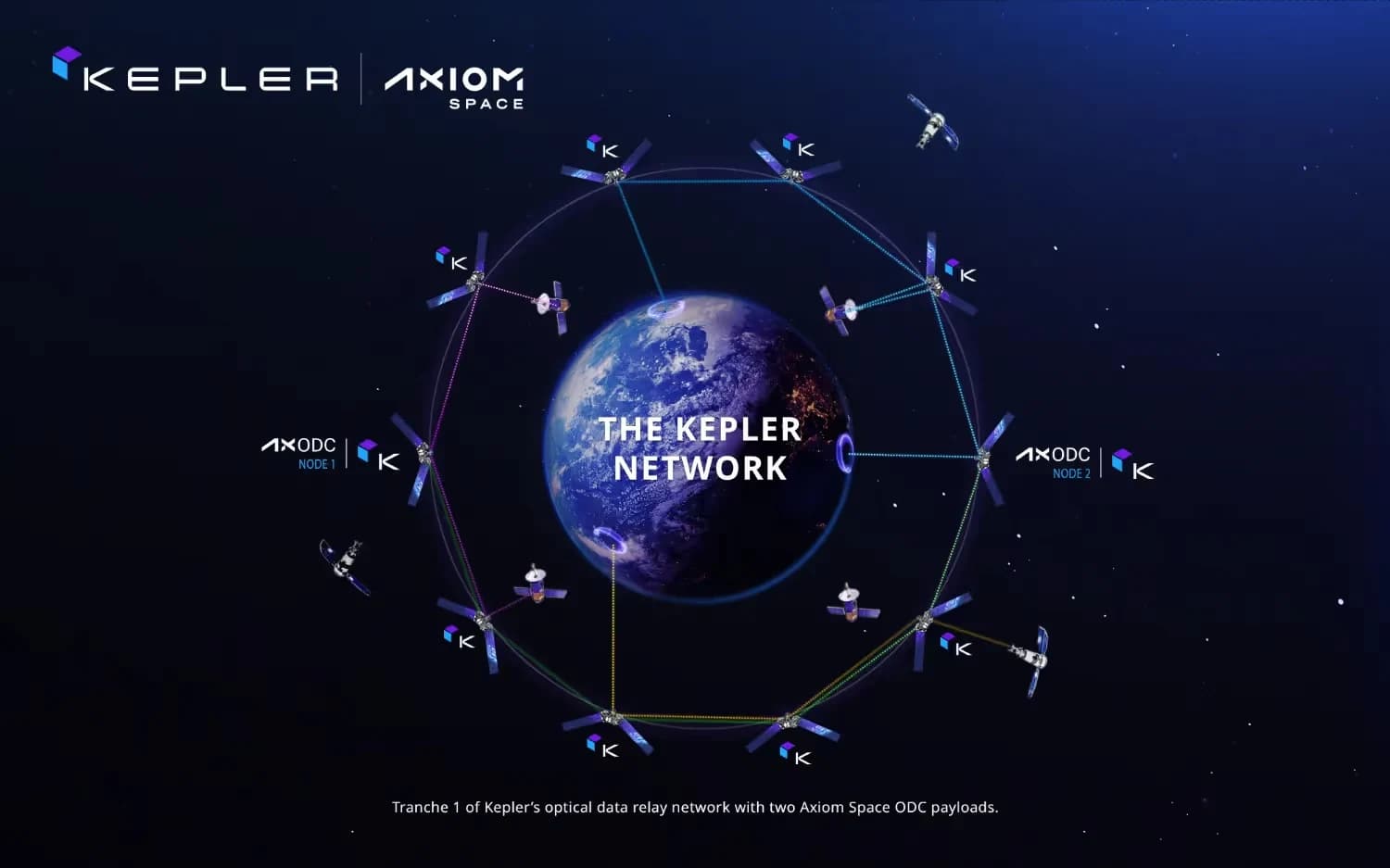
Axiom's advantage is orbital real estate. A station offers more volume, power, and thermal infrastructure than a small satellite. A planned optical ODC node on the ISS in 2027 could use existing station systems.
Its limitation is equally clear: this is not a general AI cloud. It serves companies processing space-generated data, and its scale depends on station construction.

12. What Would Falsify This Report
13. Asia-Pacific Founders: Four Traps and Four Structural Openings
13.1 Trap: Repeating Starcloud's Milestone
Putting an H100 in orbit was valuable when Starcloud did it in November 2025. Being second has little incremental value unless the new system is cheaper, denser, better cooled, regionally differentiated, or built for a different sovereignty regime.
13.2 Trap: Taking Sovereign U.S. Capital While Claiming Neutrality
Capital nationality defines compliance boundaries. A company funded by intelligence- or defense-linked capital cannot credibly promise unrestricted neutrality to every market.
13.3 Trap: Treating 1.6 Tbps Inter-Satellite Bandwidth as Service Capacity
The service bottleneck is downlink, not an internal laboratory link. A business model must be designed around useful space-to-ground throughput.
13.4 Trap: Entering CUDA and Expecting to Own the Standard
A fully CUDA-dependent company can be successful, but it is an NVIDIA hardware contractor, not the owner of a neutral platform standard.
13.5 Opportunity: Specialized Thermal Engineering
Every winner will need better cooling. Japan, Korea, and Singapore have relevant precision-manufacturing capability in high-emissivity coatings, space-grade heat pipes, large deployable structures, and in-orbit thermal-testing services.
13.6 Opportunity: In-Orbit Processing of Asia-Pacific Data
The region produces dense remote-sensing demand: South China Sea vessel monitoring, tropical forest change, typhoon tracking, and ocean-temperature observation. Local data partnerships, regional regulatory knowledge, and Asia-Pacific service windows can become genuine advantages.
13.7 Opportunity: Neutral Compute Governance
Singapore's strongest role may not be building satellites. It may be the legal and governance home for a platform serving non-aligned Southeast Asian, GCC, and South Asian customers: a trusted intermediary rather than the asset owner.
That requires a credible multi-party governance architecture under which governments with different political alignments are willing to place sensitive data.
13.8 Opportunity: A Non-NVIDIA Orbital Runtime
A multi-chip runtime supporting ARM, AMD, Cambricon-class hardware, and photonic accelerators could become the real orbital Android. ROCm and OpenCL exist on the ground, but no mature layer is optimized for intermittent links, radiation faults, orbital autonomy, and heterogeneous space hardware.
The work is software-heavy rather than launch-heavy. It requires the unusual combination of orbital dynamics, GPU programming, and fault-tolerant systems engineering.
13.9 Timing
The direction is established, but the true commercial window is more likely 2027-2030, after Starship economics and Vera Rubin delivery become clearer. The rational strategy is to build thermal, optical, and inference capabilities now, then enter the market in 2027-2028.
14. The Data Points That Matter Over the Next 12 Months
This report is based on public information available through May 20, 2026. Every progress score is a directional author assessment, not an engineering measurement or investment recommendation.
Sources17 entries with source notes and links
- IEA — Energy and AI(iea.org)
2025. Global data-center electricity consumption. A-grade source.
- ServiceNow Knowledge 2026 Conference; Glitchwire, May 2026. Jensen Huang's directional statement on agentic-AI compute, with inconsistent multiples across reports. B-grade source.
- Google Research — Project Suncatcher: An AI Research Moonshot(research.google)
2025. Launch-cost threshold and learning-curve analysis. A-grade source.
- SiliconAngle, Starcloud Series A report, March 30, 2026. “Largest commercial deployable radiator” claim. B-grade source.
- TechCrunch interview with Philip Johnston, March 2026. H100 rationale and A6000 launch damage. B-grade source.
- Tech-Insider report on Starcloud-2 hardware deliveries from AWS, Google Cloud, NVIDIA, and Crusoe. Not independently confirmed. C-grade source.
- Google Research — Project Suncatcher(research.google)
2025. Trillium radiation tests, optical links, formation dynamics, and economics. A-grade source.
- Google — Project Suncatcher(blog.google)
2025. Official project overview and Sundar Pichai statement. A-grade source.
- NVIDIA — NVIDIA Launches Space Computing Platform(nvidianews.nvidia.com)
GTC 2026. Space-1 Vera Rubin Module announcement. A-grade source.
May 2026. Financing, valuation, and 2028 rocket plan. B-grade source.
- Axiom Space — Orbital Data Center(axiomspace.com)
Two ODC nodes and partner network. A-grade source.
- Y Combinator — Starcloud(ycombinator.com)
Hypercluster architecture and company milestones. A-grade source.
- SpaceNews, Axiom and Kepler partnership coverage, April 2025. ODC technical details. B-grade source.
- Data Center Dynamics, Google and Planet partnership coverage, December 2025. Prototype details. B-grade source.
- IEEE Spectrum, Nvidia H100 in Space, November 2025. Starcloud-1 orbital validation. B-grade source.
- SatNews, The Physics Wall, March 17, 2026. Thermal architectures and Stefan-Boltzmann constraints. B-grade source.
- Leviathan Encyclopedia, Starcloud entry. Company history, architecture, and WEF Technology Pioneer information. B-grade source.
Continue reading
22 Jun 2026 · 42 min read
AI1 and SpaceX's $1.77 Trillion IPO: What the Orbital-Compute Option Is Actually Worth
AI1 is a credible engineering option, not a proven business: the gap between Musk's unveiling and SpaceX's own S-1 risk language is the investment case.
6 Jun 2026 · 31 min read
Orbit Is Architecture: Why Orbital Compute Is First an Orbit-Design Problem
Orbit choice sets the limits of orbital compute: illumination, heat rejection, radiation, downlink, lifetime, and regulation change across LEO, MEO, GEO, and SSO.
20 May 2026 · 38 min read
China's Orbital Compute Reality Check: Who Is Actually in Orbit?
China's orbital-compute programs now include real in-orbit validation, but public evidence still separates credible engineering paths from constellation-scale claims.