
AI1 and SpaceX's $1.77 Trillion IPO: What the Orbital-Compute Option Is Actually Worth
AI1 is a credible engineering option, not a proven business: the gap between Musk's unveiling and SpaceX's own S-1 risk language is the investment case.
Method & disclosure
Confidence: High for SEC filings, FCC documents, IPO pricing, and public disclosures. Medium for AI1 specifications, deployment timelines, and unit-economics estimates because the spacecraft has not yet flown.
Review mode: Human + AI cross-check
Writing support: AI assisted
Singapore Space Agency
On this page · 12
- 011. The 90-Second Summary
- 022. Why AI1 Exists Now: An IPO Needed a Third Act
- 033. The AI1 Teardown: What Is Verified, What Is Claimed
- 044. Constraint One — Bandwidth: Why AI1 Fits Inference, Not Synchronised Training
- 055. Constraint Two — The Refresh-Cycle Trap: Where Orbital Economics Invert
- 066. Constraint Three — Launch: A Leveraged Bet on a Rocket That Hasn't Priced a Mission
- 077. Constraint Four — Thermal and Power: The Single-Satellite Budget Closes Only Under Pressure
- 088. Constraint Five — Radiation and Silicon: The Chip Problem SpaceX Is Trying to Out-Vertical-Integrate
- 099. Unit Economics: Where Orbital Actually Wins — and It Is a Narrow Place
- 1010. The Capital-Structure Read: What $1.77 Trillion Is Actually Pricing
- 1111. What It Means Beyond SpaceX
- 1212. What to Watch
Key findings
The argument in brief
- AI1 is a credible engineering option, but SpaceX's own S-1 says orbital AI may never become commercially viable.
- Bandwidth and hardware refresh economics bind harder than the headline thermal problem, making inference a better fit than synchronized frontier training.
- The business case only begins to close if Starship delivers frequent commercial lift near its target cost while Gigasat scales at unprecedented speed.
- Asia-Pacific should own open thermal, optical, interface, runtime, and governance layers instead of attempting a copycat compute fleet.
SpaceX began trading on June 12, 2026 at a $1.77 trillion offering valuation — the largest IPO in history, raising $85.7 billion after the greenshoe and closing its first day worth more than $2 trillion. Three days before the debut, Elon Musk unveiled AI1, a 70-metre orbital data-centre satellite, and reframed SpaceX from "launch plus broadband" into "vertically integrated orbital compute." This teardown argues that AI1 is a real engineering option with a credible path — and an unproven business that SpaceX's own prospectus admits "may not achieve commercial viability." The gap between Musk's stage and the S-1's risk section is the entire investment case. We quantify it, then ask what it means beyond SpaceX — and point to the one ecosystem, China, mobilising a comparable response.
This is a companion to four existing pieces — "SpaceX 2026: Structural Shift" (the pre-pricing IPO logic), "Western Orbital Compute, Under Review" and "China's Orbital Compute Reality Check" (the player-by-player scoring), and "Orbit Is Architecture" (the orbital-physics layer). This article does not re-score the field; it reads the listed company and the AI1 hardware against the constraints those pieces established. Read them together.
Disclaimer: This article is independent analysis. It is not an endorsement of SpaceX, not investment advice or a recommendation to buy, sell, or hold SPCX (though it does independently assess the assumptions embedded in the market's valuation), and not affiliated with any government body. Where we describe SpaceX's plans, we distinguish verified fact (filings, official disclosures, primary technical specs) from company claim (statements by Musk or SpaceX not independently confirmed) from our own inference. We do not score companies in this piece; the scored work lives in the companion reports.
1. The 90-Second Summary
SpaceX fixed its IPO price at $135 per share on June 3 and began trading on Nasdaq under SPCX on June 12, 2026, selling roughly 555 million shares for a ~$75 billion raise at a ~$1.77 trillion offering valuation. The stock opened at $150, touched $168.75 intraday, and closed at $161, up 19% — a first-day close worth ~$2.1 trillion, the largest IPO in market history and nearly triple Saudi Aramco's 2019 record.^[1]^[2] On June 15, underwriters exercised the greenshoe, lifting the total raised to $85.7 billion (≈639 million shares).^[32] Three days before the debut, on June 9, Musk had posted a 30-minute video unveiling AI1, SpaceX's first orbital data-centre satellite.^[3] Whether deliberate or not, the timing made AI1 part of the valuation debate.
Here is the argument, compressed.
What SpaceX actually is, by the numbers. The S-1 shows $18.7 billion of 2025 revenue (up 33%), a $4.94 billion GAAP net loss, and $6.6 billion of adjusted EBITDA. Starlink is the whole engine: $11.4 billion of revenue (61% of the total) and the only segment with a real operating profit ($4.4 billion). Launch is ~22% of revenue and loss-making; the newly absorbed AI segment (Grok/X, the former xAI) is ~17% of revenue and the largest cash sink — 76% of group capex in Q1 2026.^[4]^[5] So the company that listed at $1.77T is, today, a profitable satellite-broadband business subsidising a loss-making rocket programme and a much larger loss-making AI lab.
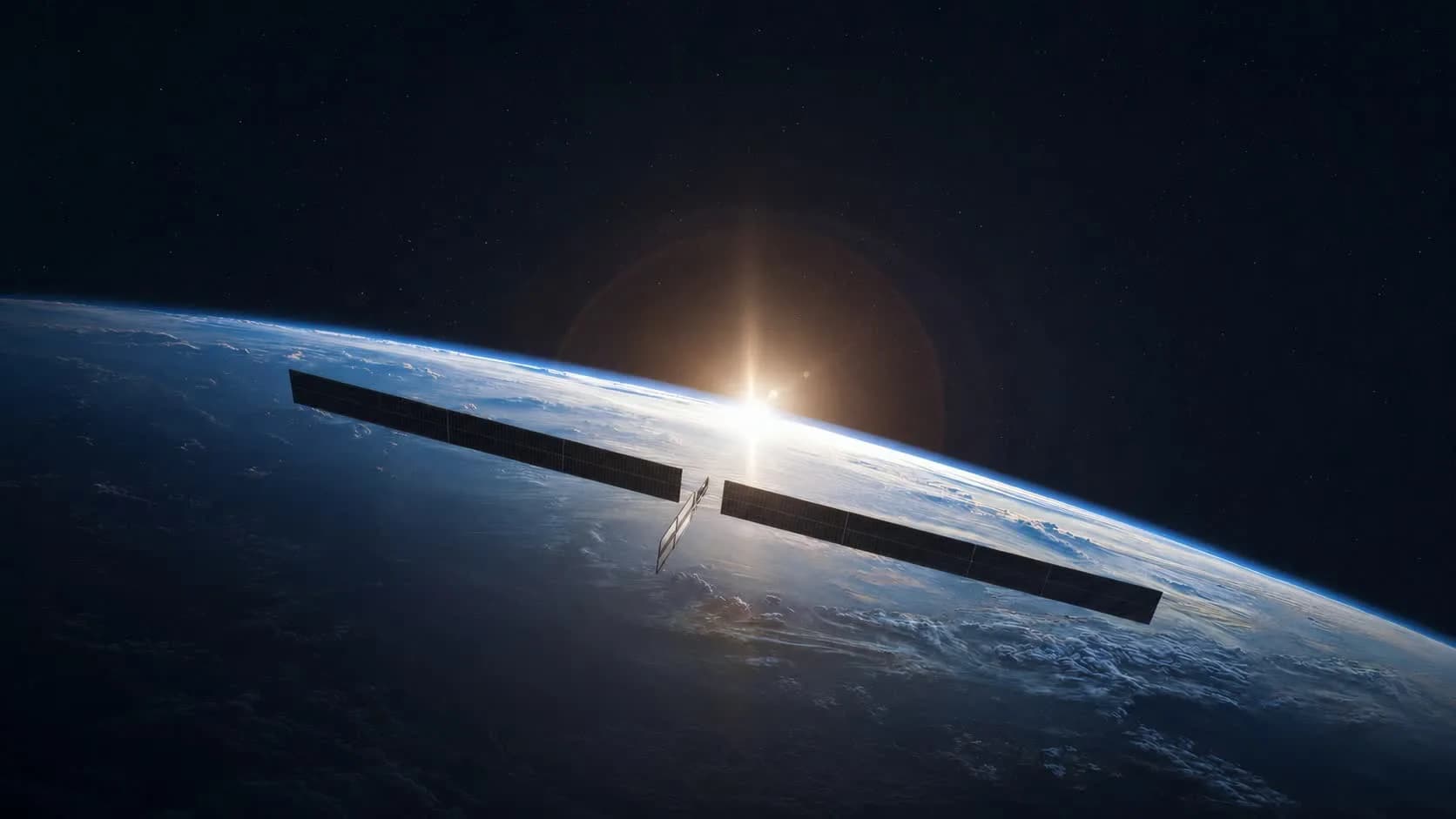
AI1 is the device that makes that arithmetic read as upside instead of drag. Its claimed specs are genuinely ambitious: 150 kW peak / 120 kW average compute, 70 metres tip-to-tip (wider than a 747-8), 20 metres tall deployed, a 150 kW solar array, up to 110 m² of deployable liquid radiators, an interchangeable chip payload, and roughly one GB300-rack-equivalent of compute per satellite.^[3]^[6]^[7] Framed as generation one of an eventual one-million-satellite constellation, with two prototypes in early 2027 and ~1 GW/yr of orbital compute by late 2027.^[8]^[9]
The binding constraints are physical and economic, not promotional. Stack them in order of how hard they bind:
- Bandwidth, not thermal, is the real wall. Frontier training needs 800 Gbps–1.6 Tbps of low-latency GPU-to-GPU interconnect (NVLink/InfiniBand class). Optical inter-satellite links run 25–100 Gbps per channel. You cannot spread one synchronised training run across orbiting nodes without cratering GPU utilisation. So AI1 is poorly matched to tightly-synchronised, multi-node frontier training; its near-term fit is inference, preprocessing, and communication-light adaptation — and SpaceX's own FCC filing implicitly concedes this by routing traffic as a petabit mesh to Starlink and down to ground.^[10]^[11]
- The refresh-cycle economics run backwards. On the ground you build the shell once (30–40-year life) and forklift chips through it three to four times a decade, recovering non-zero residual value each cycle (resale, redeployment, lower-tier workloads). In orbit you relaunch the entire structure every 5–6 years and recover nothing. That asymmetry, not the electricity bill, is what one detailed teardown calls the "line nobody prices."^[11]
- The whole case is a leveraged bet on Starship cost. At Falcon 9's ~$2,700/kg, AI1 is uneconomic on arrival. The model only closes near Starship's $100/kg target — a rocket that, per the filing's own framing, has flown ~11 test flights and never a priced commercial mission.^[7]^[12]
- Thermal is not obviously fatal, but the disclosed single-satellite budget is incomplete. A 110 m² radiator rejects ~154 kW only at an aggressive ~120 °C surface, and the same 150 kW solar array must also power the bus, pumps, comms, attitude control, and conversion losses — so the radiator area is plausible while the system-level power-and-thermal budget is unproven. The critique bites hardest at gigawatt scale (radiator area grows toward km²-class surfaces) and on engineering details (eclipse cycling, atomic-oxygen erosion, the coolant-to-radiator temperature drop).^[6]^[13]
The honest call. AI1 is a credible option, not a proven business. The physics of solar-plus-radiative-cooling in orbit is precedented; SpaceX is the one operator that has actually flown a 6,000-plus-satellite constellation; the demand it points at (AI compute scarcity) is real. But the unit economics are unproven, the timeline is aggressive to the point of fiction, and SpaceX's own S-1 says so: orbital AI compute "involve[s] significant technical complexity and unproven technologies, and may not achieve commercial viability."^[14] Musk called space-based AI a "no-brainer" on stage; the filing he signed says it might never make money.^[14]^[15] Morningstar prices the entire orbital-AI dream as a call option worth ~$16.50/share inside a stock that listed at $135 — and pegs fair value near $62–63, roughly half the IPO price.^[16]^[17]
What this means for Asia-Pacific. The wrong response is a copycat fleet. SpaceX's moat is vertical integration — launch, bus, chips (Terafab), solar, network — that no APAC actor can replicate. The right response is to own the open layers the vertically integrated giants will not standardise: high-flux thermal subsystems, optical-link components and ground terminals, payload and interface standardisation, orbital runtimes/orchestration, and neutral governance for cross-border compute. That is the thesis our China and US reality-checks already built; AI1 sharpens it.
The rest of this piece does the work behind each of those claims.
2. Why AI1 Exists Now: An IPO Needed a Third Act
Start with motive and timing, because they explain the satellite better than the spec sheet does.
SpaceX has two stories the market already understood. Starlink is a real, profitable, fast-growing broadband business — 10.3 million subscribers by March 2026, up from 2.3 million in 2023.^[4] Launch is a dominant, strategically vital, but structurally loss-making segment carrying Starship's development cost. Those two stories support a large valuation. They do not, on their own, support $1.77 trillion — roughly 94 times trailing sales and a multiple that put SPCX within range of Amazon's market cap on debut.^[2]^[18] For that number you need a third act with a total addressable market measured in the trillions. AI is the only such act available, and SpaceX acquired its entry to it five months before listing.
The xAI absorption was the setup. In early February 2026, SpaceX absorbed xAI in what was billed as the largest merger ever — $1.25 trillion combined, with SpaceX valued at ~$1T and xAI at ~$250B.^[19] Musk stated plainly that a "main reason for the merger was to better build orbital data centers."^[19] By May, xAI ceased to exist as a separate company; Grok and X became SpaceX's AI division.^[19] This is the vertical-integration thesis our "Structural Shift" piece flagged before pricing — launch, network, model, and compute inside one legal entity — now consummated and inside the S-1.
The FCC filing was the option. Back on January 30, 2026, SpaceX had already filed to operate up to one million orbital-data-centre satellites at 500–2,000 km, in dawn-dusk sun-synchronous and low-inclination shells, routing traffic via a "petabit" optical laser mesh through Starlink to ground.^[10]^[20] Our "US-China Orbital Compute" piece read that filing for what it largely is: a regulatory reservation — priority over orbital shells and spectrum, exercised cheaply, in case the economics ever arrive.^[21] A million satellites is not a build plan; it is an option written on the future.
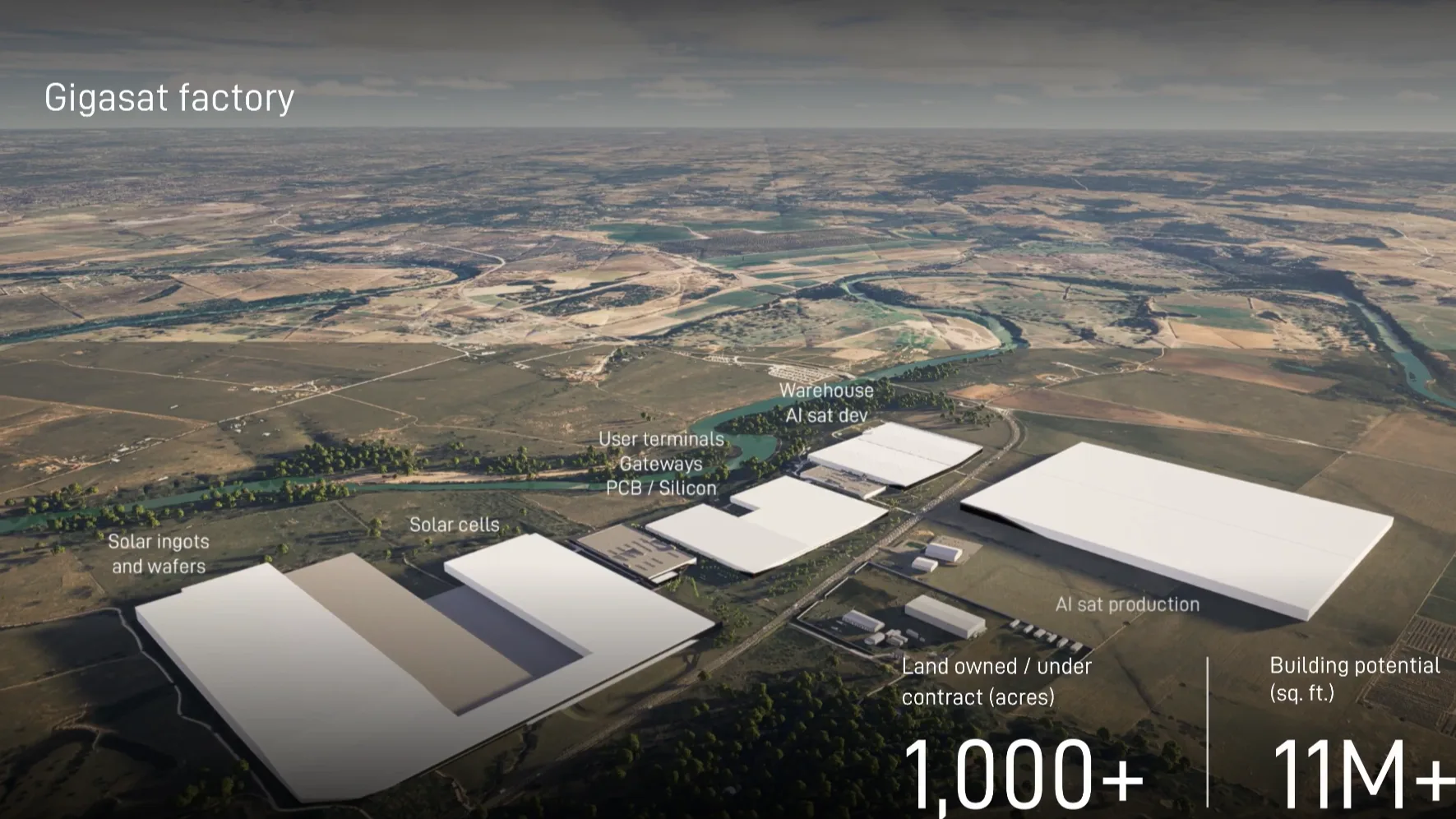
AI1 was the proof-of-seriousness the roadshow needed. A filing for a million satellites is abstract. A 70-metre spacecraft with a spec sheet, a named factory (Gigasat, Bastrop, Texas, 11M ft² planned), and a dated prototype is concrete.^[8] Unveiling it on June 9, three days before SPCX began trading on June 12, converted an abstract TAM into a tangible artefact at exactly the moment institutional and retail investors were deciding what multiple to pay.^[3] Whatever the internal reason, the sequencing had clear valuation relevance: orbital compute entered the pricing debate not as a distant filing but as a named hardware programme with dimensions, a factory, and a prototype date — and SPCX closed its first day up 19%.^[1] We cannot show from public data that AI1 moved the order book; we can show it shaped the story the order book was pricing.
The post-IPO move confirms the pattern. On June 16, 2026 — four days after listing — SpaceX exercised an option to acquire Anysphere (Cursor) for $60 billion in all-stock, the largest acquisition of a venture-backed startup on record, at ~15× revenue.^[22]^[23] Cursor said explicitly it had "been bottlenecked by compute" and would now "leverage xAI's Colossus infrastructure."^[22] Read the mechanism: a newly public company uses its premium-valued stock as currency to roll up AI assets, feeding a compute-demand narrative that justifies the very premium it is spending. The flywheel is real; whether it is value-creating or value-circulating is the open question.
The steelman. A fair reading says the sequencing is not manipulation but disclosure timed to readiness: SpaceX genuinely intends to build this, AI1's design firmed up in the spring, and you unveil when you have something to show. Both readings can be true. The unveil can be sincere engineering and a deliberately timed narrative instrument. What matters analytically is not Musk's intent but whether the artefact survives first-principles scrutiny. So we tear it down.
3. The AI1 Teardown: What Is Verified, What Is Claimed
Here are AI1's headline parameters as disclosed, with provenance flags. Verified-from-spec means SpaceX or Musk stated it in the June 9 unveil or the FCC filing and multiple outlets reported it consistently; it is still a company claim about an unbuilt vehicle, not an in-orbit measurement.
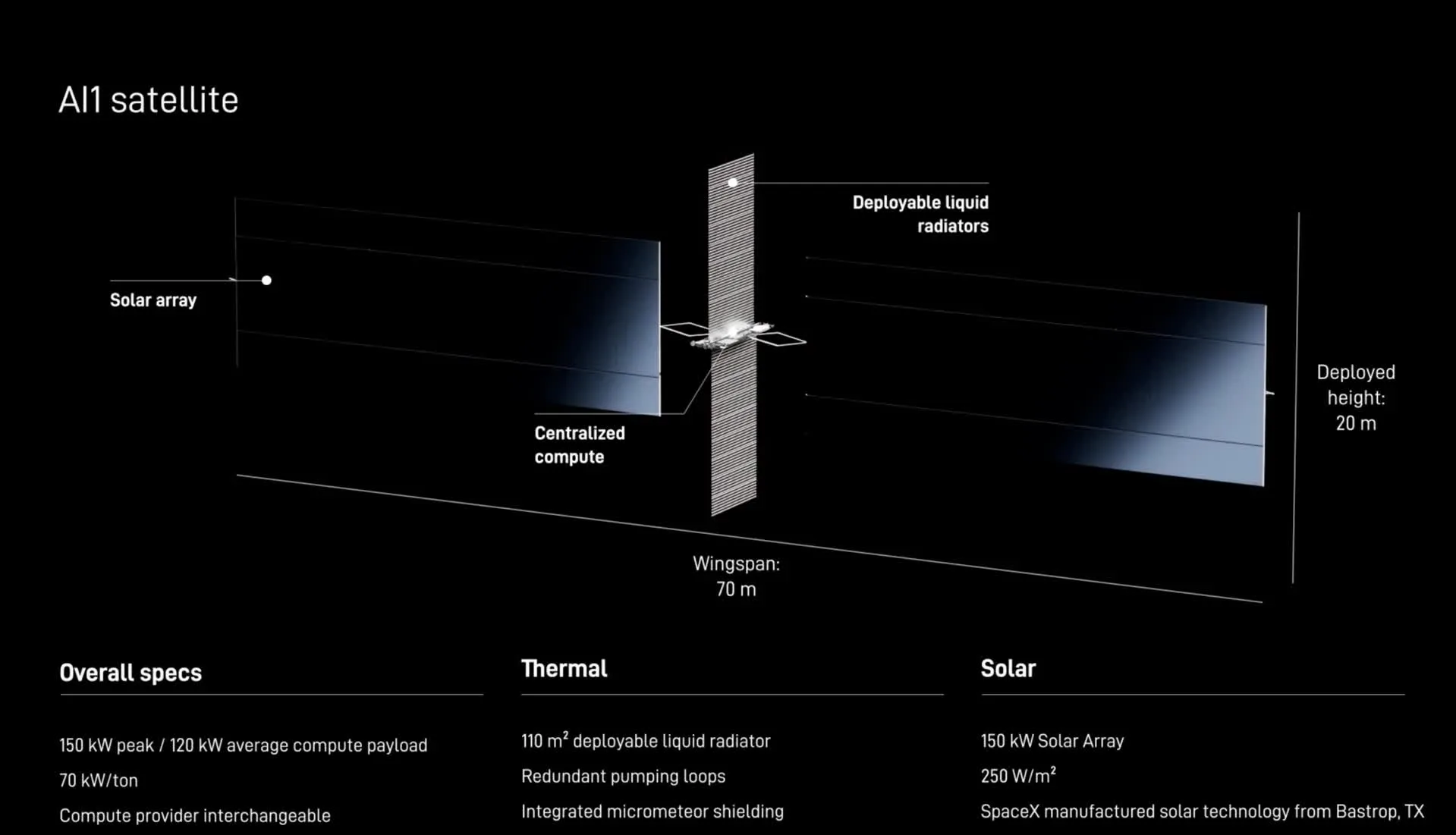
Musk's own framing is that AI1 is "much simpler than a Starlink satellite … you don't have all of the super complex antennas."^[5] A SpaceX engineer put it the same way: simpler than a broadband satellite "because it doesn't need the same large phased-array antennas."^[7] That claim is directionally credible — a compute satellite is a power-and-cooling problem bolted to a laser terminal, not a beamforming problem — and it matters, because "simpler" is the load-bearing assumption under the production-rate and cost claims. We return to whether "simpler" survives the thermal and bandwidth analysis.
Two design choices deserve emphasis up front because they are genuinely smart, not narrative:
- Interchangeable chip payload. Satellites have multi-year design lives; AI accelerators turn over every 12–18 months. Decoupling the bus from the silicon — so the compute module can be revised across production batches without redesigning the spacecraft — is the correct architectural answer to that mismatch.^[6] It does not solve the in-orbit refresh problem (you still cannot swap a chip already in orbit), but it solves the production-line refresh problem.
- Radiative-only cooling. No water, no chillers, no cooling towers. In a world where a single hyperscale campus can consume millions of cubic metres of water a year, "we radiate waste heat to a 2.7 K background and pay only the pumping cost" is a real structural advantage — if the radiator physics closes.^[24]
Now the constraints, hardest-binding first.
4. Constraint One — Bandwidth: Why AI1 Fits Inference, Not Synchronised Training
This is the constraint most coverage underweights, and it is the one that most cleanly bounds what AI1 can and cannot be.
The physics of distributed training. Training a frontier model means splitting it across thousands of accelerators that must exchange gradients on every step, synchronously. The interconnect that makes this work — NVLink, InfiniBand — runs at 800 Gbps to 1.6 Tbps per link with sub-microsecond latency. Starve that interconnect and GPU utilisation collapses, because every chip waits on the slowest link before the next step can begin.^[11]
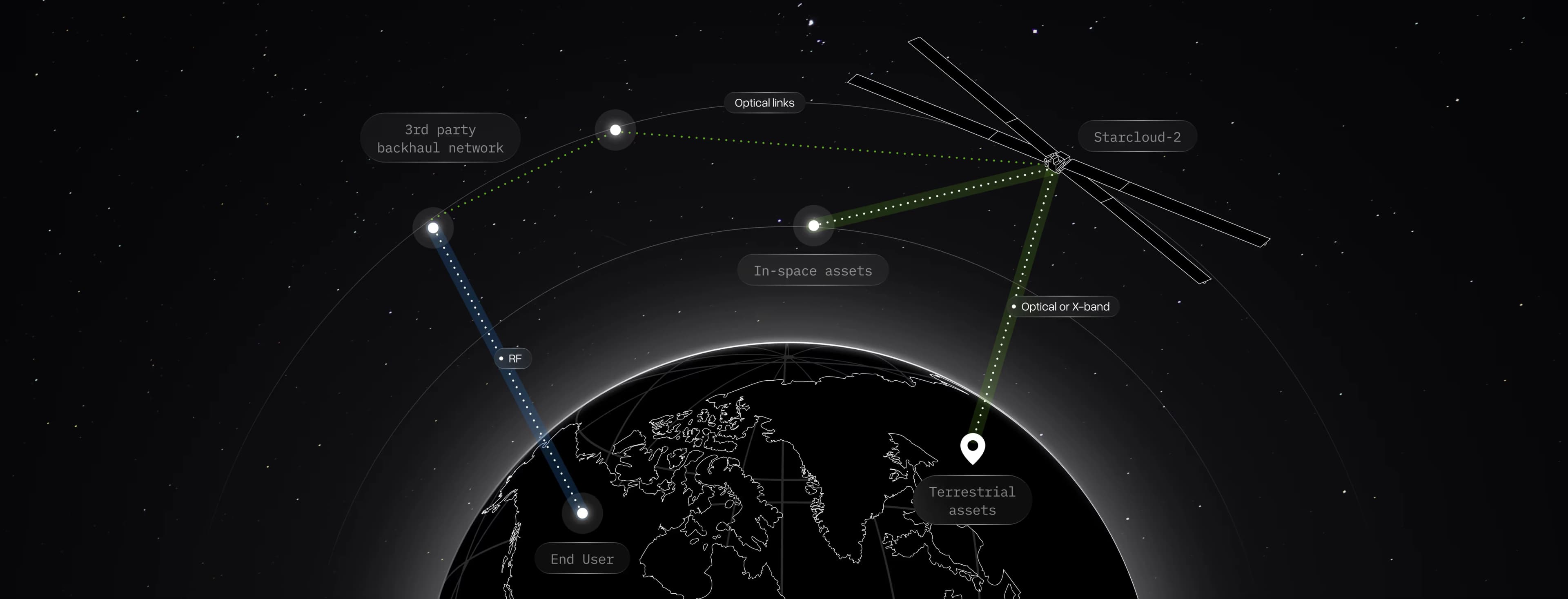
What optics in orbit actually deliver. Optical inter-satellite links — the technology Starlink already flies — are real and improving, but a single laser channel carries on the order of 25–100 Gbps, one to two orders of magnitude below the in-rack interconnect a training cluster assumes.^[11] Worse, the nodes are moving relative to each other at kilometres per second, so links acquire, hold, and hand off; a training run spread across orbiting nodes would serialise on the network and crater utilisation.^[11] Light does travel ~50% faster in vacuum than in fibre, and a petabit mesh aggregate across the whole constellation is plausible — but aggregate mesh bandwidth across a constellation is not the same as the dense, low-latency, all-to-all fabric a single training job needs.^[10]
Keep three bandwidth layers separate, because conflating them is where most orbital-compute hype lives: the intra-satellite fabric between accelerators inside one AI1 (local, high-speed, not subject to this limit); the inter-satellite optical fabric between satellites (25–100 Gbps/channel); and the space-to-ground mesh. The training objection bites only on the inter-satellite layer. So the precise claim is not "orbit cannot train" — single-satellite training, fine-tuning, distillation, RL sampling, and communication-light or asynchronous schemes are not barred — it is that AI1's headline million-satellite scale cannot host one tightly-synchronised frontier run, and that its clean near-term fit is inference and preprocessing.
This is why the architecture is inference. Inference is "embarrassingly parallel" in the way training is not: a request comes up, runs on one satellite (or a few), and the answer comes down. Onboard processing can cut downlink volume by up to ~90% versus shipping raw data to ground — the same edge-compute logic that makes onboard satellite-image processing attractive.^[25] SpaceX's FCC architecture — route within the mesh, hand to Starlink, down to authorised earth stations — is an inference-and-edge topology, not a training-cluster topology.^[10]
The tell is in SpaceX's own books. In Q1 2026, xAI/SpaceX spent $7.72 billion on terrestrial compute (Colossus II and rentals) against ~$1.05 billion of space-segment capex — a 7:1 ratio favouring the ground.^[11] They are training Grok on Earth and pointing inference at orbit. At currently disclosed link rates and cluster architectures, that bifurcation is not merely a deployment choice; it is the economically and technically favoured configuration. The Anthropic deal ($1.25 billion/month through May 2029) and Google rental (~$920M/month) that the bulls cite as compute-demand validation are demand for terrestrial training clusters today, not orbital inference tomorrow.^[26]^[16]
Implication. The honest ceiling on AI1's TAM is the inference market, not the whole AI-compute market — and inference is exactly where latency-to-user, not raw FLOPs, decides where compute should sit. A 3–7 ms one-way hop to a ~600 km satellite plus mesh routing is fine for batch inference and asynchronous workloads; it is poor for interactive sub-10 ms round-trip serving where a terrestrial edge node wins.^[11] So orbital inference competes for a slice of inference — latency-tolerant, scale-driven, power-constrained workloads — not for the AI build-out wholesale. That is a real market. It is not a $1T+ market on a 2027 horizon.
5. Constraint Two — The Refresh-Cycle Trap: Where Orbital Economics Invert
If bandwidth bounds what AI1 can do, the refresh cycle bounds whether doing it ever pays. This is the most underrated argument in the entire debate, and it does not depend on exotic assumptions.
The terrestrial model recovers capital. A ground data centre builds an expensive physical shell — power, cooling, building — with a 30–40-year life. The fast-depreciating part is the silicon, which turns over every 2–3 years. So over a decade you build the shell once and forklift chips through it three or four times, each time recovering meaningful residual value on the displaced GPUs via a deep secondary market. The shell amortises across many silicon generations; the operator captures cash on every refresh.^[11]
The orbital model strands the infrastructure at refresh. A satellite has a 5–6-year working life before radiation, thermal cycling, and orbital decay end it. When its chips go obsolete in 2–3 years, you cannot swap them — there is no orbital forklift. So you either fly increasingly stale silicon for the back half of the satellite's life, or you relaunch the entire structure — bus, solar, radiators, launch cost, all of it — to refresh the compute. Either way you recover zero residual value and pay deorbit/disposal at end of life.^[11] The operator therefore faces a dilemma, not a fixed multiple: either fly a 5–6-year satellite whose silicon is stale for its back half, or early-retire still-working buses, solar, and radiators to chase the 2–3-year chip cycle — paying the full structure again, with zero residual recovery, where a ground shell would have amortised across several silicon generations.^[11]
The numbers, roughly. A skeptical first-principles piece runs the ground baseline as: one GB300-class rack ≈ $6M capital, ~120 kW draw, ~$75,000/yr electricity at $0.06/kWh, so ~$300,000 lifetime energy across 3–4 chip generations. The orbital equivalent pays launch alone of ~$1.2M at an optimistic $200/kg, ~$3.1M at $500/kg, ~$9M at current Falcon 9 rates — i.e. launch by itself can exceed the entire terrestrial lifetime energy bill by 4–10×, before counting the satellite hardware, radiators, and zero residual recovery.^[27] ABI Research, cited in another analysis, put orbital-data-centre TCO at up to 78× terrestrial for equivalent scale, compressing only if Starship reaches its most aggressive sub-$20/kg goals.^[11]
The counter, steelmanned. Orbital optimists make three fair points. First, electricity is only 7–10% of terrestrial lifecycle cost, so "free solar" is a small prize — but the other savings (no grid interconnection queue of 7–10 years, no land/permitting fight, no water, no cooling-tower capex) can be large where the binding constraint on Earth is power availability, not power price.^[25] Second, the interchangeable-payload design means later production batches fly current silicon, narrowing the staleness penalty for the fleet even if individual units age. Third, if Starship truly reaches ~$100/kg and falls further, the launch term shrinks toward the noise. Each point is valid. None of them recovers residual value or eliminates the relaunch-to-refresh structure — they only shrink the penalty.
Our read. The refresh-cycle inversion is the most durable bear argument because it is structural, not a cost curve you can ride down. Cheaper launch helps; it does not change the fact that orbital compute is single-use infrastructure refreshed by replacement while terrestrial compute is durable infrastructure refreshed by upgrade. For orbital to win on TCO, the non-energy terrestrial frictions (interconnection, permitting, water, land) must be worth more than the entire orbital penalty stack. That can be true in specific, power-starved, latency-tolerant niches. It is not true for compute in general.
6. Constraint Three — Launch: A Leveraged Bet on a Rocket That Hasn't Priced a Mission
Every orbital-compute economic case is, underneath, a bet on Starship cost-per-kg. AI1's is more leveraged than most because it is heavy: ~70 kW/tonne implies a multi-tonne spacecraft, and you need a lot of them.
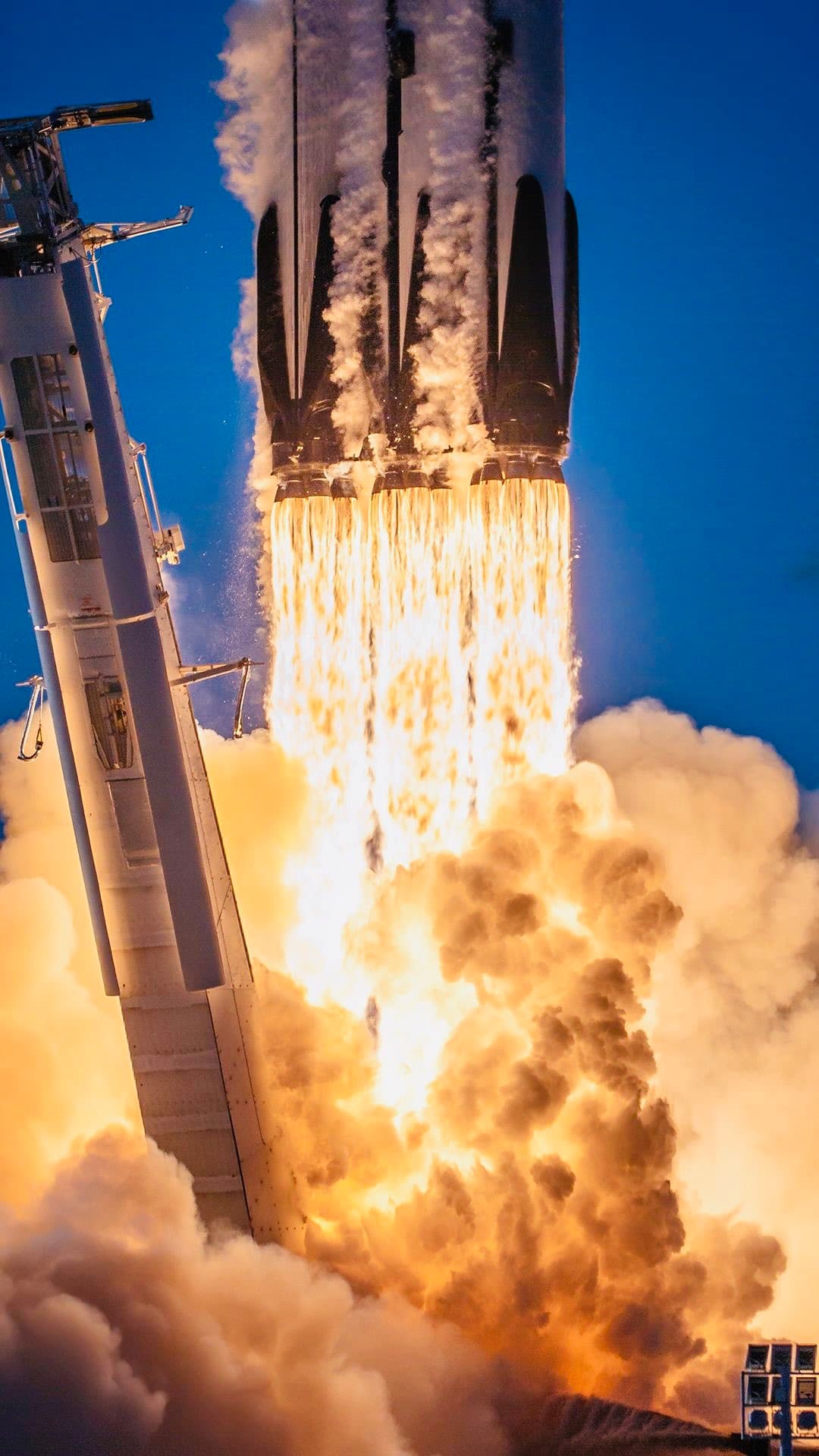
The cost gap is the whole game. Falcon 9 puts mass in LEO at ~$2,700/kg. At that price, the consensus across the skeptical and the balanced analyses is the same: AI1 is uneconomic on arrival.^[7] SpaceX quotes a Starship target of $100/kg or lower.^[7] The business case lives entirely in the ~27× gap between those two numbers — and that gap is unproven. Starship had flown roughly 11 test flights and never a priced commercial mission at the time of the filing.^[15]^[11] The S-1 says it plainly: "Any failure or delay in the development of Starship at scale or in achieving the required launch cadence, reusability and capabilities thereof would delay or limit our ability to execute our growth strategy."^[14]
The deployment arithmetic is brutal. At 150 kW per satellite, 1 GW of orbital compute needs ~6,700 AI1 satellites.^[7] SpaceX says it wants that by late 2027, from prototypes in early 2027 — i.e. ~18 months to deploy a fleet larger than the entire current Starlink constellation, at a pace 3–4× faster than Starlink's historical build.^[7] Starlink took ~4 years to reach ~6,000 satellites. At ~30–50 AI1 per Starship, 6,700 satellites is ~135–225 Starship flights for 1 GW alone — and the FCC reservation's million satellites would be a different order of magnitude entirely (~150 GW peak if fully built, which no one expects).^[7]^[21] Even the balanced analyses call the late-2027 / 1 GW timeline "aspirational rather than committed," noting Gigasat's own solar production is slated to start around end-2027 — the same window the fleet is supposed to be operating.^[6]
The steelman. SpaceX is the only entity on Earth that has built and flown a 6,000-plus-satellite constellation and a reusable orbital-class rocket. If anyone can compress the launch-cost curve and the production curve simultaneously, it is them — and Musk's standard pattern is to miss the date but eventually hit a version of the capability. So treat the late-2027 date as marketing and the capability as a live question. The right posture is not "impossible" but "show me the priced Starship flights and the first prototype's in-orbit thermal data."
Our read. Launch is not the binding constraint people assume — bandwidth and refresh economics bite harder and don't yield to cheaper rockets. But launch is the trigger condition: nothing else matters until Starship demonstrates the cadence and cost. It is the first domino, and it has not fallen.
7. Constraint Four — Thermal and Power: The Single-Satellite Budget Closes Only Under Pressure
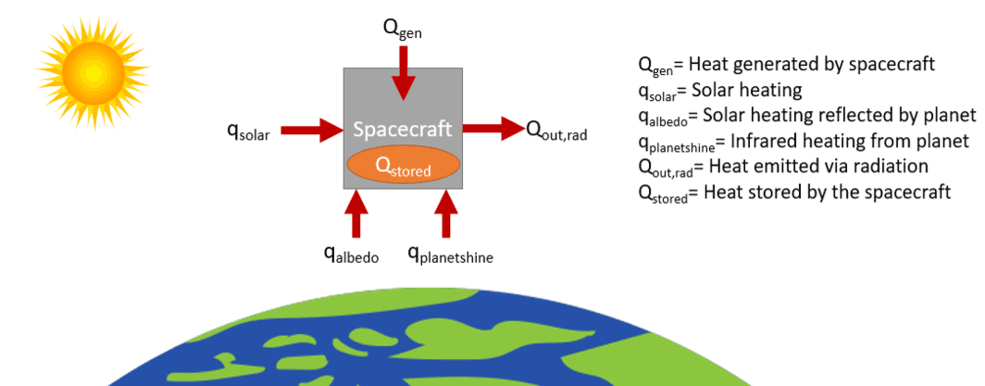
Thermal rejection is the constraint most often cited as the orbital-compute killer. Our "Orbit Is Architecture" brief already did the general physics: under Stefan–Boltzmann, holding ~1 MW of compute near room temperature needs on the order of ~1,200 m² of radiator — vacuum is an insulator, not a free chiller.^[28] The interesting question for AI1 specifically is whether the single-satellite design is self-consistent. Mostly, it is — which is why thermal is a scaling and engineering problem here, not a first-order disqualifier.
The single-unit math is not obviously impossible — but it closes only under an aggressive assumption. A 110 m² radiator rejecting ~1,400 W/m² gives ~154 kW of capacity, just above the 150 kW peak.^[6] But 1,400 W/m² implies a radiator surface near ~120 °C — far hotter than the ~35–50 °C an accelerator cold-plate wants — so the binding question is not the Stefan–Boltzmann arithmetic but the whole thermal chain (temperature lift, emissivity, parasitic pump power, on-orbit degradation) that bridges chip to radiator. And the spec sheet glosses a prior question: a 150 kW solar array cannot power 150 kW of compute, because the bus must also run pumps, avionics, optical terminals, attitude control, error-correction overhead, and conversion losses — so either the usable compute is below 150 kW or peak draw leans on batteries. SpaceX has sized the radiator to the load; it has not shown that the system-level power-and-thermal budget closes.
Where the thermal critique does bite. Three places, all real:
- The coolant-to-radiator temperature gap. One detailed teardown argues that bridging the gap from accelerator coolant (~35–45 °C) up to a radiator hot enough to shed the load (its heat-pump calculation lifts heat toward ~120 °C) adds large parasitic load — it estimates ~86 kW of extra power, ~138 m² of required radiator versus 110 m² claimed, and a realistic power-to-mass of only ~53 kW/tonne against the 70 kW/tonne claimed.^[27] This is a genuine engineering objection. It is also contested: the balanced analyses treat the 110 m²/154 kW figure as broadly sound for radiative rejection and flag the missing details (emissivity, degradation) rather than declaring the budget infeasible.^[6] The truth is unknowable from outside without SpaceX's thermal model — so we flag it as an open, disputed engineering question, not a settled failure.
- Eclipse cycling and erosion. In LEO the satellite passes through sunlight and shadow every ~90 minutes (less in dawn-dusk SSO, which is the point of choosing that orbit), driving thermal expansion/contraction that fatigues structures, while atomic-oxygen erosion degrades surfaces over years.^[6]^[28] Dawn-dusk SSO mitigates the eclipse problem — sitting in near-continuous sunlight is exactly why the FCC filing claims 99%+ solar operation — but it does not eliminate cycling or erosion.^[20]
- Scaling to gigawatts. This is the real thermal story. One satellite is fine; 6,700 of them for 1 GW implies on the order of ~700,000 m² of deployed radiator in aggregate, and the million-satellite reservation would imply km²-class radiating surface across the fleet. The thermal problem doesn't disappear at scale — it distributes, which is better than concentrating 1 GW on one structure, but it multiplies the manufacturing, deployment-reliability, and micrometeoroid-exposure surface enormously.^[28]
Our read. Thermal is a managed uncertainty, not a settled failure, at single-satellite scale — and distribution across many small units is the correct architecture for it. The honest uncertainties are the coolant-temperature/heat-pump question (disputed, unresolvable from outside) and the sheer manufactured radiator area at gigawatt scale. Neither is a reason to dismiss AI1; both are reasons to withhold belief until prototype telemetry exists.
8. Constraint Five — Radiation and Silicon: The Chip Problem SpaceX Is Trying to Out-Vertical-Integrate
The last technical constraint is the one SpaceX's vertical integration is most directly aimed at.
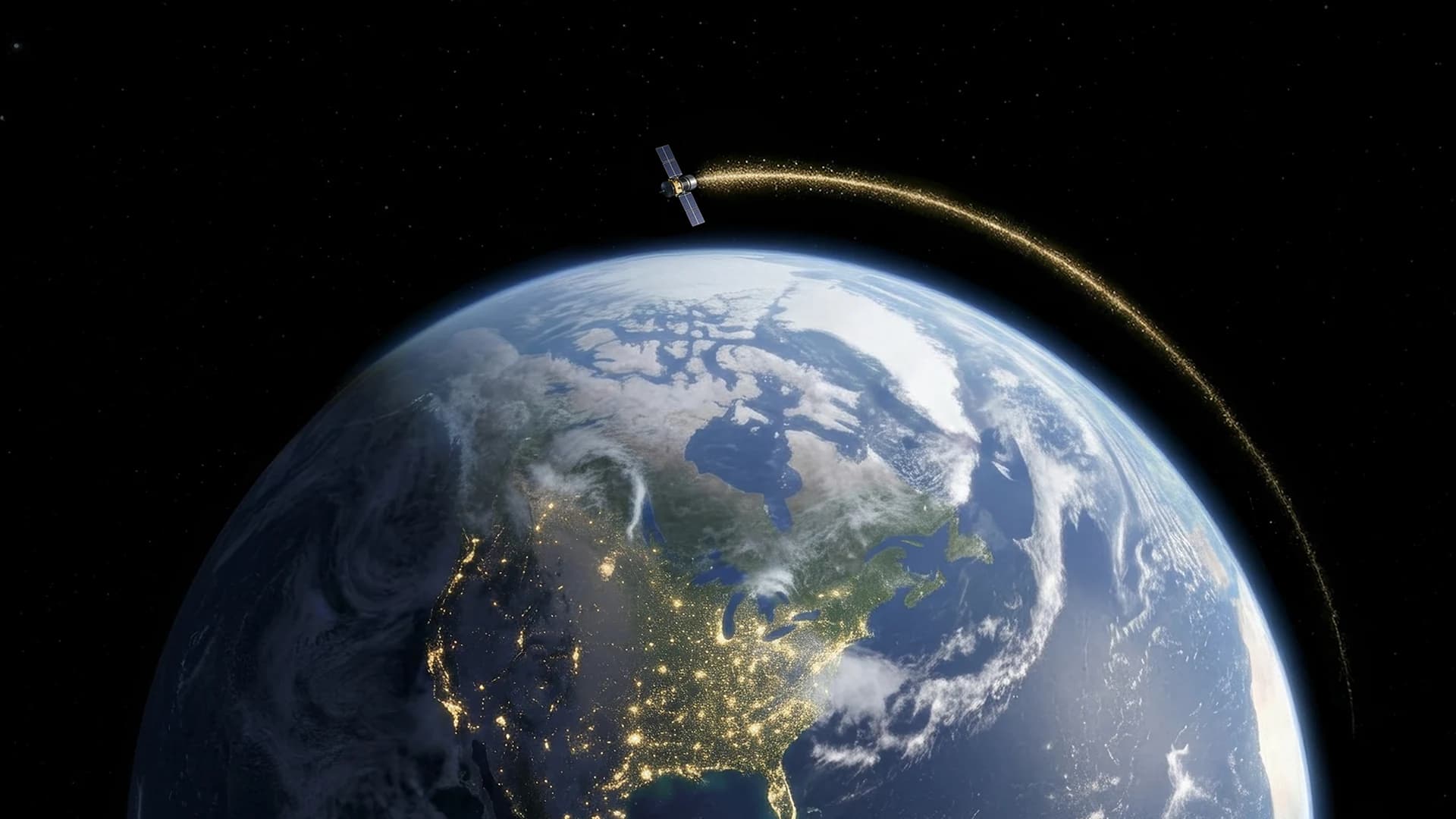
The problem. Commercial AI accelerators are not radiation-hardened. LEO exposes them to elevated radiation and repeated passes through the South Atlantic Anomaly, causing single-event upsets and cumulative degradation. Traditional rad-hard silicon costs roughly 5× terrestrial equivalents (our US-China piece used the same multiple), lags commercial performance by 2–3 chip generations, and is produced in tiny volumes — useless for a fleet meant to run frontier-class inference.^[29]^[25]
SpaceX's answer: hardness by architecture, not by process. The interchangeable payload is reported to use commercial TSMC nodes (N5/N3-class) via the Terafab chip joint venture with Tesla, achieving resilience through triple-modular redundancy, ECC memory, and configuration scrubbing rather than expensive rad-hard fabrication — the "D3" chip lineage.^[3]^[7] If it works, this sidesteps the rad-hard cost-and-lag penalty and is genuinely clever. Terafab's headline ambition — 1 TW of annual compute output with ~80% allocated to space — is, by Bernstein's own estimate (via our companion piece), a $4–5 trillion capital programme requiring 100-plus leading-edge fabs, larger than the combined market value of the world's three largest listed companies.^[30] That is narrative, not roadmap. The timeline makes it harder still. A new "D3" part could in principle tape out through an external foundry (TSMC) before Terafab's own fabrication capacity exists — so this is not a "build a leading-edge fab in 18 months" claim. What remains implausible is combining new silicon, radiation validation, spacecraft integration, and gigawatt-scale production inside the ~18 months between the June 2026 unveil and the stated late-2027 ramp, when a single leading-edge fab alone takes four to five years to build and qualify and depends on ASML's EUV monopoly. Treat the 1 TW figure and the 2027 dates as timeline inflation; treat the architecture — commercial-node silicon hardened by redundancy rather than by rad-hard process — as the part worth taking seriously.
The unresolved variable. Even with TMR/ECC/scrubbing, the open question is the on-orbit failure rate and therefore the replacement cadence — and no public MTTF model exists.^[6] Redundancy costs silicon area and power (you compute the same thing multiple times), eating into the effective FLOPs-per-watt that made orbital attractive. Whether the net is favourable is exactly the kind of thing only flight data answers.
Our read. This is the constraint SpaceX is best positioned to attack, because vertical integration (own the chip, own the bus, own the launch) is precisely the toolkit for co-designing silicon to the orbital environment. It is also the constraint where the gap between ambition (1 TW, 80% in space) and demonstrated reality is widest. Credit the architecture; discount the timeline.
9. Unit Economics: Where Orbital Actually Wins — and It Is a Narrow Place
Constraints listed separately can read like a checklist of objections. The discipline is to combine them into one number: the fully-loaded cost of useful compute, orbital versus terrestrial, and then ask in which workloads orbital can plausibly win. SpaceX has published no such number — the explainX analysis is blunt that "the fully-loaded $/kWh or $/FLOP figure for AI1 compute" remains unknown, which by itself should temper any precise claim.^[6] But we can bound it.
Build the orbital cost stack from the four constraints. Take an AI1 unit carrying ~one GB300-rack-equivalent (~150 kW, ~$6M of silicon) on a multi-tonne bus. Its lifetime cost is roughly: silicon + bus + radiators + solar (call it the hardware stack) plus launch (~$1–3M at Starship targets of $100–500/kg, ~$9M at Falcon 9) plus the killer term — you pay that whole stack again every 5–6 years with zero residual recovery, versus a ground rack whose shell amortises across 3–4 chip swaps with non-zero residual recovery (resale, redeployment, lower-tier workloads) each cycle.^[7]^[11]^[27] Now subtract orbital's genuine credits: ~free solar power (worth little — electricity is only 7–10% of terrestrial lifecycle cost), and the avoided terrestrial frictions: grid-interconnection queues of 7–10 years, land and permitting fights, water, and cooling-tower capex.^[25]
The arithmetic only closes when two things are simultaneously true. First, Earth's binding constraint must be power availability, not power price — i.e. the comparison is not "$0.06/kWh in orbit vs $0.06/kWh on the ground" but "compute you can deploy in orbit in 2027 vs compute you cannot build on the ground at all because the interconnect queue is 2034." Where that is the real situation, orbital's avoided-friction credit is large. Second, the workload must be latency-tolerant inference — because the bandwidth wall (Section 4) bars training, and interactive sub-10 ms serving loses to a terrestrial edge node. Stack those: orbital wins specifically for latency-tolerant, scale-driven, power-gated inference that cannot otherwise be sited because terrestrial power and permitting are saturated. That is a real and possibly large niche in a power-constrained AI build-out. It is not "compute" in general, and it is emphatically not training.
Put a number on the gap, honestly. Independent estimates of orbital-data-centre total cost of ownership range from "always more expensive" to ABI Research's up-to-78× terrestrial for equivalent scale, compressing only toward parity if Starship reaches sub-$20/kg — a figure no one has demonstrated.^[11] Our read is that the true figure is workload-specific and unknowable from outside, but the direction is unambiguous: at any plausible 2027 launch cost, orbital inference is a premium product justified by deployability, not a cheaper product justified by economics. SpaceX is, in the words of one teardown, "optimizing for the cheapest part of the equation (the electricity) while astronomically inflating the most expensive part (the hardware and logistics)."^[11]
The one scenario that flips this is not cheaper rockets alone — it is a world where terrestrial AI power demand so badly outruns grid build-out that hyperscalers will pay a large premium for any incremental gigawatt, on the ground or off it. That world is not implausible; it is roughly the world the Anthropic ($1.25B/month) and Google (~$920M/month) compute contracts gesture at.^[26] In that world, orbital inference is a relief valve for terrestrial scarcity — valuable precisely because it is the deployable option of last resort, not because it is cheap. That is a coherent bull case. Note what it concedes: orbital compute wins as expensive marginal capacity, which caps both its margin and its share. It is a real business and a bounded one — exactly the "Minimum Viable Product, a few percent of global AI compute by 2035" that Morningstar models at 50%.^[16]
10. The Capital-Structure Read: What $1.77 Trillion Is Actually Pricing
Pull the constraints together and the valuation question answers itself: the trillion-dollar number is not pricing AI1's cash flows. It is pricing an option on them.
Morningstar's framing is the cleanest, and it is devastating in its restraint. Analyst Nicolas Owens puts fair value at ~$62–63/share against the $135 IPO price — i.e. the market paid roughly a $72/share "option premium" for the speculative upside (orbital data centres, Mars).^[16]^[17] The orbital-AI dream specifically adds only about $16.50/share on a probability-weighted basis, across three scenarios: No-Go ~43% (orbital data centres abandoned ~2028), Minimum-Viable-Product ~50% (technically feasible, limited scale — a few percent of global AI compute by 2035), and Moonshot ~7% (Starship reusable and orbital data centres highly successful).^[16]^[17] On Morningstar's full model, the implied enterprise value is closer to ~$780 billion — under half the IPO target.^[31]
The bull case is coherent and worth stating fairly. Wedbush's Dan Ives called the listing a milestone and frames the real prize as an eventual SpaceX–Tesla combination (he puts ~80%+ odds on a merger), creating a Musk AI-and-robotics conglomerate — the "holy grail."^[26] On this view, SPCX is not a satellite stock; it is the holding vehicle for Musk's entire compute-plus-robotics empire, and orbital compute is one call option among several (Starlink cash engine, Starship as the launch monopoly, Grok, Optimus via Tesla). If even one or two of those options pay, the premium is justified. The Colossus cluster (220,000 GPUs, 300+ MW in Memphis) and the Anthropic/Google compute contracts are cited as proof the AI demand is real and SpaceX is already a serious compute operator, not a hopeful entrant.^[26]
Why we land closer to the bear, with a specific threshold. Three things tip it.
- The filing is materially more cautious than the promotional framing. The same filing that underwrites the dream says orbital AI compute "may not achieve commercial viability."^[14] A risk disclosure is not a confession — but when the S-1's risk section is this much more guarded than the CEO's stage, weight the document: it carries legal liability; the stage does not.
- The capital structure shows where conviction actually is. SpaceX itself spends 7:1 on terrestrial vs orbital compute, and immediately post-IPO spent $60B of premium stock to buy a terrestrial-compute-bottlenecked coding company (Cursor).^[11]^[22] That mix confirms the current AI business is overwhelmingly terrestrial; it does not by itself prove a long-term preference, because AI1 is still pre-deployment and the two sit at different lifecycle stages — but near-term conviction plainly sits on the ground. Cursor reinforces the point: its product is built around terrestrial, low-latency model serving and developer workflows, so a compute-bottlenecked SpaceX buying it confirms that SpaceX's near-term AI revenue is ground-based — though the acquisition does not by itself disprove a future orbital-inference role.^[22]
- The flywheel can circulate value without creating it. Using a premium multiple to acquire AI assets that justify the premium multiple is a coherent strategy and a reflexive valuation loop in which premium equity finances acquisitions that broaden the narrative supporting the premium. Starlink's ~$4.4B operating profit is real and growing; it is also being asked to subsidise an AI lab burning ~$1B/month and now a $60B acquisition.^[4]^[11] That is a lot of weight on one profitable segment.
What would change our mind — explicit thresholds.
- Bullish trigger: A flown AI1 prototype returns in-orbit thermal and compute telemetry consistent with the 120 kW/154 kW-rejection budget, and Starship completes priced commercial flights at <$500/kg. Hit both and the case for shifting probability weight from No-Go toward the MVP scenario strengthens materially, all else equal — though re-rating the fair value is Morningstar's model to run, not ours.
- Bearish trigger: The prototypes slip past 2027, or the first flight shows the thermal/refresh economics are worse than claimed, or the Cursor-style roll-ups outpace the orbital build — confirming the AI division is a terrestrial cash sink wearing an orbital story. In that case the option decays toward Morningstar's No-Go.
One discipline on our own side of the argument: you cannot back out the market's implied Moonshot probability from price alone. The gap between $135 and Morningstar's ~$62 also prices Mars, Starship's launch near-monopoly, a possible Tesla combination, and scarcity — not orbital AI by itself. The honest, narrower claim is this: the price embeds far more optionality than the proven business supports, and on a 2027 horizon Morningstar's 7% Moonshot weight is, if anything, generous. The option is real. It is not worth what June 12 paid.
11. What It Means Beyond SpaceX
If AI1 is a priced option rather than a proven business, the discipline for everyone else is to separate the layer that pays whether or not the option lands from the layer that pays only if it does. The constraint analysis above is, read correctly, a supplier map — every binding constraint is a subsystem market. High-flux thermal (deployable radiators, two-phase loops, high-emissivity coatings) is the most universal need: everyone radiates to vacuum. Optical inter-satellite links and, above all, optical ground stations are revenue pools available regardless of whose constellation flies. The open equivalent of SpaceX's proprietary interchangeable payload — a standard mechanical/thermal/power/data interface that lets third-party compute modules ride multiple buses — is the "build the Android" position. Orbital runtimes and scheduling are capital-light, exportable software. And the governance of cross-border orbital compute — spectrum, data residency, debris norms for million-satellite reservations — is unsettled and up for grabs. These are the picks-and-shovels: they get bought even if the trillion-dollar story is early.
One ecosystem outside SpaceX is attempting a comparable, full-stack mobilisation: China. In the same quarter AI1 was unveiled, Chinese state and quasi-state institutions pulled orbital compute into formal industrial planning — a defence-industrial feasibility study, a CAICT-hosted committee, regional consortia, and fresh layers of state and venture capital — even though no operator there has shown a commercial closed loop either.^[29] The mechanism is the one this teardown describes: belief reallocates capital ahead of proven economics, on both sides of the Pacific. That response is large and consequential enough to deserve its own treatment, so we analyse it in a dedicated companion piece — China's Orbital-Compute Mobilisation: Capital, Constraints, and the Layers That Can Actually Win — rather than compress it here.
For Singapore and the wider APAC neutral nodes, the honest posture is narrow. There is no AI1 to field and no state programme pointed at this. The realistic, durable edges are the picks-and-shovels above plus a convening role: optical ground stations and a neutral data-landing point usable where compliance allows; a photonics and precision-engineering base that maps onto optical and thermal subsystems; and standards-convening for payload interfaces and cross-border compute governance — the rule-setting layer that, unlike launch or silicon, does not demand capital the region cannot match. The frame to reject is "build our own orbital compute." The frame to adopt is "supply the components, set the rules, and land the data — for whichever compliant ecosystems will buy."
12. What to Watch
Five dated, falsifiable signals over the next 12–18 months. Each moves the thesis.
- First AI1 prototype flight and its telemetry (target: early 2027). The single highest-information event. Watch for whether in-orbit thermal rejection, power, and compute uptime match the 120 kW / 154 kW-rejection budget. Telemetry that confirms the budget moves orbital compute from option to nascent infrastructure; a slip past 2027 or a thermal shortfall validates the bear case.
- Priced, commercial Starship flights at a disclosed $/kg (rolling). The trigger condition for everything. Until Starship flies paid missions at materially below Falcon 9's ~$2,700/kg — ideally toward $500/kg and below — the orbital-compute economics remain a bet, not a plan.
- The terrestrial-vs-orbital capex ratio in SPCX's filings (each quarter). SpaceX spent ~7:1 on ground vs space compute in Q1 2026. If that ratio compresses toward orbit, conviction is real; if it widens — or if more Cursor-style terrestrial roll-ups dominate the cash flows — the orbital story is narrative cover for a ground business.
- Gigasat production ramp and the first 1 GW of deployed orbital compute (target: late 2027). 6,700 satellites by late 2027 is the stated claim; the realistic test is whether SpaceX deploys even the first operational hundreds at a Starlink-class pace from a factory whose own solar lines start around the same window.
- APAC's open-layer moves (rolling). Watch for a credible Indo-Pacific optical-ground-station network, any serious attempt at an open orbital-compute payload-interface standard, and whether Singapore or another neutral hub convenes governance for cross-border orbital compute. These determine whether the region captures margin and rules — or just the bill of materials.
The meta-signal underneath all five: does the gap between Musk's stage and the S-1's risk section narrow or widen? On June 9, Musk called orbital AI a no-brainer. In the April risk disclosure of the filing he signed, SpaceX said it might never be commercially viable. By mid-2027 we will know which document was right.
All data from public sources, including: SpaceX's SEC S-1 and IPO pricing announcement; CNBC, NPR, Reuters, Fortune, and Yahoo Finance IPO coverage; Tom's Hardware, DatacenterDynamics, TechSpot, Carthage Electronics, explainX, and MLQ reporting on AI1; the SpaceX FCC orbital-data-centre filing and IEEE ComSoc analysis; Morningstar valuation research; and independent first-principles teardowns by endtropy and Graham Wallington. Statements attributed to Elon Musk's June 9 unveil are sourced from secondary reporting of that video, not from direct verification of the original X post, and are flagged as company claims. Analysis represents the author's independent views and is not investment advice. Nothing here is an endorsement of SpaceX or of SPCX as an investment.
Sources32 entries with source notes and links
June 12, 2026. First-day price action, intraday high $168.75, close $161, $75B raise. B-grade source.
June 11, 2026. Record IPO size, valuation context, comparison to Aramco. B-grade source.
- Yahoo Finance — SpaceX reveals its first orbital data center, "much simpler than a Starlink satellite," Musk says(finance.yahoo.com)
June 2026. AI1 unveil specs and Musk quotes; reporting of the June 9 video. B-grade source (secondary report of the unveil).
- Hargreaves Lansdown — Inside SpaceX's IPO filing: revenue, Starlink, AI and key financials(hl.co.uk)
2026. S-1 segment breakdown, Starlink subscribers/ARPU, AI capex share, Anthropic deal, cash/debt. B-grade source (analysis of A-grade filing).
- TechSpot — Elon Musk reveals SpaceX's 230-foot-wide orbital AI data center satellite ahead of IPO(techspot.com)
June 2026. AI1 dimensions, "simpler than Starlink" quote, 2025 revenue $18.7B and net loss $4.94B. B-grade source.
- explainX — SpaceX AI1 Orbital Solar Datacenter: Technical Breakdown and Feasibility (2026)(explainx.ai)
2026. Balanced feasibility analysis: radiator 110 m²/154 kW, SSO duty cycle, bandwidth, radiation, launch, "physics work / economics unproven" verdict. B-grade source.
- Carthage Electronics — SpaceX AI1 Satellite: Orbital AI Data Center Full Breakdown (2026)(carthageelectronics.com)
2026. Specs, D3/Terafab chip (TSMC N5/N3 + TMR/ECC/scrubbing), 30–50 sats/Starship, Gigasat 10 GW solar, 6,700 sats per GW, vertical-integration vs Nvidia Space-1/Aetherflux/Starcloud. B-grade source.
- Tom's Hardware — SpaceX unveils 11-million-square-foot Gigasat factory … aims for 1 GW/year of space AI compute by late 2027(tomshardware.com)
June 2026. Gigasat factory, prototype and ramp timeline. B-grade source.
- MLQ News — SpaceX Unveils AI1 Orbital Data Center Satellite, Targets 1 GW Space Compute by Late 2027(mlq.ai)
June 2026. 1 GW by late 2027, prototypes early 2027, >6,000 sats/yr implied. B-grade source.
- IEEE ComSoc Technology Blog — Analysis: SpaceX FCC filing to launch up to 1M LEO satellites for solar-powered AI data centers in space(techblog.comsoc.org)
Feb 2, 2026. Petabit optical mesh routing via Starlink to ground, latency vs fibre, AWS CEO "far from reality" quote. B-grade source.
- endtropy (Substack) — SpaceX — Orbital Datacenters: Economics and Physics(endtropy.substack.com)
2026. First-principles teardown: training interconnect 800 Gbps–1.6 Tbps vs OISL 25–100 Gbps, refresh-cycle/residual-value argument, 7:1 terrestrial:orbital capex, ABI 78× TCO, "always more expensive" verdict. B-grade source (independent analysis).
2026. Falcon 9 ~$2,700/kg vs Starship $100/kg target; deployment-pace comparison to Starlink. B-grade source.
- Tom's Hardware — Elon Musk's first-gen orbital data center craft … AI1 satellite compute payload is 120 kW, peaks at 150 kW(tomshardware.com)
June 2026. Headline AI1 specs and interchangeable chip payload. B-grade source.
- Investing.com / Reuters — Exclusive: SpaceX says unproven AI space data centers may not be commercially viable, filing shows(investing.com)
April 22, 2026. Verbatim S-1 risk-factor language on orbital AI compute and Starship dependency. B-grade source (Reuters quoting the SEC filing; the primary document is the SEC S-1 itself).
- The Next Web — SpaceX S-1 warns orbital AI data centres may not be viable, months after Musk called space-based AI a no-brainer(thenextweb.com)
2026. Contrast between filing risk language and Musk's "no-brainer" framing; ~11 Starship test flights. B-grade source.
- Fortune — SpaceX's record IPO has Wall Street torn between a Musk "holy grail" and a $72-per-share leap of faith(fortune.com)
June 11, 2026. Bull (Ives, Wedbush, Tesla-merger) vs bear (Owens, Morningstar $63 fair value, scenario weights, Colossus/Anthropic/Google compute facts). B-grade source.
- Morningstar — Why We Think the SpaceX IPO Is Overvalued(morningstar.com)
2026. Fair value ~$62–63/share, ~$72 option premium, orbital-AI ~$16.50 call-option value, No-Go 43% / MVP 50% / Moonshot 7% scenarios. B-grade source (analyst research).
June 3, 2026. Fixed $135 roadshow price, $1.77T valuation, ~94× trailing sales context. B-grade source.
- CNBC — Musk's xAI, SpaceX combo is the biggest merger of all time, valued at $1.25 trillion(cnbc.com)
Feb 3, 2026. SpaceX absorbs xAI; ~$1T + ~$250B; "orbital data centers" as stated rationale; Grok/X become SpaceX AI division. B-grade source.
Feb 1, 2026. FCC million-satellite filing, 500–2,000 km, dawn-dusk SSO, 99%+ solar, optical mesh to Starlink/ground. B-grade source (reporting on A-grade FCC filing).
Apr 28, 2026. Companion analysis: million-sat filing as regulatory reservation, Stefan-Boltzmann ~1,200 m²/MW, Orbital Chenguang capital signal, Terafab/Bernstein $4–5T, three-window APAC framing. Prior SSA analysis (synthesis of cited primary and secondary sources; not an independent primary source).
June 16, 2026. $60B all-stock Anysphere/Cursor deal, ~15× revenue, "bottlenecked by compute" / Colossus quote. B-grade source.
June 16, 2026. Deal confirmation, structure, largest VC-backed acquisition on record. B-grade source.
- DatacenterDynamics — SpaceX details AI1 satellite "data center," claims 150kW peak compute(datacenterdynamics.com)
June 2026. AI1 specs, radiative cooling framing, no-water advantage. B-grade source.
2026. Electricity ~7–10% of terrestrial lifecycle cost; grid-interconnection/permitting/water frictions; onboard processing ~90% downlink reduction; inference-vs-training split. B-grade source.
- Fortune — bull-case detail, Wall Street torn …(fortune.com)
June 11, 2026. Dan Ives "holy grail" Tesla-merger thesis; Colossus 220k GPUs/300+ MW; Anthropic $1.25B/month, Google ~$920M/month. B-grade source.
June 2026. Skeptical first-principles thermal/mass/economics: heat-pump parasitic load, ~138 m² required radiator, 70 kW/tonne "unreachable," launch ~4–10× lifetime energy bill. C-grade source (single-author independent calculation; contested by ref-6 on thermal).
- Singapore Space Agency — Orbit Is Architecture: Why Orbital Compute Is First an Orbit-Design Problem
June 6, 2026. Companion technical brief: Stefan-Boltzmann radiator sizing, SSO/dawn-dusk illumination, eclipse cycling, downlink and lifetime constraints. Prior SSA analysis (synthesis of cited primary and secondary sources; not an independent primary source).
May 20, 2026. Companion analysis: rad-hard ~5× cost, Three-Body Constellation, Guoxing 22 in-orbit AI satellites, "5 POPS" as theoretical capacity. Prior SSA analysis (synthesis of cited primary and secondary sources; not an independent primary source).
May 27, 2026. Companion layered review of Western orbital-compute players and the thermal/bandwidth/radiation/capital constraints. Prior SSA analysis (synthesis of cited primary and secondary sources; not an independent primary source).
- Yahoo Finance — SpaceX valued at just $780 billion by Morningstar, less than half its IPO target(finance.yahoo.com)
2026. Morningstar full-model ~$780B enterprise value vs $1.75T target. B-grade source.
June 15, 2026. Greenshoe exercised: +83.3M shares, ~$85.7B total raise. B-grade source.
Continue reading
12 Jul 2026 · 98 min read
The Third Pole in Orbit: OneWeb's Soul, DayOne's Method
A Singapore-founded Indo-Pacific orbital-compute venture is buildable only as a phased, demand-anchored operating company whose multi-sovereign capital cannot control it.
6 Jun 2026 · 31 min read
Orbit Is Architecture: Why Orbital Compute Is First an Orbit-Design Problem
Orbit choice sets the limits of orbital compute: illumination, heat rejection, radiation, downlink, lifetime, and regulation change across LEO, MEO, GEO, and SSO.
23 Jun 2026 · 30 min read
China's Orbital-Compute Mobilisation: Capital, Constraints, and the Layers That Can Actually Win
China is organising state capital, launch, satellites, silicon, and optical links around orbital compute before the sector has proved a commercial closed loop.